Ground robots are becoming a larger part of Ukraine’s war effort
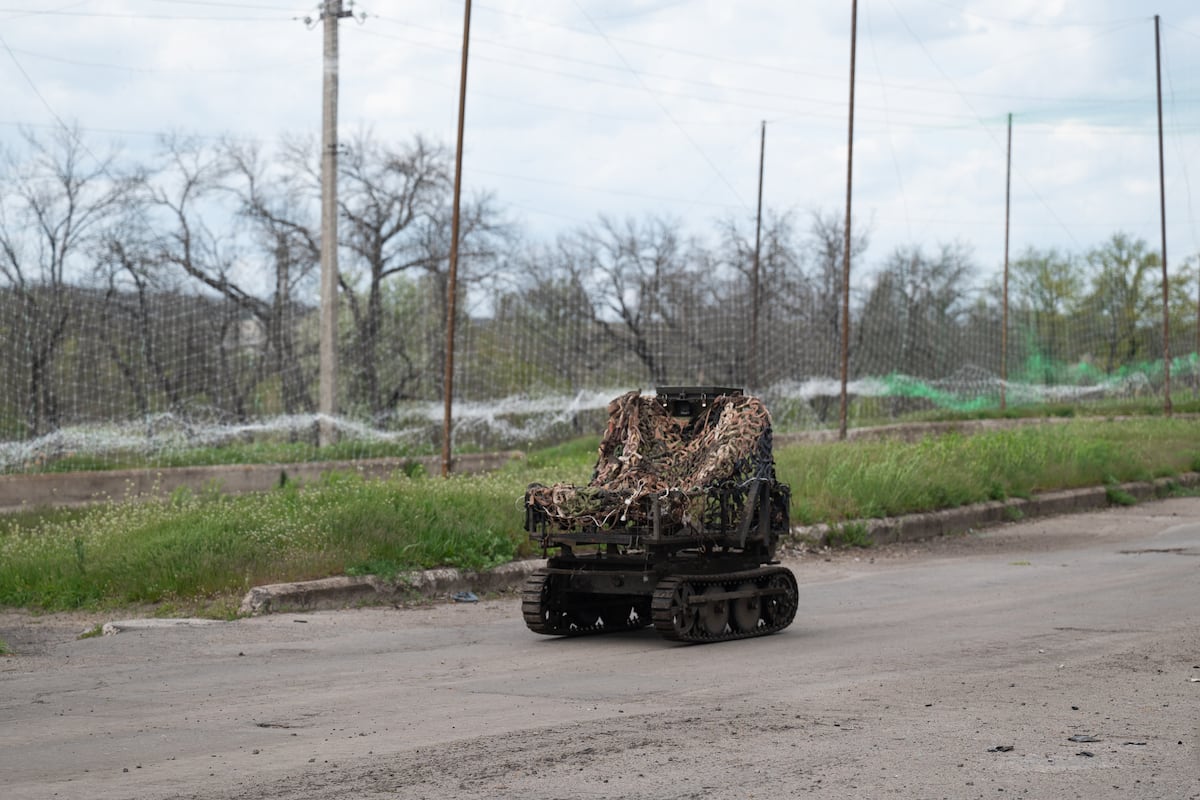
Ukraine’s battlefield innovation has been closely associated with aerial drones, but unmanned ground vehicles are now moving into a far broader role. Defense officials and front-line units say the same robotic platforms used to haul ammunition and evacuate wounded soldiers are also being used to rescue civilians from areas where conventional evacuation has become too dangerous.
The clearest example came on April 25 near Lyman, where operators from Ukraine’s 3rd Army Corps and the Cerberus unmanned ground systems unit used a robot to extract a 77-year-old woman from the gray zone. Reconnaissance drones monitored the rescue from above, while Russian drone activity reportedly made a standard ground evacuation impossible.
Dual-use is not an exception but a doctrine
What stands out in the Ukrainian account is that robotic dual-use is being described as strategy rather than improvisation. Heorhii Khvystani, chief of staff of the Unmanned Systems Battalion of Ukraine’s 58th Separate Motorized Brigade, said at the Lviv Drone Autonomy Conference that tasks assigned to the Unmanned Systems Forces include fire impact, mine-laying, logistics, engineering work, and evacuation of the wounded, among others.
That list helps explain why the Lyman rescue matters. It is not a one-off humanitarian anecdote attached to a military technology story. It shows how Ukraine is treating ground robotics as a flexible operational layer that can move supplies, reduce troop exposure, recover casualties, and in some circumstances pull civilians out of contested terrain.
Production is now scaling quickly
The numbers attached to the program are substantial. Defense Minister Mykhailo Fedorov said the military carried out more than 9,000 missions using UGVs in March alone. He also said the ministry had contracted 25,000 UGVs in the first half of 2026, more than double the previous year’s total. President Volodymyr Zelenskyy then announced the production of 50,000 ground robots for the year.
If those figures translate into fielded capability, Ukraine is moving toward a robotic ground force of unusual scale. The stated goal is equally ambitious: Fedorov said Ukraine wants 100% of frontline logistics performed by robotic systems. That target may prove difficult in full, but even partial success would reduce the number of soldiers exposed during repetitive resupply and evacuation missions.
Why logistics may be the real breakthrough
The battlefield conversation around autonomy often focuses on strike systems, but logistics may be where ground robots deliver the most immediate value. Ammunition transport, casualty extraction, and movement through drone-saturated kill zones are exactly the kinds of tasks that can impose high risk while requiring predictable routes and repeatable loads. A workable UGV does not need to replace maneuver units to alter the shape of operations. It only needs to make dangerous support tasks less dependent on direct human presence.
That is why the Lyman rescue resonated. A machine built for combat-zone hauling became a means of civilian survival because the environment had become too hostile for standard evacuation methods. In that sense, the robot’s value was not only tactical but humanitarian.

A signal for future warfare
Ukraine’s expansion of ground robotics points to a larger transformation in land warfare. Air drones changed reconnaissance and strike patterns first. Ground systems may now begin to change how armies think about resupply, recovery, engineering work, and contested movement under persistent surveillance. The side that can move cargo, casualties, and civilians with fewer exposed personnel gains more than efficiency. It gains resilience.
The technology is still maturing, and scaling production does not automatically solve reliability, training, command integration, or maintenance. But Ukraine’s current trajectory is clear. Unmanned ground vehicles are no longer a niche experiment. They are being turned into an operational backbone, one mission at a time.
This article is based on reporting by Defense News. Read the original article.
Originally published on defensenews.com