The Coast Guard is reorganizing around its most specialized units
The U.S. Coast Guard says it will create a new Special Missions Command to centralize control of its deployable specialized forces, a structural change the service argues is necessary as demand for those units continues to rise. The command is slated for official commissioning in October and will bring a wide range of elite Coast Guard teams under a single umbrella rather than leaving them split across the service’s Atlantic and Pacific area commands.
On paper, this is an organizational reform. In practice, it is a statement about how the Coast Guard sees the threat environment changing. The service is signaling that specialized maritime response, coastal security, interdiction, and hazardous incident capability now require a more unified command structure.
That shift aligns the Coast Guard more closely with a broader U.S. defense and homeland security trend: centralizing high-demand specialist units so they can be trained, equipped, and deployed with greater consistency.
What changes under the new structure
Today, the Coast Guard’s deployable specialized forces are overseen administratively and operationally by the service’s two area commanders. The new arrangement will replace that split model with one command dedicated to these forces.
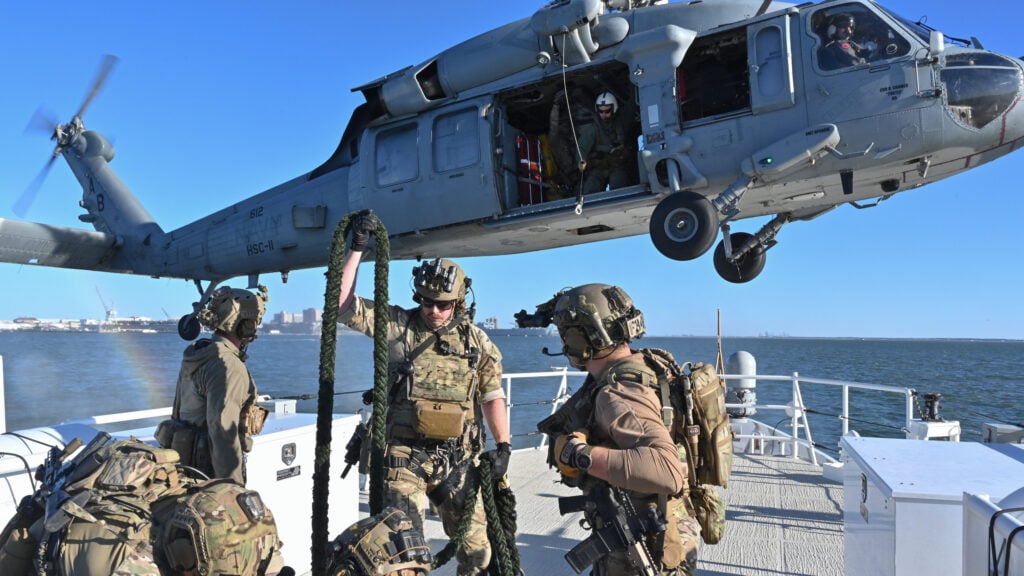
According to the service, the new Special Missions Command will include maritime security response teams, tactical law enforcement teams, maritime safety and security teams, port security units, regional dive lockers, and the national strike force. These units handle missions ranging from maritime terrorism response and drug interdiction to port protection and disaster response involving oil, chemical, or nuclear incidents.
Bringing them together does more than simplify reporting lines. It creates a mechanism for shared readiness standards and a clearer institutional identity for units that are already treated as elite capabilities inside the service.
Why now
The Coast Guard tied the move directly to an “uptick in demand” for these forces and to the need to respond to emerging threats, enhanced border security operations, and special national security events. That list is notable because it spans both military-adjacent missions and domestic security demands.
The Coast Guard occupies a hybrid position in U.S. national security. It is a military service, a maritime law enforcement agency, and an emergency response organization. Its specialized units often operate at precisely the intersections now seeing heightened pressure: border enforcement, port security, contingency response, and support to joint operations.
In that context, the existing distributed oversight model may have started to look outdated. If the same specialized teams are repeatedly called for complex or urgent missions, a dedicated command can improve prioritization, training coherence, and force generation.
Leadership is framing it as more than a bureaucratic move
Commandant Adm. Kevin Lunday described the new command as a “vital evolution” and said the service is forging its “most elite operators into a single, razor-sharp instrument of national power.” That language is more forceful than standard bureaucratic announcement language, and it reflects how the Coast Guard wants this shift to be understood.
The message is that the Special Missions Command is not being created for administrative neatness. It is being framed as an investment in operational effectiveness, one meant to ensure specialized teams are “the best trained, equipped, and organized force possible,” in Lunday’s words as cited in the source text.
Capt. Robert Berry, who is leading the pre-commissioning effort, reinforced that position by arguing that demand for deployable specialized forces is at an all-time high. His statement casts the reorganization as a natural response to an evolving geopolitical landscape rather than a discretionary internal reshuffle.
What the new command could improve
Centralization is not automatically better, but it can solve specific problems. Elite units that are dispersed across regional command structures may face uneven resourcing, inconsistent doctrine, and competing operational priorities. A single command can standardize preparation and make it easier to allocate scarce specialist teams where they are most needed.
That is especially relevant for units that deal with rare but high-consequence missions. Port security, maritime counterterrorism, underwater operations, and hazardous response all depend on sustained training and specialized equipment. If those capacities are managed under broader regional structures, they can struggle for attention against more routine operational demands.
A dedicated command also creates a stronger focal point for advocacy inside the service. Budget requests, force design, and readiness planning often become easier when a mission set has its own institutional center of gravity.
It also reflects rising pressure in the maritime domain
The announcement should be read against the wider backdrop of maritime security concerns. Ports, coastal infrastructure, shipping lanes, and maritime borders are facing more scrutiny as the United States responds to smuggling, irregular migration, supply chain disruption, disaster risk, and strategic competition. The Coast Guard’s specialized teams sit directly inside those pressures.
That helps explain why the command will encompass such a broad set of capabilities. The service is not building a narrow special-operations headquarters. It is consolidating a portfolio of units designed for difficult, dangerous, and often politically sensitive missions across the maritime environment.
In that sense, Special Missions Command is as much about readiness for ambiguity as for any single threat. The Coast Guard wants a force package that can move from coastal interdiction to port security to disaster response without relying on improvised command relationships every time.
Questions will be about execution, not logic
The rationale for the change is straightforward. The harder question is whether the command will receive the resources, authorities, and organizational discipline required to make the model work. New commands can clarify priorities, but they can also add another layer of headquarters if they are not built around real operational needs.
The source material suggests the Coast Guard is aware of that risk and is trying to frame the change in explicitly mission-focused terms. The promise is sharper readiness, better organization, and faster adaptation to threats. Those are measurable in principle, but they will have to be demonstrated after commissioning.
A notable signal from a service under growing demand
The creation of Special Missions Command is significant because it reveals how the Coast Guard views its future workload. A service does not elevate units into a new unified command unless it expects sustained, not temporary, demand for them.
By moving its deployable specialized forces under a single banner, the Coast Guard is recognizing that elite maritime response is now a central requirement rather than a peripheral one. That judgment reflects both a more complex security environment and a service trying to sharpen the way it prepares for it. If the command delivers on its stated goals, it could become one of the more important institutional shifts in the Coast Guard’s recent force structure.
This article is based on reporting by Breaking Defense. Read the original article.
Originally published on breakingdefense.com