Italy weighs a cheaper way to shoot down drones
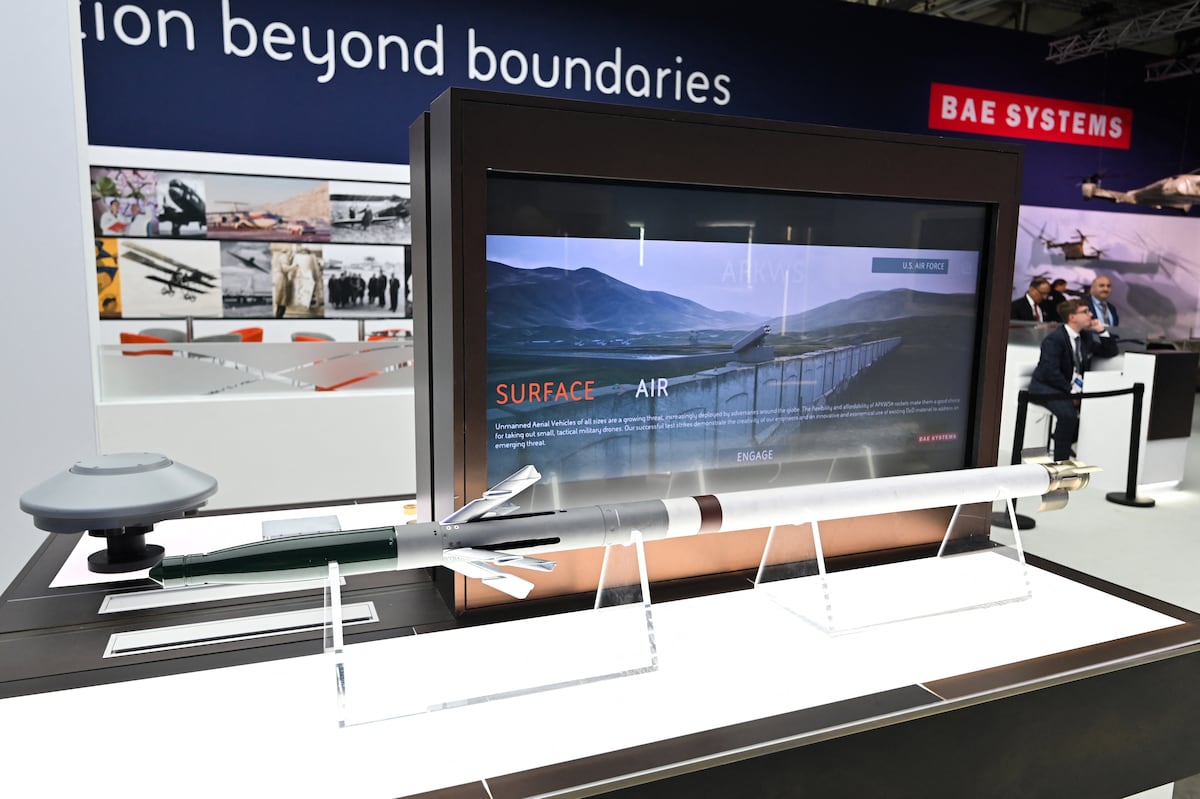
Italy is evaluating a U.S.-approved weapons package that could give its air force a far less expensive way to intercept drones. At the center of the potential deal is BAE Systems' Advanced Precision Kill Weapon System II, or APKWS, a guidance kit that converts unguided rockets into precision weapons by fitting between a rocket motor and warhead.
The appeal is straightforward: drones are proliferating, and many are cheap. Using premium air-to-air missiles to destroy them can quickly become a losing economic trade. Defense News reported that the Italian Air Force is considering the U.S. technology specifically because it offers a lower-cost alternative to firing more expensive missiles against relatively inexpensive targets.
The possible sale was enabled by U.S. State Department approval of a Foreign Military Sale to Italy covering 5,031 APKWS II guidance systems. The approval also includes launchers, warheads, rocket motors, and technical support, bringing the potential value of the package to $364 million. Defense News, citing sources in Italy, reported that no contract has yet been signed and that the system remains under evaluation.
Why cost now matters as much as capability
Counter-drone warfare has become one of the defining procurement pressures for militaries across Europe and beyond. The problem is not only technical, but financial. A force can field capable fighters and advanced missiles and still struggle if every interception burns through munitions that cost several times more than the target they destroy.
That is the specific gap the APKWS approach is meant to address. According to the report, the system can transform a rocket costing under 100,000 euros into a guided weapon. Defense News said that is roughly one-tenth the cost of missiles such as the AMRAAM that might otherwise be used in some air-defense scenarios. The implication is significant: a guided rocket may not replace every interceptor in every mission, but it can expand the menu of responses for lower-end aerial threats.
For air forces under budget pressure, that flexibility matters. It can preserve stocks of higher-end missiles for more demanding targets while still enabling a credible response to drone incursions, especially when those incursions are frequent or involve one-way attack systems that are cheap to mass-produce.
How the system works
The APKWS concept is built around upgrading unguided rockets rather than designing an entirely new missile from scratch. The guidance section uses four fold-out wings, each carrying a laser seeker, to steer the rocket toward a designated target. In effect, the kit turns a simpler munition into a precision weapon with a lower entry cost than purpose-built air-to-air missiles.
That kind of retrofit logic is increasingly attractive in a defense market trying to scale quickly. Governments want more magazine depth, faster fielding, and less dependence on long procurement cycles for exquisite weapons. A modular conversion kit fits that demand because it leverages existing rocket components while adding guidance where it counts.
Italy's interest also reflects a broader military trend: the search for systems that are good enough, affordable enough, and available fast enough to respond to the drone era. In that environment, the best solution is not always the most sophisticated weapon. It is often the one that aligns effectiveness with sustainable cost.
Possible Eurofighter role
Defense News reported that the likely platform for the weapon in Italy would be the Eurofighter. That matters because the jet already plays a central role in air policing missions and homeland defense. Adding a cheaper drone-intercept option to that aircraft would give Italy a way to adapt an existing frontline platform to a threat set that has evolved much faster than many air-defense inventories.
The report also linked the discussion to real operational pressure. This month, an Italian Eurofighter participating in NATO air policing in the Baltics reportedly shot down an unidentified drone that entered Latvian airspace. That episode underscored how drone incidents are no longer abstract planning scenarios. They are active operational problems for European forces conducting routine defense missions.
Seen in that light, Italy's interest in APKWS is not just about buying another munition. It is about adjusting the cost structure of air policing and homeland defense in an environment where unmanned threats can appear suddenly, repeatedly, and at relatively low cost to the attacker.
A signal from allied adoption
Italy is not assessing the system in a vacuum. Defense News noted that the Royal Air Force announced in May that it was already using APKWS on its Eurofighters after a rapid procurement effort that moved from testing to deployment in two months. The RAF said the system gives pilots an accurate option for destroying aerial targets at a fraction of the cost of traditional air-to-air missiles.
That allied precedent could matter as much as the hardware itself. When one European operator demonstrates that a system can be integrated quickly onto a common aircraft type, it lowers perceived risk for others considering the same move. It also strengthens the argument that counter-drone capability can be accelerated through adaptation rather than waiting for entirely new air-defense architectures.
For NATO members, commonality has practical benefits beyond procurement. Shared experience on employment, training, logistics, and tactics can shorten the path from acquisition to operational usefulness. If Italy proceeds, the deal would fit into a wider allied pattern of trying to build layered, economically sustainable defenses against unmanned threats.
What the potential sale says about the market
The proposed package highlights a broader shift in military buying priorities. For years, airpower investment often emphasized range, stealth, sensors, and high-end missile performance. Those priorities remain, but drone warfare has introduced a new criterion: whether a force can afford to keep defending itself day after day against large volumes of comparatively cheap targets.
That challenge is pushing militaries toward hybrid arsenals. Premium missiles still matter for advanced aircraft and demanding engagements. But forces also need intermediate and lower-cost tools that can absorb routine counter-drone work without exhausting budgets or inventories. Guidance kits such as APKWS are attractive because they help create that middle layer.
Italy has not committed yet, and evaluation does not guarantee purchase. But the fact that the option is being seriously considered is itself revealing. It shows how quickly the economics of air defense are reshaping procurement choices, especially in Europe, where militaries are trying to strengthen readiness while containing costs.
If Italy ultimately moves ahead, the decision would be notable not because it introduces a radically new class of weapon, but because it would confirm a practical new rule of modern air defense: defeating drones is not only about hitting them. It is about doing so at a price that can be sustained.
This article is based on reporting by Defense News. Read the original article.

Originally published on defensenews.com