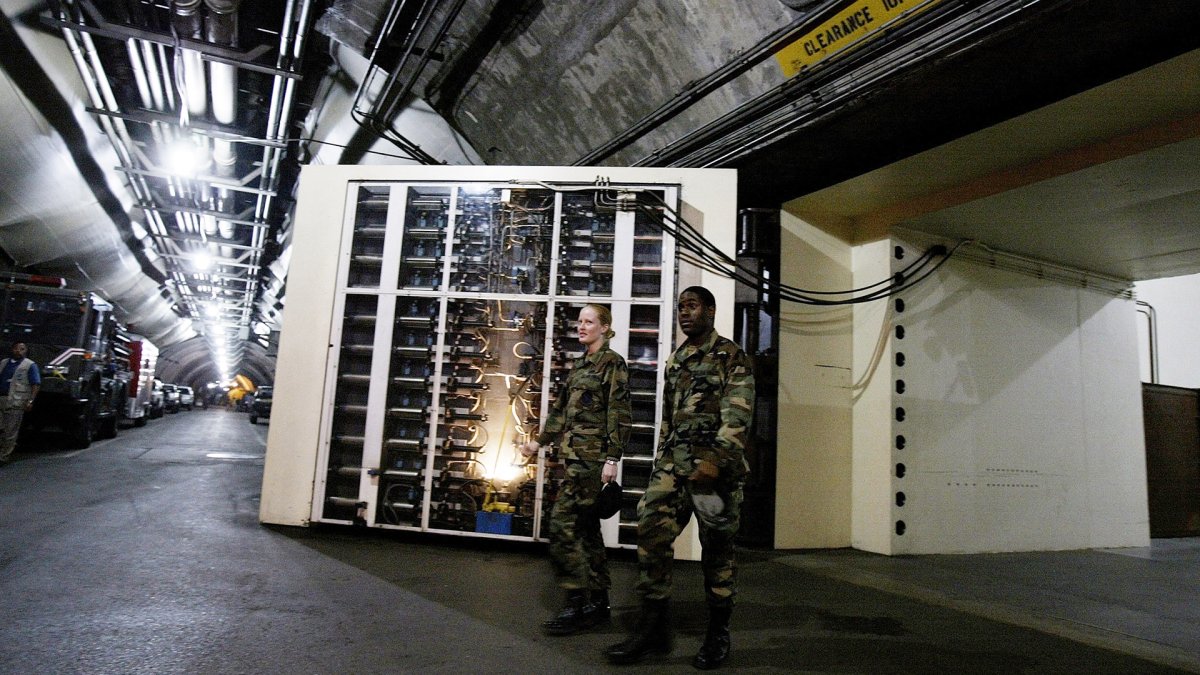
Welcome back to Bunker Talk, our weekend open discussion thread for readers who want to go beyond the headlines. This week's featured image pulls double duty: it's a striking view of the interior entrance to the Cheyenne Mountain Complex, and it's also a reminder that some of the most interesting stories are the ones hiding in plain sight.
The photograph, taken in 2004 at the headquarters of NORAD, shows two military personnel exiting the administrative area through a doorway that looks like something out of a Cold War thriller. But the real drama is in the details around that entrance.
A Fortress Carved Into Granite
Cheyenne Mountain was constructed in 1958, at the height of the Cold War, when the threat of nuclear attack made survivable command centers a national priority. The complex was designed to keep the North American Aerospace Defense Command operational even under the most extreme conditions. Buried under a granite mountain, the facility was built to shrug off near misses and keep the continent's air defenses coherent.
The numbers are staggering. Personnel work at 7,000 feet inside the mountain, surrounded by solid rock. The entrance is sealed by two 25-ton security doors, each designed to protect the inner offices from any type of attack. Those doors aren't just heavy; they're precision-engineered pieces of Cold War engineering, meant to maintain a blast-tight seal while allowing daily operations to continue. If you've ever wondered what "hardened" really means in military infrastructure, this is the benchmark.
The complex also carries its own independent water and air supplies, making it self-sufficient for extended periods. In an era where supply chain resilience is a buzzword in defense circles, Cheyenne Mountain was literally built to be an island of sustainability.

From Missile Defense to 7,000 Flights a Day
NORAD's original mandate was external air, missile, and space defense. That mission has evolved over the decades, but the post-9/11 shift was particularly significant. Since September 11, 2001, the command has watched roughly 7,000 aircraft per day within the United States, tracking flight patterns and maintaining contingency plans for everything from commercial airliners to the President's flights and landings.
This isn't a purely military operation. NORAD coordinates closely with civilian authorities, and it works with the Pentagon, federal agencies, state governments, and local officials. The command also works with the Department of Homeland Security, although it is not part of DHS. That distinction matters, because it underscores how a Cold War organization has adapted to a world where the boundary between defense and homeland security is deliberately porous.
The scope of the daily mission is hard to overstate. Every one of those 7,000 aircraft has its flight pattern covered, including contingencies for the highest-profile aircraft in the country. That kind of persistent, comprehensive surveillance requires a mix of radar, satellite, and human oversight that has become the quiet backbone of American air sovereignty.
A Combined, Bilingual Command
One of the lesser-known aspects of NORAD is its binational character. Canadian military officials make up about 10 to 15 percent of the command's 326 total staff at Cheyenne Mountain. That integrated structure is a legacy of the original 1958 agreement between the United States and Canada, and it remains one of the most enduring examples of allied cooperation in military history. It also means that the officers working in that granite bunker are not just Americans looking after American airspace; they're part of a truly continental defense enterprise.
Inside the complex, the 25-ton doors and independent life support systems are matched by a workforce that trains for scenarios most of us hope never occur. The combination of physical hardening, operational redundancy, and international staffing makes Cheyenne Mountain a unique artifact of the atomic age that is still doing real work today.

Why This Image Fits Bunker Talk
It's easy to look at a photo of a door and see only a door. But the image this week is an invitation to think about the invisible architecture of national security. The personnel walking through that administrative area are part of a system that has quietly protected the continent for six decades. The door is just the most visible symbol of a deeper truth: defense is often about preparing for the worst while doing the unglamorous work of monitoring the everyday.
That spirit also carries over into this open thread. Bunker Talk is a place for the best commenting crew on the net to chat about the things we didn't cover this week, or to revisit the things we did. It's an off-topic thread by design, which means you can bring up just about anything that grabs your interest.
Keep the Conversation Useful
To make sure this thread stays valuable, we ask everyone to follow a few ground rules:
- Be respectful when discussing politics. Disagreements are fine, but stick to facts and avoid personal attacks.
- No drive-by political memes or conspiracy theory rants. Links to crackpot sites will be removed.
- Don't feed trolls. If someone is being disruptive, use the mute button and move on.
- Avoid obsessive behavior about other users. If you don't like someone, don't interact with them.
The goal is to keep the conversation quality high, whether we're talking about military technology, strategy, foreign policy, or whatever random topic catches your eye. The newsletter side of TWZ is all about weekly insights and analysis on those subjects, but Bunker Talk is where the community gets to steer the ship.
So, what did we miss this week? What deserves a second look? The door is open — figuratively, at least. The 25-ton version stays sealed.
This article is based on reporting by twz.com. Read the original article.
Originally published on twz.com