A long-hidden missile has entered public view
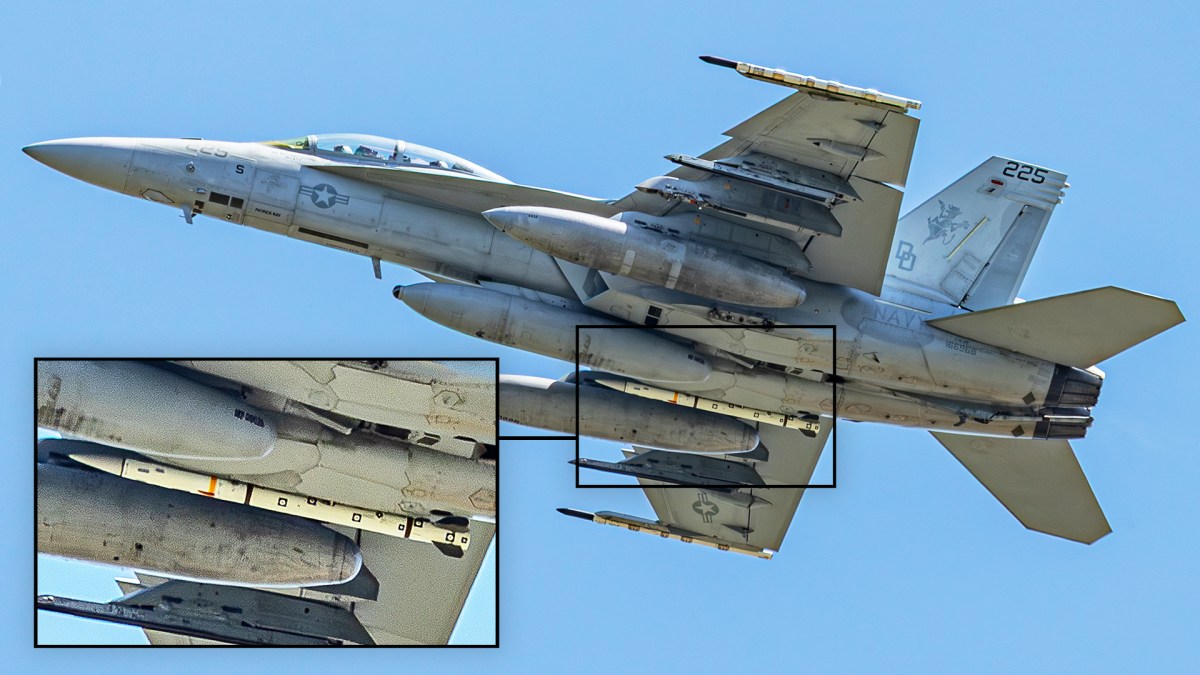
After years of development and testing without a public look, the U.S. military’s AIM-260 Joint Advanced Tactical Missile has finally been photographed. The image, described in the supplied report, shows an F/A-18F Super Hornet from Air Test and Evaluation Squadron 31 carrying the missile near Eglin Air Force Base in Florida on May 13. For a program that has operated largely behind a veil, that first clear visual is a significant event in itself.
The AIM-260 is expected to augment and ultimately replace the AIM-120 AMRAAM in U.S. service. That mission has made the missile one of the more closely watched air-to-air programs in the U.S. arsenal. The available picture does not answer every question about performance, but it does confirm important aspects of the weapon’s external design and suggests that the program is far enough along to be carried openly on a test aircraft in a setting visible to photographers.
The design appears built for speed and reach
According to the source text, the missile’s visible configuration is strikingly minimalist. It has four fins at the tail and lacks the AIM-120’s mid-body control surfaces or side strakes. That cleaner profile is described as reflecting optimization for maximum speed and range.
That matters because long-range air combat increasingly rewards weapons that can reach farther, sustain energy, and fit within modern aircraft carriage constraints. Even without official performance figures in the supplied material, the shape itself points to design priorities. A missile stripped of unnecessary external features can reduce drag and support the kind of kinematic improvements expected from a successor to a mature system like the AMRAAM.
The image also appears to show a yellow band near the front of the missile, which the report says indicates a live high-explosive warhead. Two black bands toward the rear may point to the rocket motor’s location, while the nose cone is a distinct light gray relative to the mostly white body. Those details do not reveal the full seeker or propulsion architecture, but they offer fresh clues for analysts who have had little public material to examine.
Test context matters as much as the image
The aircraft carrying the missile was photographed departing Eglin, a base routinely used as a staging point for aerial weapons testing as well as other research, development, test, and evaluation work. Its location near extensive over-water ranges in the Gulf of Mexico makes it a natural environment for such activity.
The test jet itself also carried supporting hardware, including flight data pods and a modified drop tank with an infrared search and track sensor on the centerline station, according to the source text. Those details reinforce the impression that this was not casual carriage but part of a structured developmental or evaluation context.
That is important because the AIM-260 story has never been about mere existence. The missile has long been known to be in development, and flight testing was understood to have started years ago. The new development is that the program has finally crossed into a stage where outside observers can connect the name to a visible airframe and a visible weapon shape.
What the reveal changes
Public imagery changes how a secretive program is discussed. Before a weapon is seen, debate tends to revolve around budgets, timelines, and fragmentary official statements. Once a credible image appears, the conversation expands into design analysis, compatibility questions, and visible indicators of maturity.
In this case, the first public view of the AIM-260 strengthens the sense that the program is becoming a more concrete part of the future U.S. air combat inventory. It does not mean the missile is fully fielded, and the supplied source does not make that claim. But it does mean the era of discussing the JATM as a nearly abstract successor concept is ending.
The image also arrives at a time when air-to-air missile performance has growing strategic relevance. Longer-range engagements, contested airspace, and the need to preserve advantage against advanced threats all increase the value of a weapon able to do more than the current standard loadout. The AMRAAM has had a long and consequential service life. Any system positioned to replace it is automatically important.
For now, the biggest development is visual confirmation. The AIM-260 exists not just as a program name but as a photographed test article with a recognizable configuration. After years of secrecy, that alone is a meaningful shift.
This article is based on reporting by twz.com. Read the original article.
Originally published on twz.com