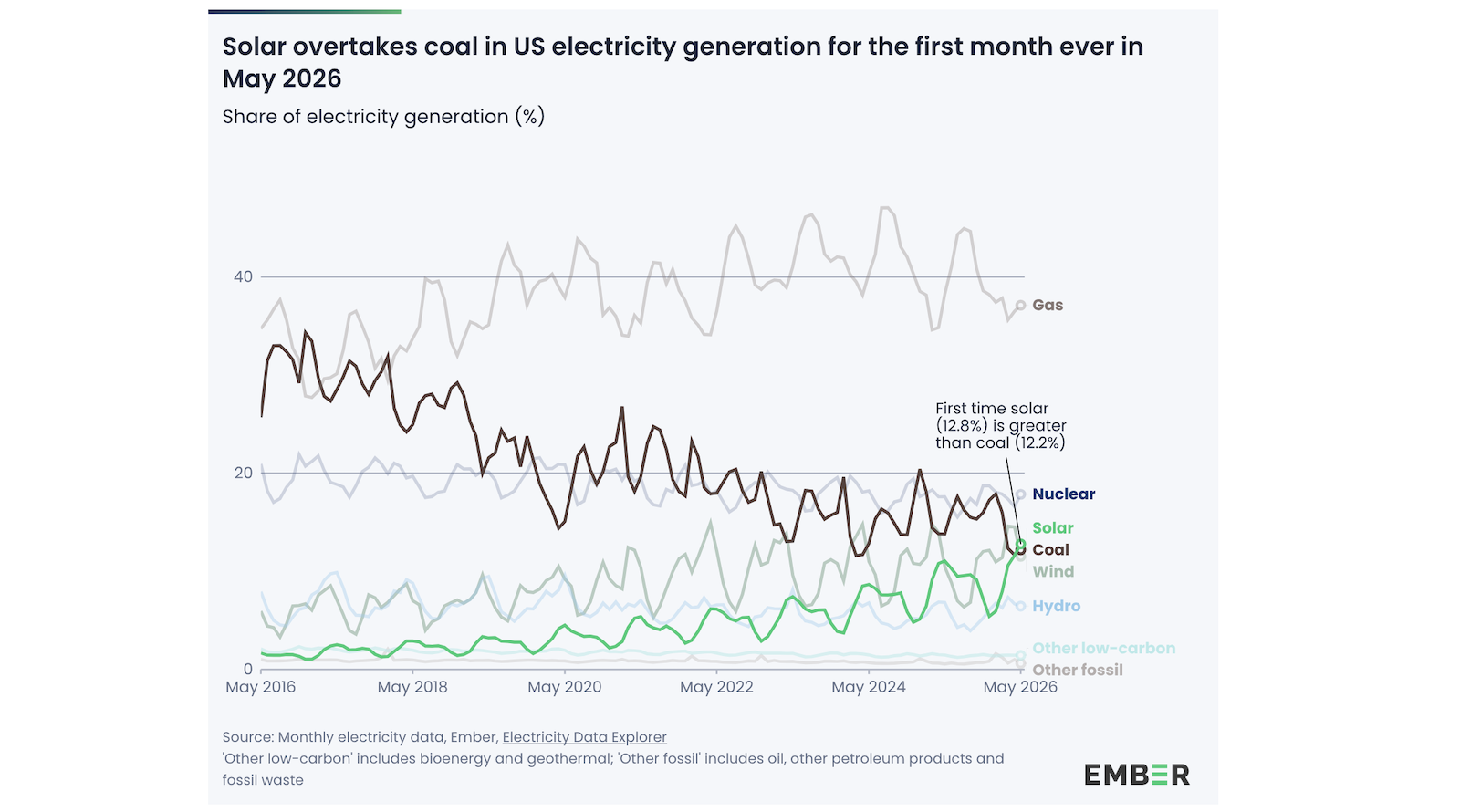
Solar passes coal for a full month in the US
Solar power generated more electricity than coal across the United States in May 2026, a threshold that would have seemed distant only a decade ago. According to figures cited by CleanTechnica from Ember, solar supplied 12.8% of total US electricity in May, while coal provided 12.2%.
The result is historically significant because it marks the first full month in which solar outproduced coal nationwide. In absolute terms, Ember said solar reached a record 45.5 terawatt-hours in May, up 17% from the same month a year earlier and above the previous monthly record set in July 2025.
The crossing point does not mean coal has disappeared from the grid, nor that solar will remain ahead every month of the year. Seasonal demand patterns still matter. But the May data captures a structural trend that has been building for years: coal is steadily losing ground, while solar is moving from a fast-growing niche resource into one of the country’s largest electricity sources.
A symbolic crossover backed by longer-term change
Single-month milestones can sometimes overstate a shift, especially in energy systems where weather, fuel prices and seasonal demand can move numbers around. In this case, though, the one-month crossover sits inside a much larger change in the US generation mix.
Ember’s comparison shows how quickly the balance has moved over the past five years. In May 2021, coal accounted for 19.7% of US electricity, versus just 12.2% in May 2026. Over the same period, solar rose from 5.4% to 12.8% of generation. Put differently, coal’s share was nearly cut in half, while solar’s share more than doubled.
That trend explains why the May result matters beyond the headline. Solar is no longer simply adding marginal daytime output during favorable months. It is now large enough to displace a legacy fuel that for decades formed a central pillar of US power generation.
The data also places solar in a new competitive tier. Ember said solar became the third-largest source of electricity in the United States in May, behind natural gas and nuclear. That ranking underscores how rapidly utility-scale projects and distributed solar installations have expanded, even as transmission, storage and interconnection challenges continue to shape how much renewable capacity can be added and how effectively it can be used.

Why the shift happened now
May is a favorable month for solar because strong sunlight often coincides with relatively moderate electricity demand. Summer air-conditioning loads have not yet fully peaked, so solar can claim a larger share of the power mix before overall demand rises further. Ember noted that total solar generation often peaks in June or July, but solar’s share of the mix can be highest in April or May for precisely that reason.
That seasonal pattern means coal may still move back ahead of solar later in the year. Even so, the broader direction is difficult to miss. If solar is already setting records before the hottest months of summer, more record-breaking output may still be ahead this year.
CleanTechnica’s summary of the Ember data suggests that further monthly records are plausible in the coming summer months. If that happens, the May crossover would look less like a one-off event and more like an early marker of a repeated seasonal reality in which solar regularly surpasses coal during high-production periods.
What it says about the US electricity transition
The milestone also reflects a deeper reordering of the economics and operating logic of the US grid. Coal has been in retreat for years as older plants struggle to compete and as renewable deployment keeps growing. Solar, by contrast, has benefited from sustained capacity additions and a generation profile that increasingly matters at scale during daylight hours.
That does not mean solar can directly replace every function coal once served. Coal plants have traditionally been dispatchable, while solar output varies with weather and time of day. The practical implications of a higher-solar grid therefore depend on additional investment in transmission, storage, flexible generation and grid operations. But generation share still matters because it shows where energy is actually coming from and which technologies are taking a larger role in meeting demand.
The fact that solar is now approaching nuclear in monthly generation terms is another indication of how fast the landscape is changing. Nuclear remains a major steady source of carbon-free electricity, while gas still dominates total generation. But solar’s rise is compressing the space once occupied by coal and changing the order of major contributors on the grid.
For policymakers, utilities and grid planners, the May figures reinforce a practical reality: renewable growth is no longer a future-oriented talking point. It is materially reshaping the monthly power mix in the largest electricity market in the world.

What to watch next
The key question now is not whether solar can occasionally beat coal, but how often that happens and what comes after. Repeated summer records would strengthen the case that the crossover has become a recurring feature of the US power system. Continued year-over-year declines in coal would make the gap easier for solar to hold and widen.
Another point to watch is whether solar’s rise continues to outpace overall power demand growth. If it does, renewables will keep pushing older fossil generation lower in the mix. If demand accelerates because of electrification, data centers or industrial expansion, solar’s absolute output may keep rising even if its share faces new pressure.
For now, the May 2026 numbers stand as a clean benchmark in the US energy transition: solar produced more electricity than coal over a full month, reached a new output record, and climbed to the position of the country’s third-largest power source. What was once a long-term projection has entered the monthly data.
This article is based on reporting by CleanTechnica. Read the original article.
Originally published on cleantechnica.com