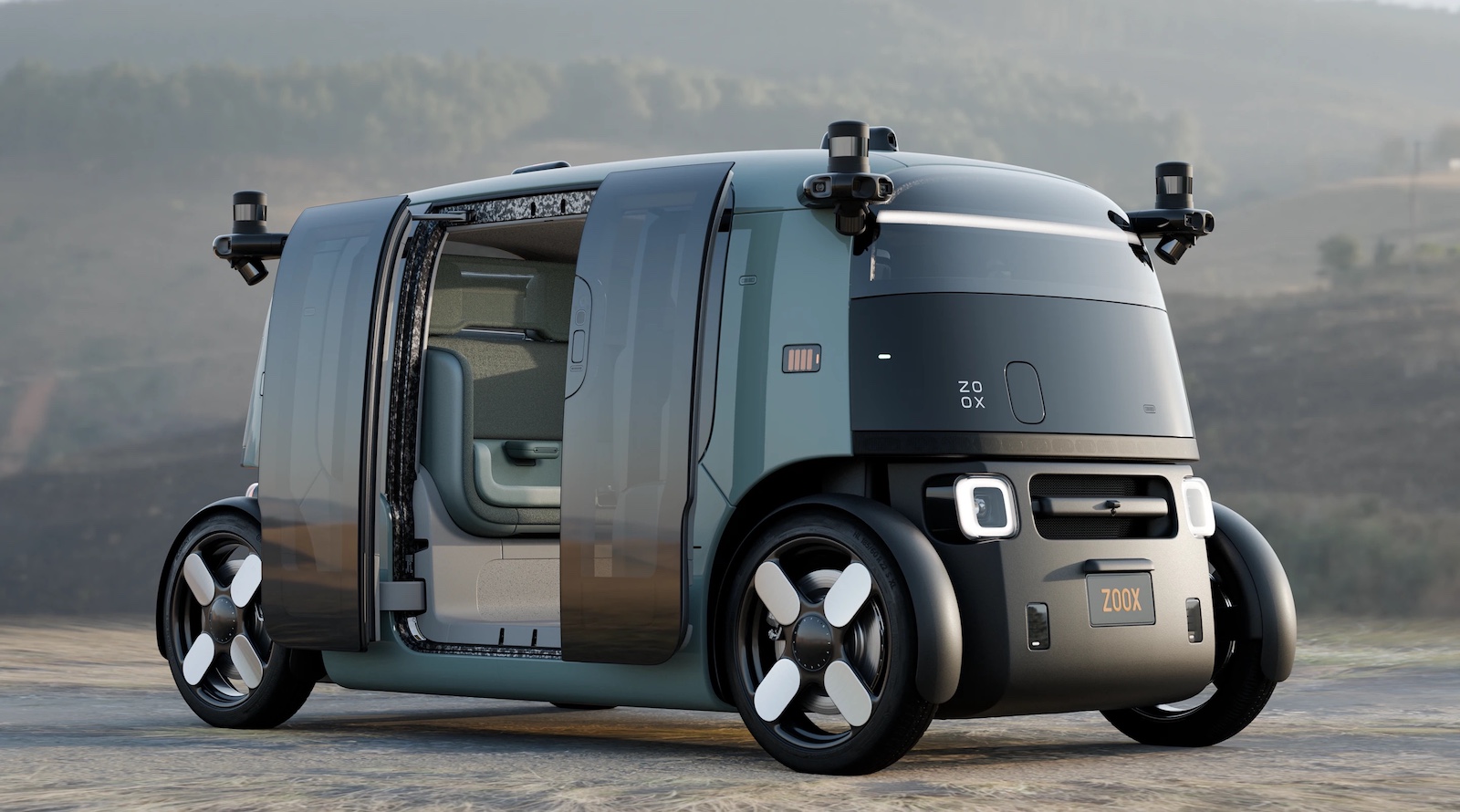
Zoox wins a notable U.S. approval for its purpose-built robotaxi
Zoox says it has received a federal decision from the National Highway Traffic Safety Administration that clears a major obstacle to commercial service in the United States: the ability to begin charging passengers for rides in vehicles designed without traditional human driving controls. That means no steering wheel, no pedals, and no fallback driver interface built into the cabin.
The approval does not amount to an unrestricted national rollout. Zoox still needs to satisfy state and local requirements in the markets where it plans to operate, and the federal action comes with limits on scale and extra reporting obligations. Even so, the development is important because it moves the company beyond pilot framing and closer to a transportation business built around a vehicle conceived from the start as an autonomous shuttle rather than a modified passenger car.
What the decision actually changes
According to the supplied report, Zoox said the NHTSA action gives it federal approval to begin charging for rides and that paid service will start first in Las Vegas. Reuters, as cited in the source text, reported that the exemption allows commercial deployment of up to 2,500 vehicles in each of the next two years. That is a meaningful cap, but it is also enough to support a serious operating program if Zoox can expand service territory and maintain utilization.
The distinction matters because several robotaxi deployments in the U.S. have used vehicles derived from conventional automobiles that still retain human controls. Zoox is pursuing a different product definition. Its robotaxi is intended to function as a dedicated autonomous vehicle, not a consumer car retrofitted with self-driving hardware and software. In practical terms, that design choice affects everything from cabin layout to safety architecture to the regulatory questions agencies must answer before permitting commercial use.
The exemption therefore signals more than permission to collect fares. It also indicates that regulators are willing, at least in a bounded way, to make room for a vehicle category that does not fit the historical assumption that a licensed human must always be able to take over through a steering wheel and pedals.
A limited but important green light
The approval comes with guardrails. Zoox is not being given a blank check to scale as fast as it wants, and it is not allowed to sell these vehicles. The source text also says the company must meet added reporting requirements, including disclosures related to crashes or inappropriate stopping on roads. NHTSA Administrator Jonathan Morrison, again as quoted in the supplied material, said the agency retains the ability to withdraw the exemption if major safety issues emerge.
That condition is central to understanding the policy significance of the decision. U.S. regulators are not treating autonomy as a one-time certification event. Instead, this looks more like supervised market entry: authorize a limited deployment, require operating data, watch for failure patterns, and preserve the option to halt or revise the arrangement if real-world performance does not match expectations.
For Zoox, that means federal approval is best viewed as a conditional launch platform rather than a final regulatory victory. The next phase will depend on execution in service, including how consistently the vehicles behave in public traffic, how incidents are reported, and how state regulators respond once commercial operations begin.
Why this matters beyond one company
The robotaxi industry has spent years arguing that autonomy should not be constrained by the architecture of legacy cars. Zoox is one of the clearest expressions of that argument. If a vehicle is never intended to be driven by a human, then forcing it to carry a steering wheel and pedals may be inefficient at best and a design compromise at worst. A purpose-built robotaxi can be optimized around sensors, passenger space, ingress and egress, and symmetric operation in urban environments.
The federal action gives that thesis a stronger foothold in the U.S. market. It also creates a reference point for competitors. If Zoox can operate commercially under this framework, other developers of autonomous vehicles without human controls are likely to press for similar treatment. The source text itself raises that possibility by noting that other robotaxi operators may not be far behind in seeking comparable approvals.
That does not guarantee a rapid cascade of exemptions. Companies pursuing the same opening would still need to present safety cases that satisfy regulators, and the terms may vary based on vehicle design and operating domain. But policy precedents matter. Once an agency demonstrates a path for one applicant, the question shifts from whether such vehicles can ever be approved to how broadly the approach can be applied.
Las Vegas is the first test market
Zoox says Las Vegas will be the first city where it starts charging for service, assuming remaining state requirements are completed. That choice makes strategic sense. A launch market needs demand density, a manageable operating environment, and a pathway to visible public use. Las Vegas has already served as a proving ground for several mobility experiments because it combines tourism traffic with routes that can deliver repeated trip patterns.
The real test will be whether Zoox can turn regulatory progress into reliable operations. Paid robotaxi service is not judged only by novelty. Riders and regulators will be looking for consistency: safe stops, predictable routing, recoveries from edge cases, and minimal service interruptions. A capped deployment can still generate substantial scrutiny if the vehicles are highly visible and if incidents are quickly amplified through public reporting.
The next phase is operational credibility
For the broader autonomous vehicle sector, this is a milestone worth noting because it narrows the gap between prototype ambition and permitted business activity. For Zoox specifically, it opens the door to proving that a robotaxi with no human controls can do more than operate in demonstrations. It can, at least under a limited federal exemption, enter the market as a fare-charging service.
The harder part starts now. Regulatory novelty attracts headlines, but long-term credibility will come from day-to-day performance under real service conditions. If Zoox can show that a purpose-built autonomous vehicle handles those conditions safely and at useful scale, this approval may be remembered less as an exception and more as an early template for the next stage of urban autonomous transport.
This article is based on reporting by CleanTechnica. Read the original article.

Originally published on cleantechnica.com