Texas approves a major AI data center and wind farm pairing, with limits
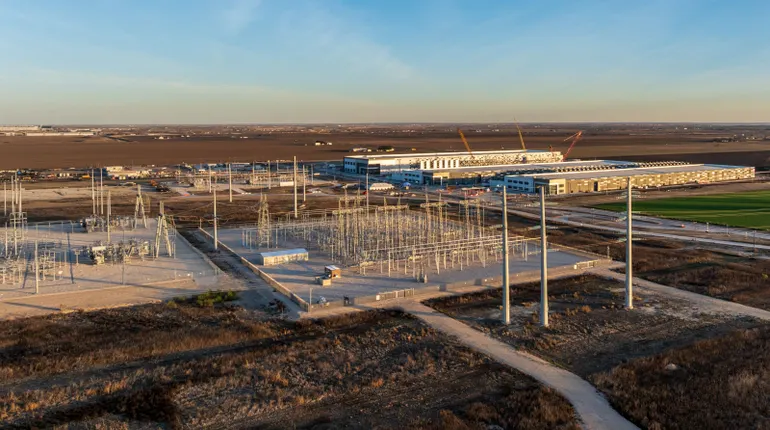
Texas regulators have approved a net metering arrangement for a 260-megawatt AI data center co-located with a wind farm of roughly the same size, creating one of the clearest early signals yet for how the state may handle large behind-the-meter computing loads. The decision matters well beyond a single site. It arrives as developers race to secure power for data centers tied to artificial intelligence while grid operators and regulators try to prevent those projects from undermining system reliability.
According to Utility Dive’s account of the order, the Public Utility Commission of Texas approved the arrangement after rejecting an argument from the developer that a second planned data center at the same site should face lighter curtailment obligations. The broader project now includes two data centers, with total load of about 525 MW, compared with generation capacity of 265.5 MW from the wind resource. That mismatch was central to the case because it tested whether co-location could be treated as meaningfully self-supplied when demand from the site can exceed the renewable output attached to it.
The commission’s answer was not to block the concept, but to impose conditions that keep grid operators in control during stress events. Under the July 23 order described by Utility Dive, the data center must be capable of curtailing its full load within 30 minutes during grid emergencies. If necessary, that curtailment must be enforced through physical breaker disconnection. The project is also barred from participating in paid demand-response programs tied to the arrangement.
A reliability-first reading of Texas policy
The ruling is notable because it represents one of the first major tests of Texas Senate Bill 6, which became law in 2025 and established new rules for large loads in the Electric Reliability Council of Texas territory. One of the law’s most consequential features is that it gives the grid operator authority to disconnect data centers during grid emergencies. That authority reflects a larger change in the way states and utilities are beginning to think about hyperscale computing: not simply as another industrial customer, but as a class of load with unusual speed, size, and potential system impact.
Rather than carving out a project-specific exemption, Texas commissioners largely adopted ERCOT’s proposed reliability conditions. That choice suggests the state is trying to build a repeatable regulatory template instead of negotiating one-off deals around every new AI-linked power project. For developers and investors, that may be a mixed outcome. It offers more clarity than an outright rejection, but it also makes clear that co-location alone will not exempt large facilities from emergency grid obligations.
The decision therefore establishes an important principle. A data center may sit next to a generating resource and structure its power arrangement around that proximity, but if its load profile can materially burden the wider system, the state still expects it to behave like a reliability-sensitive customer. In practice, that means emergency curtailment capability is becoming a core part of the business case for large AI infrastructure in Texas.
Why this matters for the AI buildout
Power has become one of the main constraints on AI expansion. Training and serving advanced models require dense clusters of computing hardware, and those clusters need large, dependable electricity supplies. Renewable co-location has been promoted as one way to speed project development, lower emissions, and reduce exposure to congested interconnection queues. But the Texas order shows how quickly those advantages collide with grid-planning realities when the load is measured in hundreds of megawatts.
The approved arrangement may still move forward, but it comes with operational constraints that could alter project economics. If a facility must be able to shed its full demand within 30 minutes and potentially disconnect physically, developers may need more robust backup systems or additional on-site resources to keep computing workloads stable. Utility Dive cited GridTracker co-founder Chris Talley, who wrote after the decision that the order is not a “death blow” to co-location in ERCOT. Instead, he argued, the architecture now effectively requires full backup capacity. In a follow-up message reported by the outlet, he clarified that he meant resources capable of carrying the load off-grid for a meaningful period, not merely bridging a short interruption.
That interpretation is important because it points to the next phase of the market. Co-located renewables may help anchor part of a project’s supply, but they may no longer be enough on their own. Developers may need batteries, dispatchable generation, or other forms of backup to make large AI campuses workable under the reliability rules Texas is signaling. If so, the winning development model may not be the simplest clean-power pairing, but a more complex hybrid design built around curtailment compliance.
A template other projects will watch closely
The order could have significance beyond this one 260-MW facility because it may serve as a reference point for later behind-the-meter proposals in the state. Utility Dive noted a pending co-location application from Amazon and Vistra, underscoring that this is not a niche issue. Texas is one of the most important power markets in the United States, and its treatment of large AI loads will be watched by utilities, grid planners, developers, and regulators elsewhere.
For policymakers, the case illustrates a balancing act that is becoming harder to avoid. States want the investment, construction, and prestige that accompany AI infrastructure. They also want to expand renewable generation and present co-location as a pragmatic solution. But they do not want those projects to gain reliability advantages unavailable to other customers or to create hidden burdens during emergencies.
Texas’ answer, at least for now, is conditional permission. The state is allowing the project to proceed, but only on the assumption that emergency curtailment is real, rapid, and enforceable. That is a more disciplined framework than the rhetoric around “data centers next to wind farms” sometimes implies. It treats co-location not as an automatic grid bypass, but as an arrangement that still has to prove it will not compromise system operations when demand spikes or supply tightens.
As AI computing expands, that distinction may become one of the defining issues in power regulation. The July order suggests Texas wants to remain open to large data-center development while drawing a firm line on reliability. For the industry, that means future growth in ERCOT may depend as much on curtailment design and backup strategy as on access to cheap wind power.
This article is based on reporting by Utility Dive. Read the original article.

Originally published on utilitydive.com