A canal-top solar concept moves from theory to field data
One of the recurring questions around clean-energy infrastructure is whether new power can be built without intensifying competition for land and water. A California pilot now offers fresh evidence that one answer may be to build directly over water-delivery systems that already exist.
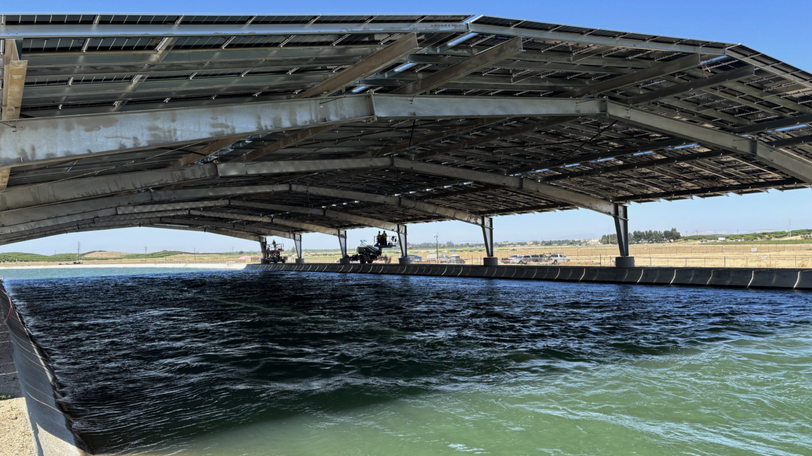
The 1.6 MW Nexus project, completed in September 2025 on irrigation canals operated by the Turlock Irrigation District, has shown that solar panels installed above canals can reduce water evaporation by 70% and algae growth by 85%, according to reporting from pv magazine. The installation was developed through a public-private partnership involving the California Department of Water Resources, Turlock Irrigation District, Solar AquaGrid, and the University of California, Merced.
Why canal-top solar is attracting attention
The appeal of the concept is its dual use of infrastructure. Instead of converting additional land to utility-scale solar, developers place photovoltaic arrays over active canals and use the same footprint to generate electricity while shading water. In water-stressed agricultural regions such as California’s Central Valley, that combination matters.
Evaporation is not a marginal issue in canal systems that run through hot, dry conditions. Cutting those losses can preserve water that would otherwise be lost before reaching farms and communities. Shading also changes canal conditions in ways that can suppress algae growth, reducing one of the operational headaches that water managers routinely face.
The Nexus pilot was launched in 2022 specifically to test whether these benefits would hold up under real operating conditions rather than in conceptual studies. The reported results suggest they do.
What the pilot measured
According to the source text, the project tracked a broad set of performance indicators, including electricity generation, evaporation losses, water quality, aquatic impacts, and operational efficiency. The headline results are the evaporation and algae figures, but the broader significance is that the pilot was designed as an empirical test of technical and operational feasibility on active irrigation infrastructure.
That distinction is important. Many energy concepts look promising on paper but struggle once they intersect with maintenance requirements, existing utility operations, or environmental constraints. Canal-top solar has to coexist with flowing water, inspection needs, support structures, and the realities of irrigation scheduling. A real-world pilot offers a stronger basis for expansion decisions than modeling alone.
Land use and grid value
Canal solar also addresses a common friction point in the energy transition: siting. Large solar projects often face delays or opposition because they compete with agricultural land, habitat, or other local priorities. By using existing canal corridors, developers can reduce that land-use pressure while placing generation close to rural loads.
For irrigation districts and agricultural regions, that proximity may matter almost as much as the water savings. Local power generation can support pumping and other energy-intensive operations, and it may do so without the transmission and siting complications tied to some greenfield developments. The pilot therefore sits at the intersection of energy, water management, and agricultural resilience rather than fitting neatly into only one policy box.

Why California is a logical test bed
California’s canal networks and recurring drought pressures make it one of the most plausible places to test this model at scale. The state has large solar ambitions, extensive irrigation infrastructure, and a strong incentive to reduce evaporation losses. That combination means the canal-top approach is not merely an engineering novelty. It is being assessed against real constraints that are central to the state’s economy.
The Central Valley context is especially relevant because it concentrates both water demand and land-use sensitivity. If solar can deliver meaningful output there while preserving water and avoiding new land conversion, the model becomes easier to justify economically and politically.
What comes next
The pilot does not by itself prove that every canal is suitable for solar coverage. Costs, structural requirements, maintenance access, and local environmental conditions will all shape where the concept works best. But the findings strengthen the case that canal-top solar can produce multiple operational benefits at once rather than trading one resource problem for another.
That is the broader importance of the Nexus results. Many infrastructure proposals promise co-benefits, but relatively few generate quantified evidence that can inform investment and policy. Here, the project appears to have produced exactly the kind of field data needed to move the discussion forward.
A practical model for resource-constrained regions
As energy planners search for lower-conflict deployment models, canal solar offers a practical narrative: use existing corridors, generate renewable power, conserve water, and improve canal conditions. The reported 70% reduction in evaporation and 85% drop in algae growth make the idea harder to dismiss as a niche experiment.
For regions balancing climate adaptation with power expansion, the lesson may be that infrastructure does not always need to be built in separate layers. Sometimes the most valuable projects are the ones that make one piece of public infrastructure do more than one job.
This article is based on reporting by PV Magazine. Read the original article.
Originally published on pv-magazine.com