Europe’s energy shock response is showing up in the import bill
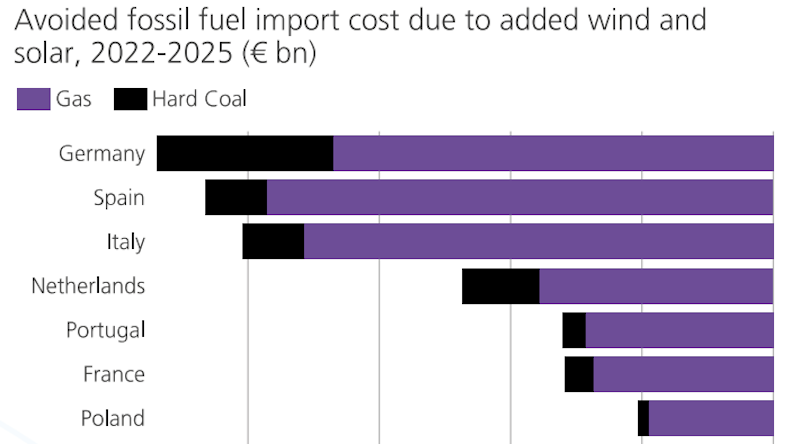
European countries avoided an estimated €72 billion in fossil fuel imports between 2022 and 2025 as wind and solar deployment accelerated after Russia’s invasion of Ukraine, according to analysis cited in coverage of the 75th edition of the Statistical Review of World Energy.
The reported savings come from a rapid change in the region’s power mix. Wind and solar together supplied 30% of European Union electricity in 2025, up from 19% in 2021. Over the same period, gas-fired generation fell by 15% and coal generation dropped by 38%.
That shift matters beyond climate targets. It suggests renewable capacity is no longer only a long-range decarbonization project. In Europe’s case, it also functioned as a near-term energy security response to a geopolitical shock that exposed the cost of dependence on imported fossil fuels.
From climate strategy to strategic insulation
The period after early 2022 forced Europe to move faster on questions it had already been debating for years: how to reduce exposure to imported fuel, how to stabilize power prices, and how to build a more resilient electricity system. The latest figures indicate that the answer, at least in part, came from scaling domestic renewable generation more quickly.
The cited report says supportive policy environments, including the European Union’s REPowerEU framework, helped speed that buildout. By 2025, wind and solar generation reached 852 terawatt-hours. That total exceeded the combined electricity generation from coal, gas, and oil, which stood at 760 terawatt-hours.
That crossover is the central development. It means wind and solar were no longer a supplementary layer on top of a fossil-heavy system. They moved into a role large enough to displace major volumes of conventional generation across the bloc.
In practical terms, that translated into reduced need for imported fuels, especially gas. The analysis cited in the article says most of the €72 billion in avoided imports came through lower gas purchases. Germany, Spain, and Italy were identified as the countries with the largest savings.
Why the gas number matters most
Gas has occupied a uniquely sensitive place in Europe’s energy system because it touches power generation, industry, heating, and geopolitics all at once. When gas prices spike or supply becomes uncertain, the effects are broad and immediate. Avoiding gas imports, then, has an outsize effect compared with simply reducing a smaller or less strategically exposed fuel stream.
The figures suggest the renewable buildout did more than improve emissions performance. It also helped shield the region from additional spending during a period when imported fossil energy carried both economic and political risk. That makes the renewable surge a case study in how power-system transitions can produce security and affordability benefits at the same time.
There is also an important systems implication. Every percentage point of electricity demand met by domestic wind and solar reduces the amount of fuel that must be bought, transported, and burned elsewhere in the system. In a region as import-dependent as Europe, the cumulative value of that substitution becomes large quickly, especially over several years of elevated fuel-market stress.
A structural shift, not just a temporary reaction
The most significant element in the data is not only the headline savings figure. It is the pace at which the electricity mix changed between 2021 and 2025. Moving wind and solar from 19% to 30% of supply in four years is not a marginal adjustment. It indicates a structural reweighting of the generation fleet.
Coal and gas both lost ground over the same period, with coal seeing the steeper decline. That pattern points to a dual displacement effect: renewables pushed out the highest-emitting coal generation while also reducing reliance on gas plants that often set power prices and tie electricity markets to volatile fuel imports.
For policymakers, that creates a stronger argument for treating renewable expansion and grid modernization as strategic infrastructure rather than as sector-specific climate policy. The more renewable capacity can be connected, balanced, and integrated, the more Europe can insulate itself from future import shocks.

What the numbers do and do not say
The reported savings do not imply Europe has solved its energy security problem. The region still relies on imported fuels, and the underlying article itself argues that more wind and solar capacity is needed. But the data does show that deployment already undertaken since 2022 had a measurable macroeconomic effect.
That distinction matters. Energy-transition debates often treat benefits as distant, diffuse, or difficult to quantify. In this case, the reported avoided-import figure offers a concrete measure tied to a defined period and a specific policy-and-market response.
It also reframes the value proposition of renewable energy. The case for faster deployment is no longer only cleaner generation in the long run. It is also lower exposure to external suppliers, less import spending, and a stronger domestic electricity base in the present.
What comes next for Europe
If Europe wants to extend this trend, the next phase is likely to depend not only on adding more wind turbines and solar panels, but also on the enabling systems around them. Faster permitting, stronger grids, storage, and policies that keep new projects moving from approval to connection will determine whether the 2022-2025 acceleration becomes a durable trajectory.
The latest numbers suggest that the first wave of that acceleration already changed the balance of the power system. Wind and solar generated more electricity in 2025 than coal, gas, and oil combined, while helping avoid tens of billions of euros in fossil fuel imports over four years.
For a region forced to rethink energy security under pressure, that is more than a symbolic milestone. It is evidence that industrial-scale renewable deployment can alter trade exposure, reshape the electricity mix, and produce strategic economic gains on a timeline measured in years, not decades.
This article is based on reporting by CleanTechnica. Read the original article.

Originally published on cleantechnica.com