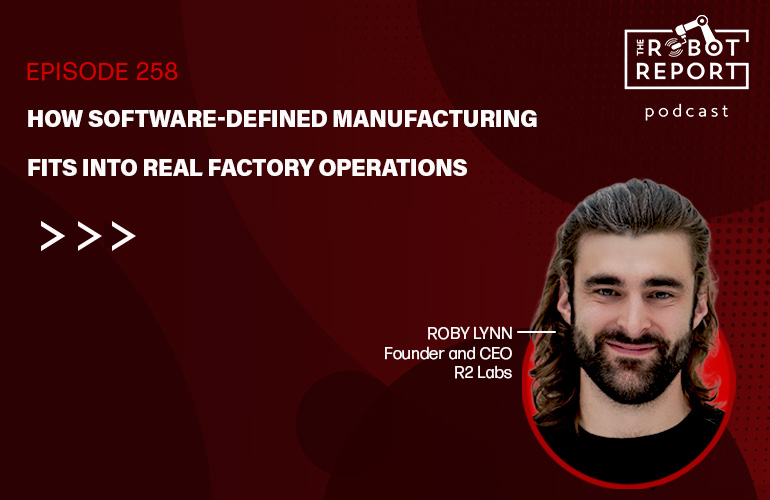
Software-defined manufacturing is moving from a concept in engineering labs to a practical strategy for the plant floor, and a recent episode of The Robot Report Podcast explored what that transition actually looks like. In Episode 258, host Mike Oitzman welcomed Dr. Roby Lynn, founder and CEO of R2 Labs, a smart manufacturing technology provider based in Peachtree Corners, Georgia. Lynn described his company's approach to connecting old and new systems in manufacturing, and why flexibility has become a key goal for factories that are often locked into hardware-centric workflows.
What is software-defined manufacturing?
At its heart, software-defined manufacturing is about using automation to make production more flexible. Instead of physically tearing out lines or rewiring entire cells whenever a product changes, the focus moves to the software layer that controls the equipment. This means operators can shift between tasks by updating programs rather than replacing hardware. It is a mindset that treats machines as flexible platforms, not single-purpose tools.
That flexibility is increasingly important in an environment where product lifecycles shorten, supply chains shift, and customers demand more customization. For Lynn, the path to that flexibility is not to build brand-new factories from scratch, but to bring modern digital capabilities to equipment that manufacturers already own and trust.

R2 Labs and the R2 Autonomy Controller
R2 Labs, the company Lynn founded and leads, is squarely focused on smart manufacturing. Its flagship product, the R2 Autonomy Controller, or RAC, is designed to bring new life to legacy equipment. The controller gives companies access to the latest industrial technology, including AI vision and advanced robotics, without requiring them to discard their existing machines.
Factories today are often fragmented places. Programmable logic controllers, robots, vision systems, and other equipment frequently operate on separate islands of automation. The RAC bridges PLCs, robots, and AI, creating a more unified control environment. By connecting these components, the controller lets manufacturers add intelligence to systems that were originally built around static sequences.
Modernizing without a complete overhaul
One of the most practical aspects of the RAC is that it can be integrated into real factory operations without forcing a complete line replacement. Legacy machines can be retrofitted to work with advanced robots or AI-powered vision systems. This matters because industrial equipment is often expensive, durable, and engineered to last for decades. Throwing that hardware away when a new technology emerges is not always feasible or financially sensible.
Instead, the RAC acts as an intermediary that allows older equipment to benefit from newer capabilities. For example, a machine that previously followed a fixed path can be connected to an AI vision system that inspects parts and adjusts the process in real time. The result is a more flexible, responsive production line that still uses the same core hardware.
A conversation with Dr. Roby Lynn
Lynn is well prepared to lead that kind of effort. He holds a Ph.D. in mechanical engineering from the Georgia Institute of Technology and previously worked at Formlabs, a company known for its advanced 3D printing platforms. That background gives him a deep understanding of both the hardware side of manufacturing and the software systems needed to make machines more responsive.
In the podcast interview, Lynn talked about how the RAC fits into the broader push toward software-defined manufacturing. He emphasized that the goal is not simply to add sensors or robots, but to create a control architecture where changes can happen in software, not just through physical reconfiguration. That is what makes manufacturing truly agile.

News from the week in robotics
The episode also covered several other stories from the world of robotics and automation. One of those was the NoTip autonomous delivery system, which is representative of how autonomous technology is extending beyond factory floors into public spaces. Another major topic was Unitree Robotics and its plans for an initial public offering. The story highlights the growing investor interest in humanoid robots and the broader robotics sector.
In the safety space, FORT Robotics announced it would take its safety stack public through a SPAC merger. Safety is a critical piece of bringing robots closer to people, especially as they move out of cages and into workplaces. The episode also touched on Logic's automation of rail-to-road transloading using the Logic Pallet and Digital Twin OS, showing how digital simulation and physical operations can be aligned more closely.
RoboBusiness 2026
Toward the end of the show, the team reminded listeners about RoboBusiness 2026, which is a key event for the robotics and automation community. The conference offers an opportunity to see these technologies in action, hear from industry leaders like Dr. Lynn, and connect with companies that are building the next generation of manufacturing tools. Early registration savings are available for those who plan to attend.
What this means for factory operators
For manufacturers, the rise of software-defined manufacturing brings a clear message: the future does not have to wait for a new building and a new fleet of machines. By layering intelligent software over existing assets, companies can gain many of the benefits of advanced automation while preserving their past investments. The RAC from R2 Labs is one working example of that principle.
The controller unifies the different control systems found in a modern factory, bridging PLCs, robots, and AI in a way that makes the entire plant more adaptable. This is not just a theoretical idea; it is a practical approach being implemented in real operations. As Dr. Lynn explained on The Robot Report Podcast, the key is to bring the flexibility of software to the physical reality of the factory floor.
Key takeaways from the episode
- Software-defined manufacturing enables more flexible production through automation.
- R2 Labs' RAC brings AI vision and advanced robotics to legacy equipment.
- The controller bridges PLCs, robots, and AI to unify fragmented manufacturing systems.
- Retrofitting existing lines can be a faster and more affordable path to modernization.
- The robotics industry continues to see major news, from delivery robots and humanoid IPOs to new safety systems and logistics automation.
As the industry moves forward, conversations like this one will help manufacturers understand how to apply software-defined thinking to their own operations. The technology is ready, and with products like the RAC, the path to a smarter factory is becoming clearer every day.
This article is based on reporting by The Robot Report. Read the original article.

Originally published on therobotreport.com