Humyn Labs has raised $47 million in a Series A financing as it builds a business around one of robotics’ persistent constraints: obtaining training data that reflects the messiness of real workplaces rather than controlled simulations.
The company says it works with frontier AI laboratories, robotics companies and world-model developers, gathering and enriching data from real-world operations. Humyn Labs also says it has exceeded $50 million in annualized revenue within six months of starting operations, an unusually rapid commercial milestone for a young physical-AI company.
A financing split between equity and debt
The round comprises $26 million in equity led by Accel and $21 million in venture debt led by Lighthouse Canton. Other participants in the equity financing include Prosus Ventures, BeeGlobal, Finserv Intelligence through Bajaj Finance, Bajaj Alts AI Opportunities Fund, Dallas Venture Capital, Lighthouse Canton, Jump Trading LLC and Anita Pramoda, formerly chief financial officer of Epic.
The company’s pitch is not simply that robots need more data, but that the data must be collected for the practical conditions in which a customer wants a system to operate. Co-founder Ishank Gupta told The Robot Report that much robotics development remains constrained by the gap between laboratory and simulated environments and the real world.
That proposition puts Humyn Labs in a strategically important layer of the robotics stack. Model builders can develop perception, planning and control systems, but their performance depends on examples of people, tools, environments and tasks. A data supplier that can collect, label and verify those examples at scale can become a close partner in the deployment process.

Four kinds of signals
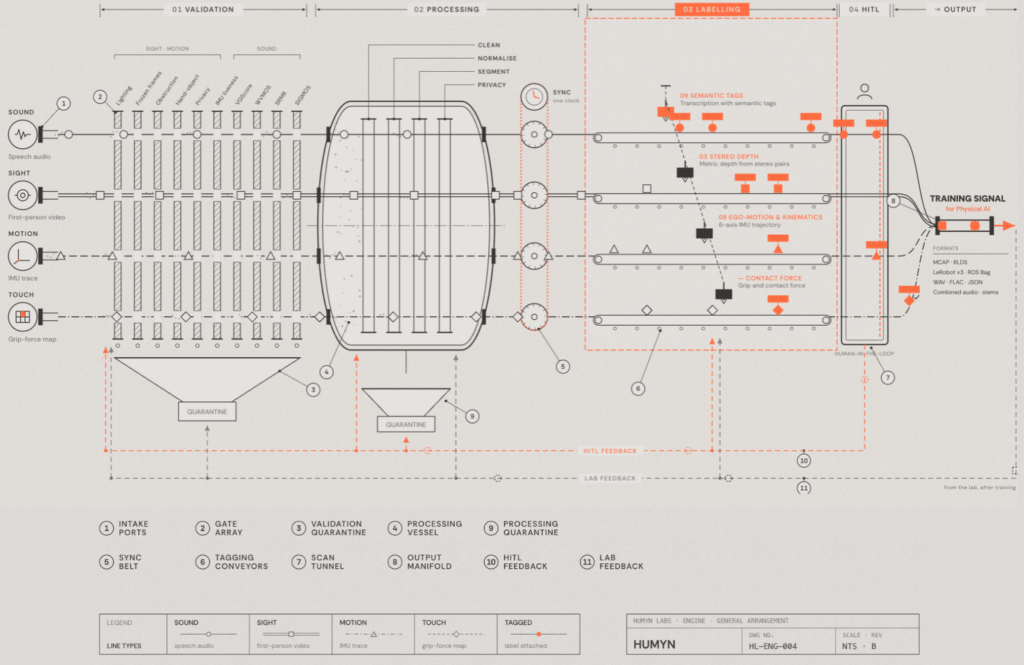
Humyn Labs says it currently gathers data across four modalities: vision, sound, touch and motion. It uses proprietary capture devices to record how people perform particular jobs according to a laboratory’s requirements. Its data engine then converts those recordings into labeled, training-ready datasets with verified provenance, according to the company.
These modalities matter because physical tasks rarely reduce cleanly to one camera view. A robot working around people or manipulating objects may need visual context, the sounds associated with an activity, information related to touch, and records of how a body or tool moves. Humyn’s collection approach is designed to capture those signals together where appropriate.
Gupta said the company treats audio differently from vision, touch and motion. For audio, it focuses on collecting across languages rather than industries. Vision, touch and motion data tend to be more industry-specific and are often collected together, he said.
Collection beyond a single market
The company says it operates and works with on-the-ground collection partners in more than 20 countries. Its largest operating areas are Latin America, Southeast Asia, South Asia and East Asia. That geographic footprint is central to its stated model: a customer can request a bespoke collection and enrichment program, rather than rely only on a fixed, generic dataset.
Humyn Labs describes itself as both a data partner and a deployment partner. In practice, that means starting with what researchers need and building a collection program around it. The company says its capture operations are intended to be an extension of a customer’s research team.
Why real-world data has become a robotics priority
Robotics developers increasingly need systems that can move from testing conditions into homes, workplaces and other variable settings. Simulation remains useful, but the company argues that it cannot fully substitute for records of how real people carry out work. The value proposition is therefore tied to preparing systems for deployment rather than merely improving performance on a benchmark.
Humyn divides its customer work into three broad industry categories: residential, commercial and industrial. The supplied report does not detail each category’s individual projects, but the framing suggests the company is seeking a broad market for multimodal physical-world data rather than focusing on a single type of robot.
The funding also highlights growing demand for data infrastructure around robotics and world models. A model can be trained on synthetic scenarios, but a collection partner capable of gathering task-specific examples may help address situations where customers need evidence from a particular environment, workforce or operating context.

What the round signals
The $47 million round gives Humyn Labs resources to continue expanding a data-capture and enrichment operation across multiple regions. Its combination of equity and venture debt also reflects an operationally intensive model: collecting, labeling and validating real-world data requires more than distributing software.
For the company, the next test is whether its data operation can keep matching the needs of highly varied customers while preserving the provenance and quality it says it provides. For robotics developers, the appeal is straightforward: access to data that is closer to the conditions their machines will encounter after they leave the lab.
Humyn Labs’ financing is therefore a reminder that the contest to build capable robots is not only about algorithms or hardware. It is also about the systems that observe real work, turn those observations into usable datasets and help close the distance between a promising demonstration and a dependable deployment.
This article is based on reporting by The Robot Report. Read the original article.
Originally published on therobotreport.com