Atlas moves beyond automotive manufacturing
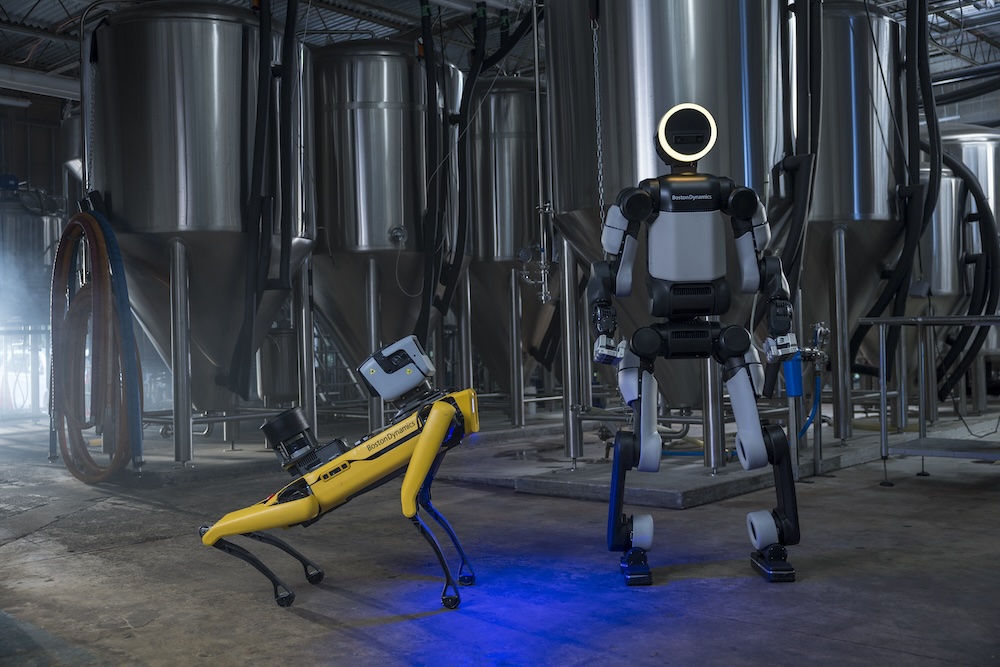
Boston Dynamics’ electric Atlas humanoid is set for its first announced trial outside the automotive industry. GlobalFoundries plans to test the robot in semiconductor manufacturing beginning in early 2027, according to The Robot Report.
The agreement is significant because it shifts Atlas from a highly structured vehicle-production setting into an environment with different workflows, equipment, safety requirements and integration challenges. It is not yet a broad factory deployment. The companies say they will identify suitable applications, assess readiness and integration needs, and train Atlas for specific tasks. They have not disclosed how many robots will be used, which sites will host them or what jobs they will perform first.
Those unknowns matter. A trial can demonstrate technical potential without proving that a system is ready for large-scale, continuous production use. Even so, the GlobalFoundries project provides an important opportunity for Boston Dynamics to test its commercial humanoid strategy with a customer outside its parent company, Hyundai Motor Group.
An existing relationship provides a starting point
GlobalFoundries is not beginning from zero with Boston Dynamics. The semiconductor manufacturer has already used the company’s Spot quadruped for industrial inspections, and the two companies are expanding Spot deployments across GlobalFoundries’ manufacturing network.
At the company’s Singapore facility, two Spot robots have traveled nearly 900 kilometers and completed more than 90,000 inspections in sub-fab areas since April 2026, according to the companies. They reported a 99% mission success rate. That experience gives GlobalFoundries practical familiarity with deploying mobile robots, managing their missions and using machine-collected data in industrial operations.
Spot and Atlas are designed for different roles. Spot is a mobile quadruped commonly used for remote inspection and data collection. A humanoid is meant to work in environments built for people, potentially allowing it to use existing aisles, tools and workstations without a factory being redesigned around a purpose-built machine. But that possibility is not the same as an achieved result. The coming work is intended to determine where Atlas can fit and what changes or safeguards would be necessary.

Why semiconductor fabs are a demanding test
Semiconductor manufacturing is a particularly consequential setting for an industrial robot trial. Fabs rely on tightly controlled processes, specialized equipment and exacting operating procedures. Downtime can be expensive, while errors, contamination concerns or unreliable handoffs can undermine the value of automation.
GlobalFoundries and Boston Dynamics will therefore need to do more than show that Atlas can navigate a facility or manipulate an object. They will need to establish that the robot can operate safely and reliably around people, infrastructure and semiconductor-manufacturing processes. The source does not identify the initial tasks, so it is not possible to say whether the robot will handle materials, perform inspections, operate equipment or support workers in another way.
That task selection will likely be central to the trial’s value. The best early applications for humanoids may be repetitive work that is difficult to automate with fixed machinery but still bounded enough to test safely. A narrowly chosen use case can reveal whether a robot’s mobility, perception and manipulation justify the operational complexity of introducing it to a production environment.
Commercialization needs external proof points
Boston Dynamics unveiled the product version of electric Atlas at CES 2026. At that time, it said its initial production run for the year had already been committed, with robots allocated to Hyundai and Google DeepMind. Google DeepMind is working with Boston Dynamics to integrate Gemini Robotics foundation models into Atlas.
The planned GlobalFoundries test follows Boston Dynamics’ earlier indication that it would begin work with additional customers in early 2027. It gives the company an external proving ground that is neither a public demonstration nor a deployment within Hyundai’s automotive operations.
For the humanoid-robot industry, that distinction is important. Interest in general-purpose industrial robots has risen rapidly, but adoption will ultimately depend on whether machines can deliver useful work inside real operating constraints. Customers need evidence on reliability, supervision requirements, integration costs and the ability to recover from unexpected conditions. A limited trial is designed to produce that kind of evidence, even if it does not resolve every question.
From predictive maintenance to physical AI
GlobalFoundries’ stated goal is to expand its use of AI-enabled manufacturing. Pradip Singh, the company’s chief manufacturing officer, said Spot had helped shift maintenance practices from reactive work toward predictive maintenance by collecting data from thousands of inspection points. He described scaling Spot and testing Atlas as the next steps in putting physical AI to work across the company’s operations.
The phrase captures an increasingly common industrial ambition: connect AI systems to machines that can sense and act in the physical world. In a factory, that can mean gathering inspection data before equipment fails, moving autonomously through a facility, and potentially carrying out selected physical tasks. The benefits, however, depend on careful deployment rather than a simple software upgrade. Hardware, site procedures, safety cases and workforce workflows all have to align.
What to watch in 2027
The first useful signal from the Atlas trial will be specificity. The companies have said they will identify applications and train the robot for them, so future disclosures about the chosen tasks and operating locations will show how ambitious the initial program is. Results on uptime, autonomy, worker supervision and integration will be more meaningful than a simple announcement that a robot entered a fab.
GlobalFoundries’ experience with Spot may make it a relatively well-prepared customer for this experiment. But Atlas will face a distinct technical and operational test: proving that a humanoid form factor can provide value in semiconductor manufacturing, not merely function inside it. The early-2027 trial will be a measured step toward that answer, and a notable benchmark for Boston Dynamics’ effort to turn Atlas into a commercial industrial platform.
This article is based on reporting by The Robot Report. Read the original article.

Originally published on therobotreport.com