Runway makes its Praxis-1 robotics model available with open weights
Runway AI has released Praxis-1, a world action model for robotics that developers can use under the Apache 2.0 license. The release puts the model’s weights, inference code and fine-tuning code into developers’ hands, including for commercial applications.
Praxis-1 is designed to predict video and robot actions together. Runway describes it as a 27-billion-parameter mixture-of-experts diffusion transformer, built on the company’s video foundation-model work. The underlying idea is that learning to predict how scenes evolve can help a system build a useful representation of the physical world before it is trained to act within it.
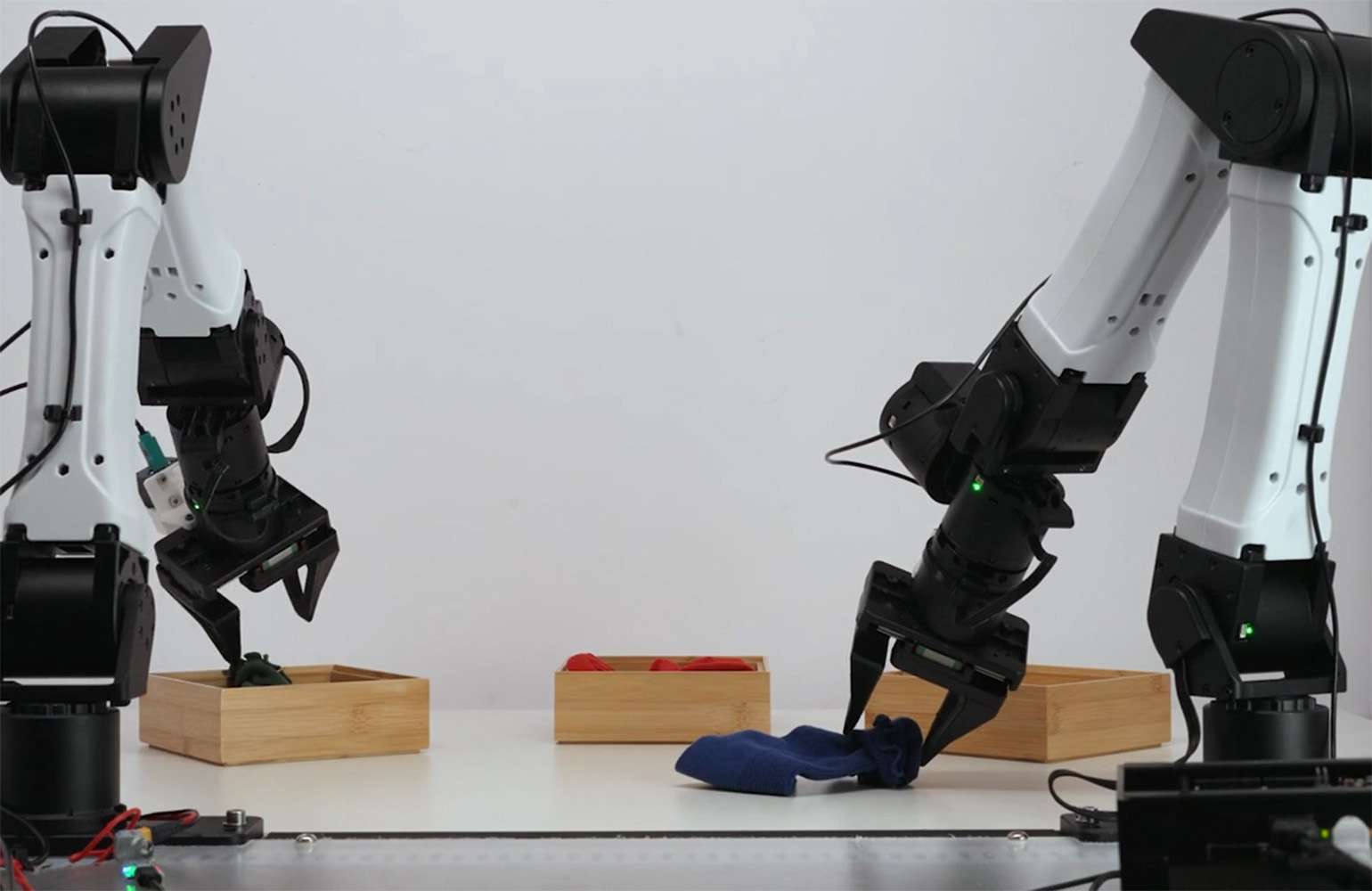
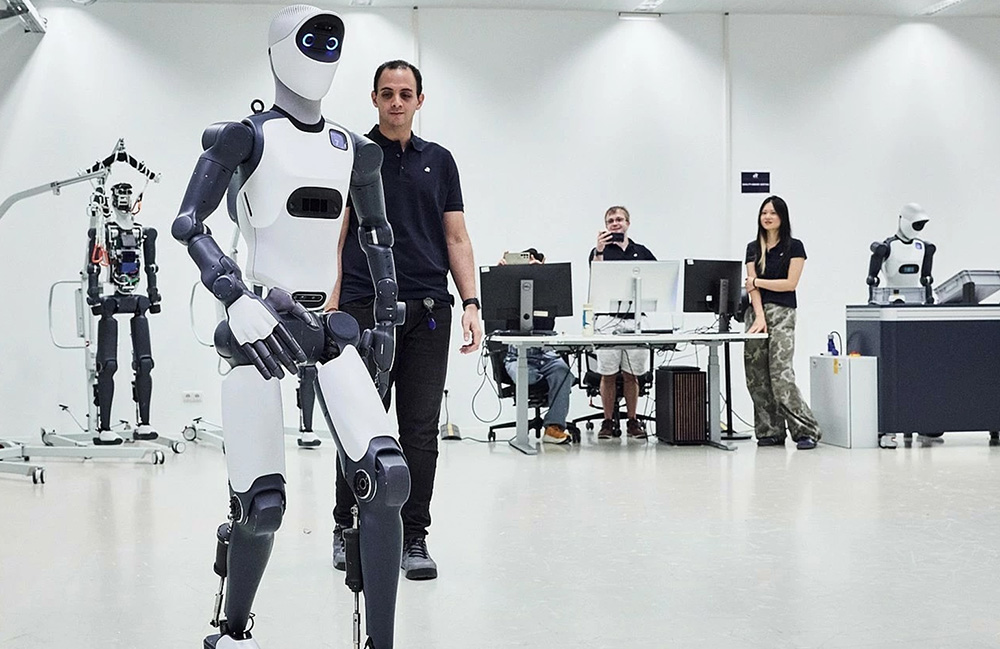
The company had announced Praxis-1 in September with launch partners Noble Machines, Standard Bots and Ultra. Those partners have since run it on several types of hardware: a legged humanoid robot, a six-axis industrial arm and a dual-arm warehouse robot. The broader availability means other robotics teams can now evaluate, adapt and deploy the system on their own machines rather than treating it solely as a closed demonstration.
From video prediction to physical action
Runway’s robotics head, Andy Chen, said the model’s approach rests on a practical observation: a model trained to predict video must learn substantial information about objects, hands, movement and task progress. In Praxis-1, that visual understanding remains part of the training objective while the system learns to produce actions.
That is a notable framing for robot learning. Rather than approaching control as an isolated mapping from a camera frame to a motor command, the model is intended to join perception, an expectation of what will happen next and an action choice. The source material characterizes Praxis-1 as a world action model, a label that reflects this combined treatment of observation and action.
Chen offered an example from Noble Machines’ warehouse work. An earlier Runway model reportedly required substantial training to learn a task involving picking up wooden planks individually and placing them in a container. He said Praxis-1 learned that task from about half an hour of examples, then completed it successfully 15 times out of 15. In a second test, the model was given a previously unseen messy pile of planks to sort into bins. Chen said it cleared the entire pile in six out of 10 attempts.
Those results are company-reported partner tests, not a substitute for independent evaluation across sites and tasks. Still, the example illustrates the type of capability developers are seeking: a base model that can be adapted from relatively limited demonstrations and can cope with variation beyond the exact arrangement it saw during training.
Reported benchmark position
On the RoboLab-120 benchmark, Runway said Praxis-1 achieved a 46.2% success rate across 1,200 episodes. The article compares that result with 42.9% for FLUX 3 Action, 36.8% for Cosmos3 Nano and 28.0% for π0.5. The report says Praxis-1 ranks fifth overall on the leaderboard, while Chen described it as the top-ranked world action model and the top-ranked open-source end-to-end policy on NVIDIA’s RoboLab leaderboard.
Benchmark scores are useful for comparing systems under a defined test setup, but their relationship to a particular factory, warehouse or service-robot environment is not automatic. Robots encounter differences in camera placement, lighting, objects, surfaces and safety constraints. The more consequential question for prospective users will be whether a model can be tuned and validated reliably for their specific equipment and operating conditions.
Praxis-1’s availability may make that evaluation easier. The release includes support for both full fine-tuning and low-rank adaptation, or LoRA. That gives developers a choice between extensively retraining the model for a use case and making a more targeted adaptation. The model is also available through GitHub and Hugging Face, with native LeRobot support, and through vLLM-Omni. Hosted inference is available on Reactor.
Deployment across NVIDIA hardware
Runway said Praxis-1 runs across a range of NVIDIA hardware, from H100 and B200 data-center GPUs to RTX 5090 and RTX PRO 6000 workstation GPUs, as well as Jetson Thor hardware on the robot itself. The spread is significant because robotics workflows commonly span multiple computing environments: teams may train or fine-tune models on powerful centralized hardware, test them on workstations and ultimately need to run them close to the machine.
The Apache 2.0 license also matters. It permits commercial use, and Runway says the open release covers both the model weights and the accompanying inference and fine-tuning code. For robotics developers, that can reduce dependence on a proprietary hosted model and allow the system to be examined and altered as part of a larger robotics stack.
The release does not settle whether a general-purpose model can replace conventional robotics engineering. A useful deployed system still has to connect perception and action to a particular robot’s sensors, actuators, workspace and operational safeguards. But releasing a base model with partner-tested demonstrations, adaptation tools and an open license changes who can conduct that work.

Why the release is important
Praxis-1 arrives amid an effort to make robotics models more reusable across different embodiments and tasks. Runway’s reported partner work spans a humanoid, an industrial arm and a warehouse robot, while its own description emphasizes learning physical regularities from visual prediction. If developers can reproduce and extend those results, an open model of this scale could become a common starting point for manipulation and warehouse-automation experiments.
For now, the most concrete development is the release itself: developers can obtain the model, run it on supported NVIDIA systems and adapt it for their own hardware. The coming tests will determine how well its reported benchmark and partner performance transfer to the varied, imperfect environments where robots are expected to work.
This article is based on reporting by The Robot Report. Read the original article.
Originally published on therobotreport.com