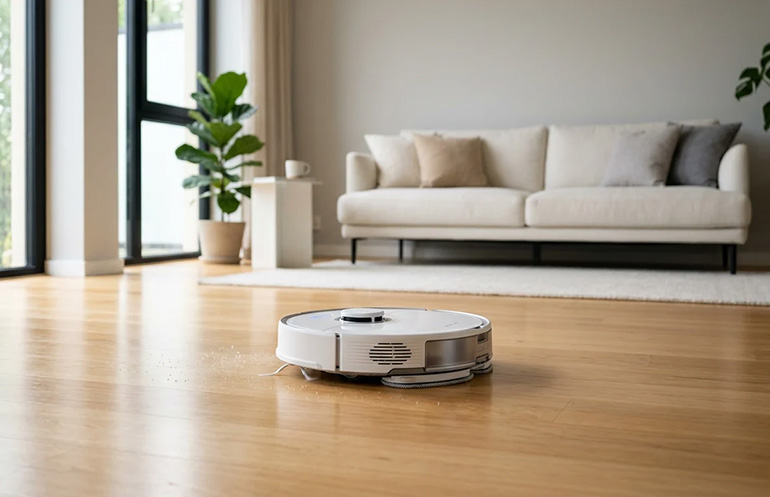
Narwal Robotics is positioning itself for an initial public offering after spending roughly a decade developing household cleaning robots, according to executives interviewed by The Robot Report. The company’s strategy reflects both the promise and the difficulty of consumer robotics: building a machine that can vacuum and mop is only part of the challenge; making it sufficiently reliable, automated and affordable for daily household use is the harder test.
Narwal makes robots that vacuum and mop. Its leaders say the company has pursued what they describe as embodied intelligence as it tries to move home robots beyond an early-adopter phase and toward broader consumer adoption.
A difficult market to scale
Household robotics has long faced high barriers in research and development, supply chains and algorithms, Narwal founder and chief executive Junbin Zhang said. He described an early period in which the company spent three years on research and development without revenue, iterating the structure of a self-cleaning mop more than 10 times.
That experience highlights why seemingly narrow household tasks can become complex robotics problems. A robot that washes its own mop needs to locate and return to its base station precisely and repeatedly. Narwal said such capabilities demanded positioning algorithms that were not mature in the industry when the company began developing them.
Manufacturing was another constraint. The company said contract manufacturers were initially reluctant to work with it because of complex product structures and low early volumes. For a consumer device maker, technical capability is not enough: products must also be made at scale, at predictable quality and at a price that can compete with established home appliances.
Automation is becoming the product
Narwal argues that competition in household cleaning has shifted away from simply adding hardware specifications. The more important measure, it says, is a low-intervention cleaning experience that requires less work from the owner.
The company points to overseas household needs including deep carpet cleaning and pet-hair management. Narwal said it developed a carpet-cleaning module that can lift the mop and increase suction, claiming a 40% to 50% improvement in carpet-cleaning performance compared with traditional models. It also cited its DualFlow tangle-free system as an effort to address pet hair.
These claims are company assertions, but they describe the direction of the category: consumer robots are being judged increasingly on how well they handle real homes without constant rescue, maintenance or manual switching between modes.
Industry change creates an opening
Narwal’s IPO ambition comes as the household-robotics market is being reshaped. iRobot, identified in the report as an early pioneer, entered bankruptcy proceedings late in 2025 and has since emerged with a new owner. Narwal sees an opportunity to expand as the market looks for products that combine cleaning automation with dependable operation.
The company has offices in Shenzhen, China, and Covina, California. Its leaders said it has tested 30 technical approaches to self-cleaning robotic mops and built supply-chain capabilities intended to preserve cost control.
For consumers, the competitive question will remain simple: does the robot save enough time and effort to justify its cost and the space taken by its charging and cleaning base? For manufacturers, answering that question requires a much broader stack of capabilities, from navigation software and mechanical design to parts sourcing, testing and service.
Narwal’s planned IPO is therefore more than a financing milestone. It is a bet that household robots are approaching a stage where dependable automation, rather than novelty alone, can support a larger and more durable market.
This article is based on reporting by The Robot Report. Read the original article.
Originally published on therobotreport.com