Robot delivery becomes a developer platform
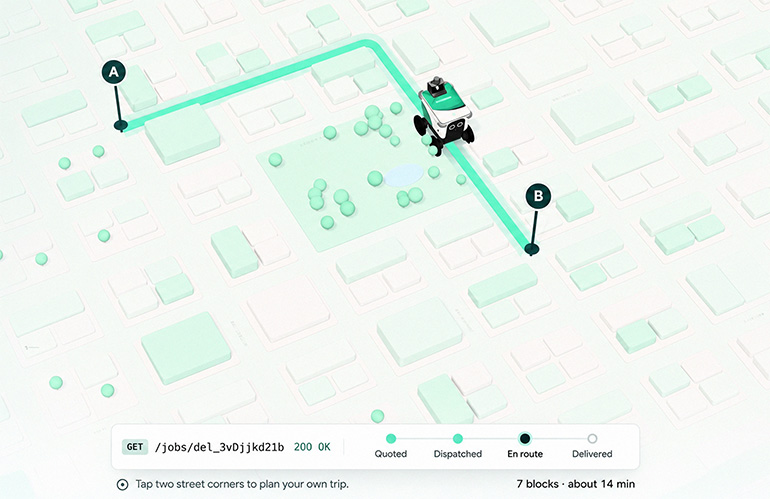
Serve Robotics has opened access to its autonomous sidewalk delivery fleet through a public application programming interface, or API. The company says the new AV Delivery Developer Portal will allow developers, businesses, hobbyists and AI assistants to programmatically request deliveries from its robots.
The launch shifts the company’s delivery machines from a service accessed primarily through third-party delivery platforms toward infrastructure that outside organizations can build on. Serve has also released a sandbox environment where developers can build and test applications before using live robots.
For autonomous delivery, the change is significant because it moves beyond a single consumer ordering flow. A business could potentially incorporate a delivery robot into its own workflow, while a software developer could add physical delivery requests to an existing application. Serve says robots can be dispatched with a few lines of code or through an AI agent.
From delivery partner to programmable fleet
Serve Robotics was spun out of Uber in 2021 and designs and operates robots intended to navigate complex, human-centered environments. The company says it has deployed more than 2,000 robots across the United States and Australia, reaching about 3 million people and supporting delivery for more than 4,000 restaurants.
Until this launch, Serve said its robots had been available through third-party delivery partners. The developer portal is designed to expand that access to organizations with needs outside the traditional restaurant delivery model.
The company highlighted several potential uses. Local businesses could extend their delivery footprint without adding staff. Businesses could move goods between offices. Developers could integrate robot dispatch into applications, and AI assistants could be given a way to initiate a task in the physical world.
Those are possibilities enabled by access to the fleet, rather than evidence that each use case is already operating at scale. The practical success of the platform will depend on where robots are available, how well integrations work, and whether individual businesses find the service affordable and useful.

Why APIs matter for physical AI
APIs are common in digital services because they let one software system request actions from another. Applying that model to delivery robots creates a bridge between software and a physical operation: an application can request that an autonomous machine carry goods through a neighborhood.
That does not eliminate the complexity of robotic delivery. The fleet must still safely navigate public and private environments, and service availability must align with the locations and operating conditions of a request. But the API lowers the barrier for organizations that want to experiment with a robot-enabled service without creating a robotics company from scratch.
Serve’s chief executive and co-founder, Ali Kashani, framed the opening as an opportunity for people living and working in neighborhoods to develop uses the company itself may not have anticipated. The strategy treats its delivery fleet as a shared operational layer on which others can create services.
An expansion following other openings
The company says its systems have completed hundreds of thousands of deliveries across more than 150 neighborhoods in 20 U.S. cities. Earlier in the year, Serve acquired hospital service robot provider Diligent Robotics. It also launched Serve Physical AI Services last week, opening its technology to companies developing other types of robots.
Together, those moves point to a broader effort to position Serve’s experience in real-world robot operations as a platform. The delivery portal focuses on access to an existing fleet, while the Physical AI Services initiative addresses companies building new robotic systems.
The distinction matters. A fleet API provides an immediate, bounded capability: organizations can request work from robots already in operation. Services for robot builders aim at a different layer of the market, where companies need technology and operational support for their own machines.

The test is whether new services follow
The announcement provides the interface and testing environment, but the next question is what developers and businesses build with them. Delivery networks have typically been organized around large consumer platforms. A public robot-delivery API could encourage more specialized services, including local logistics tools or software that connects autonomous delivery to internal business processes.
Serve’s approach also offers a concrete example of how AI assistants could move from answering questions and handling digital tasks to initiating services in the physical world. The article describes this as an available capability, not as an account of particular agents already making deliveries independently.
For the robotics industry, the launch is a bet that the value of a delivery fleet can increase when outside developers can use it. Its outcome will depend on adoption, operational reliability and the range of applications that emerge from the new access.
- Serve Robotics launched the AV Delivery Developer Portal and a testing sandbox.
- The company says its fleet includes more than 2,000 robots across the U.S. and Australia.
- The API is intended to let outside developers and businesses programmatically request robot deliveries.
This article is based on reporting by The Robot Report. Read the original article.
Originally published on therobotreport.com