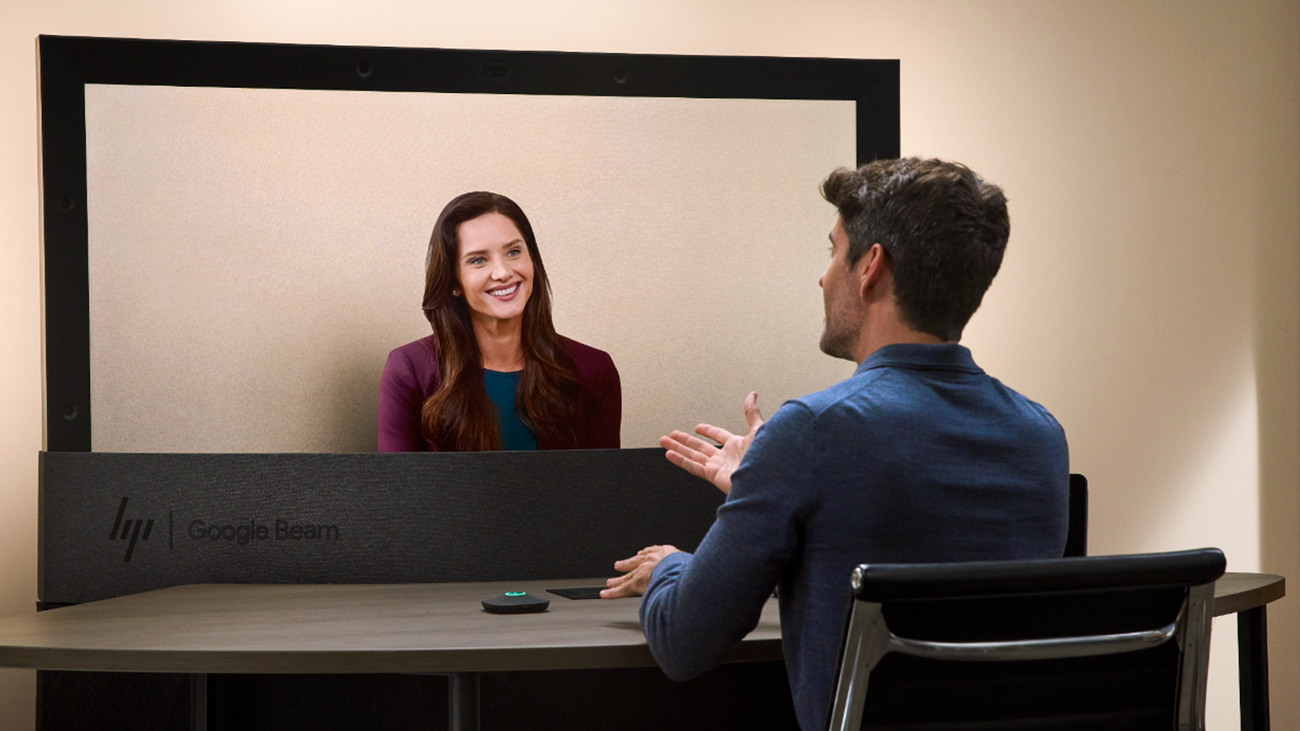
Google is expanding Google Beam, its hardware-based video communication system designed to make remote conversations feel more like in-person meetings. The company says Beam units are now shipping to customers across six countries, supported by 18 channel partners, and that an extended network with workplace provider Industrious will give more people a chance to try the technology.
The announcement is less about another conventional videoconferencing application than about the infrastructure needed to make immersive communication usable outside a small number of early adopters. Beam relies on specialized hardware to create a stronger sense that the person on the other end of a call is present in the room. Google’s expansion suggests it is testing whether that experience can move from a limited showcase into a distributed business product.
From early trials to a broader network
Google says Beam is expanding its footprint to six countries and is supported by 18 channel partners. The company also identifies HP as a source of new hardware for the platform. Together, those details point to an effort to develop a commercial ecosystem rather than operate Beam only as a Google-managed installation.
That matters because specialized communications hardware is difficult to scale through software distribution alone. Organizations need equipment, physical space, installation, maintenance and a clear reason to reserve the room. Partners can help address those operational requirements in regions where Google does not directly manage deployments.
Google has also partnered with Industrious on what it calls its first extended network. Starting in October, prospective users can book and test Beam units at selected Industrious locations. That model can lower the barrier for companies that are curious about immersive meetings but are not ready to purchase or deploy dedicated equipment themselves.

Google’s case for immersive meetings
The company frames Beam around a simple goal: helping people experience a more genuine face-to-face connection despite distance. It says internal testing found that Beam improved team connection and reduced the need for follow-up meetings. Google also says early users have included Netflix and Bain, which have used the technology for remote interviews.
Those results should be read as Google’s own reported findings, rather than an independent comparison of all meeting technologies. Even so, they identify the business problem Beam is trying to solve. Standard video calls make remote work possible, but they can leave participants with less of the body language, eye contact and conversational ease present in a shared room. When communication is less clear, teams may compensate with more meetings, more written follow-ups or slower decisions.
Beam’s proposition is that purpose-built hardware can improve the quality of the interaction itself. Instead of treating every call as a small image on a laptop screen, the system aims to make the remote participant feel more physically present. That is an ambitious claim, but it aligns with a segment of the collaboration market that sees spatial and visual fidelity as a way to reduce the friction of distributed work.
Why the workspace partnership is important
The Industrious arrangement is one of the most practical parts of the expansion. Shared workspaces are already used by distributed companies, traveling employees and organizations with smaller office footprints. Placing Beam units in those locations allows a team to access the technology when it is valuable without requiring a permanent installation in every office.
It also turns the network into a testing ground. Companies can schedule a session, experience the format directly and decide whether the perceived benefits justify a dedicated deployment. That is likely more useful than evaluating the concept from a product video, since the product’s value rests heavily on how natural a conversation feels in person.
For Industrious, the units could make selected locations more distinctive for teams that need high-quality interview rooms or executive collaboration space. For Google, the partnership provides a route to demonstrations and utilization beyond its own offices and existing customers.

A measured expansion, not mass-market rollout
Google’s update indicates wider availability, but it does not describe Beam as a consumer product or a replacement for ordinary video calls. Its special hardware, channel-partner model and selected workspace rollout all suggest a product aimed first at organizations with recurring, high-value remote interactions.
That positioning is sensible. Most routine meetings do not need specialized facilities, and software conferencing remains far easier to use spontaneously. Beam is more likely to be evaluated for situations where communication quality carries unusual weight: interviews, client discussions, leadership meetings and collaboration among teams separated by long distances.
The company’s next challenge is demonstrating that the improved sense of connection persists across varied workplaces and is worth the cost and complexity of dedicated hardware. Its six-country rollout, partner base and Industrious network are steps toward answering that question in real settings.
For now, the expansion shows that Google is pursuing immersive video communication as a physical service network as much as a technology feature. If businesses find that Beam consistently reduces follow-up work and improves remote interaction, that network approach may become central to how the product reaches teams beyond Google’s earliest users.
This article is based on reporting by Google AI Blog. Read the original article.
Originally published on blog.google