A 24-hour test in a working convenience store
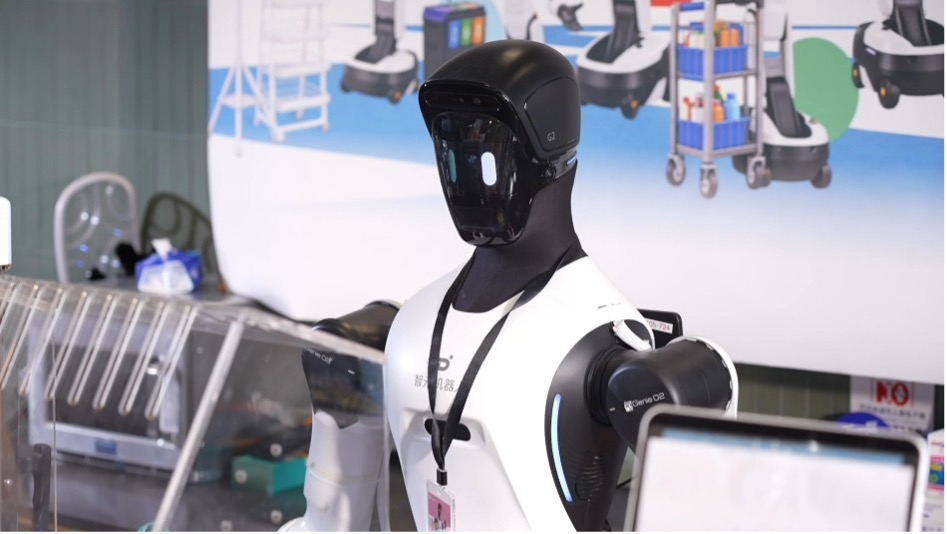
Six AGIBOT G2 wheeled humanoid robots completed a combined 1,730 tasks during a 24-hour trial at an operating convenience store in Shanghai’s Xuhui District, according to AGIBOT’s technology showcase report. The trial ran from 10 a.m. on November 2 to 10 a.m. on November 3, placing the robots in a live customer-facing setting rather than a short, controlled demonstration.
The event was livestreamed to more than two million viewers across online platforms. Four of the six robots passed the final performance assessment. The result is notable less as a declaration that retail automation has been solved than as a detailed example of how a group of embodied AI systems was tested over a full operating day with varied duties and changing demand.
The store trial concluded AGIBOT’s AI WAVE technology showcase, which began on October 22. The company said the broader program included releases involving robotics data, simulation, AI models, hardware and operational software. The convenience-store deployment was intended to bring those elements together in one setting.
What the robots did
The six robots divided work across customer assistance, shelf inspection, restocking, coffee preparation, checkout and hot-food service, and cleaning. Their recorded task total included customer interactions as well as physical work in the store.
- 683 customer-service interactions
- 369 product pickups and deliveries
- 147 coffee orders
- 126 breakfast servings
- 277 shelf-inspection and restocking tasks
- 128 table-cleaning tasks
Those categories illustrate the breadth of the test. It was not limited to moving goods through a back room or greeting customers at an entrance. The robots were asked to work among retail shelves, products, orders and people while participating in several different parts of store operations.
The figures are combined totals for all six machines, so they should not be interpreted as a performance result for a single robot. Nor do the reported totals establish how much human supervision each task required. They do, however, show the scale of the workload used in the trial and the kinds of activities AGIBOT selected for assessment.
Testing beyond a staged demonstration
The trial covered four operating periods: a lunchtime rush, evening peak hours, overnight operations and the following morning’s breakfast rush. Each period imposed different demands. Busy hours created more customer requests, while overnight operation shifted attention toward maintaining the store environment and its routine tasks.
AGIBOT said the robots were evaluated on time on duty, task completion, customer feedback, response times and their ability to deal with unexpected situations. Two evaluators also conducted practical rounds based on conditions the machines might encounter while serving customers.
One test involved ordering regular and sugar-free Coca-Cola, checking whether a robot could distinguish between similar-looking products. In another, evaluators rearranged chewing-gum packs and asked robots to return them to their correct positions. A third test blocked an aisle with a person and a box to assess whether the robots could identify the obstruction and navigate around it.
These examples matter because retail work is full of small variations. A robot must do more than recognize a product in an orderly display; it must distinguish similar items, respond when a shelf no longer matches an expected arrangement and operate safely when a route is obstructed. The source report does not provide individual scores for each robot or detailed results for every challenge, but it says four machines met the final assessment criteria and two did not meet all of them.
What the result does—and does not—show
The trial provides a snapshot of a multi-robot retail deployment under a defined set of conditions. It suggests that wheeled humanoid systems can be assigned a wide mix of service and store-maintenance tasks over an extended period. It also shows that evaluation included failures or shortfalls: one-third of the participating robots did not pass the final assessment.
That distinction is important. A 24-hour run and a large task count are useful operational markers, but they are not by themselves a measure of commercial readiness across retail. The report does not state the economics of the deployment, the level of human support, the criteria needed to pass, or whether the trial will lead to permanent use in the Shanghai store.
Still, the design of the trial points toward a practical direction for embodied AI: testing systems where work changes by the hour and where a machine must combine perception, navigation, product handling and customer interaction. Rather than measuring a single polished capability, AGIBOT’s event attempted to assess whether several robots could sustain a collection of ordinary store duties across a day and night.
For now, the most concrete outcome is the reported record: six robots, 1,730 combined tasks, a livestreamed 24-hour operation and four passing machines. Future deployments will determine whether such trials can be repeated with consistent performance in more stores and over longer periods.
This article is based on reporting by The Robot Report. Read the original article.
Originally published on therobotreport.com