Building a broader data foundation for robots
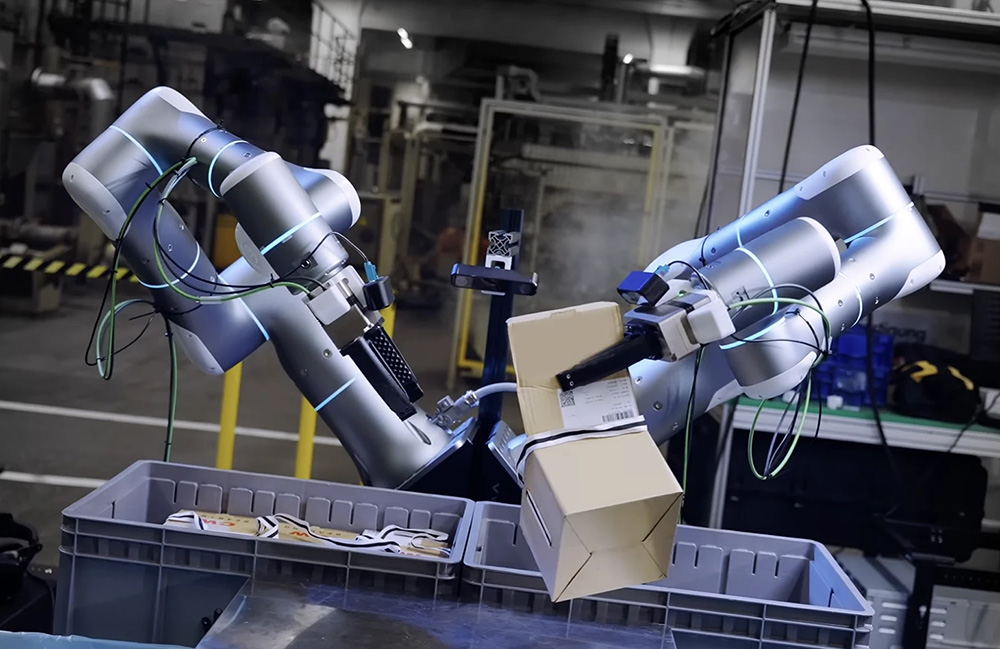
Rhoda AI is pursuing a simple but ambitious premise: robots need a far larger and more varied source of training data if they are to work reliably outside carefully controlled demonstrations. The company is using internet-scale video to build models intended to understand motion, physics and physical interaction, then applying that prior to robotics.
Rhoda emerged from 18 months in stealth earlier in 2026 with $450 million in Series A funding. It says it is working with customers in automotive, manufacturing, logistics and e-commerce to deploy its direct video action, or DVA, model.
The challenge it is addressing is familiar across robotics. A machine can perform an impressive task in a lab, but real deployments are full of variation: objects arrive in different positions, workspaces change, and each run can unfold differently. Rhoda co-founder and CEO Jagdeep Singh said that dealing with this messiness requires robust models, and that robustness requires a massive training dataset.
Why video is central to the approach
Large language models advanced rapidly in part because they could learn from a vast amount of text. Robotics has not had an equivalent internet-scale data source for physical interaction. Singh contrasted that abundance of language data with the much narrower data available for robots.
Historically, developers have attempted to collect robot data through teleoperation: people control robots while the systems record demonstrations. That approach can produce compelling examples, such as robots folding T-shirts or making coffee. But Rhoda argues that demonstrations alone have not supplied the volume and variety needed for robust autonomous manipulation in real-world settings.
Rhoda’s bet is that video can help close the gap. Video contains examples of motion, object interaction and changing scenes at a scale that is difficult to reproduce solely through bespoke robot-data collection. The company pretrains its models on video before adapting them for robotic use.
How direct video action works
Many physical-AI developers are working on vision-language-action, or VLA, models. Those systems use images or video of a robot’s surroundings along with text instructions. Rhoda says its DVA model is designed around a related but distinct sequence: it takes a history of video frames, action tokens and language tokens, predicts a near-term video scene, then converts that prediction into robot actions.
In Singh’s description, the model forecasts what it expects to happen in the scene over the next few hundred milliseconds, or about the next half second. A second component, the action converter, takes that predicted scene and produces actions for the robot.
The design is meant to make video prediction an intermediate representation of the robot’s next move. Instead of mapping a perception-and-language input directly to a command, the system first models the likely physical continuation of the situation and then translates it into an action space the robot can execute.
Joining mobility and manipulation
Rhoda recently extended the approach with mobile DVA, which it says combines manipulation and mobility in one policy. That matters for use cases where a robot must both move through a facility and interact with objects, rather than operate from a fixed position.
Automotive, manufacturing, logistics and e-commerce environments are natural targets for such systems because they contain repetitive tasks but also substantial day-to-day variation. A model able to handle different configurations could be more useful than one built around a tightly scripted setup.
Rhoda’s claims should be read as an account of its technical strategy and deployment ambitions, not as independently established proof that generalized robotics has been solved. The company itself frames real-world variability as the defining problem. That means actual performance will depend on how models behave across changing environments, objects and operating conditions.
The broader robotics question
The company’s approach reflects a wider shift in robotics toward foundation-model-style training. The goal is to create a reusable prior from broad data, then use it to make task-specific systems more adaptable. In this case, the foundational material is video of physical activity rather than text.
That strategy has appeal because physical systems must contend with details that are easy to overlook in a demonstration. Lighting changes, objects shift, surfaces differ, and the same action may require a slightly different response each time. A model that has absorbed a wide range of visual examples of movement and interaction could, in principle, begin with a stronger expectation of what is physically plausible.
Whether that expectation translates into dependable robots will be the practical test. Rhoda is positioning DVA as a way to turn large-scale video understanding into useful action in factories, warehouses and other operational environments. Its progress will be measured not by a single polished demonstration, but by whether robots can keep performing when the world refuses to repeat itself exactly.
This article is based on reporting by The Robot Report. Read the original article.
Originally published on therobotreport.com