The Automation Exploration Problem
Manufacturers of all sizes recognize that automation can help solve labor shortages, increase throughput and quality, reduce waste, and deliver more consistent output. Yet the journey from recognizing that potential to actually deploying a robotic cell is often intimidating. The market is crowded with thousands of industrial robots in countless shapes and sizes, from a wide variety of brands, alongside thousands of end effectors and peripherals. Combine those options with different layouts, safety requirements, and integration needs, and the number of possible configurations becomes almost infinite.
For a company new to automation, the questions pile up quickly. What robot size and peripherals are needed? How much floor space will the cell occupy? Will throughput justify the investment? How well will the new system integrate with existing machinery? Is there a risk of becoming locked into a single vendor? How long will the return on investment take? Answering these questions with static drawings, CAD layouts, or spreadsheets is possible, but those tools do not reveal how a robotic system will actually behave in practice.
Why Digital Twins Matter Now
Macroeconomic conditions are making capital decisions more difficult. Global economic uncertainty and rising energy input costs are weighing on manufacturers. Sentiment and investor morale have dipped in several key markets, and many companies are subjecting new capital expenditures to greater scrutiny. In this environment, the temptation is to postpone automation projects until conditions feel more predictable. But uncertainty does not have to mean standing still.
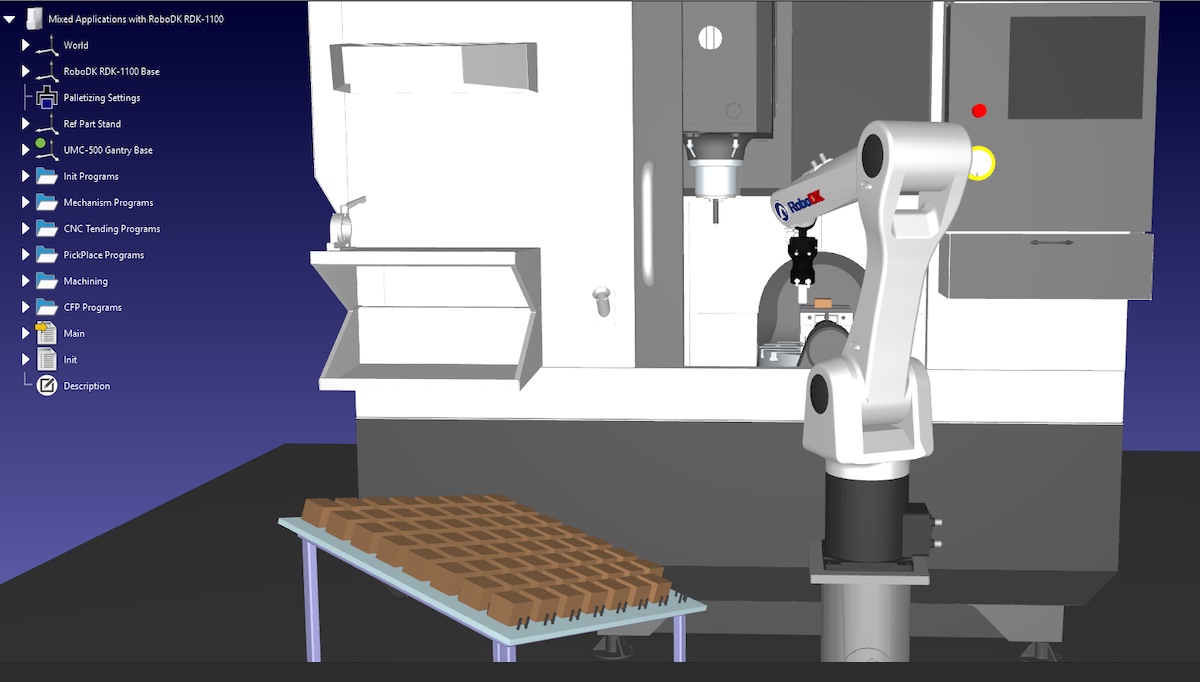
Digital twin software offers a way to de-risk early exploration. Instead of committing capital upfront, manufacturers can build a virtual model of a proposed robotic cell and test it under realistic conditions. The digital twin acts as a dynamic simulation that improves on static representations. It allows companies to compare robots and layouts, test peripherals, refine robot base positions, explore guarding layouts, model part flow, and consider operator access before any physical equipment is purchased.
This approach is especially valuable for first-time automation buyers. It also complements the work of systems integrators. While a digital twin does not necessarily replace a systems integrator, it can help manufacturers evaluate robots and plan applications more effectively before an integrator is brought in or before internal implementation begins.

What a Digital Twin Can Show You
A digital twin is a virtual model of a complete robotic cell. It can include the robot, end-of-arm tooling, fixtures, conveyors, sensors, operators, and surrounding equipment. Rather than relying on assumptions and sketches, the digital twin demonstrates how the system will actually function. This insight can be broken into several key areas.
Reach, Trajectories, and Cycle Times
One of the first things a digital twin can verify is whether the robot will reach all required positions. This may seem basic, but reach issues often emerge only after installation. Digital twin software lets users test trajectories and toolpaths in advance, refining base positions and orientation to ensure the robot can access every point in the work envelope.
Cycle time estimation is another major benefit. By simulating the actual motion of the robot, including acceleration, deceleration, and auxiliary actions, manufacturers can estimate how long each production cycle will take. This information directly feeds into throughput calculations and helps validate whether the automation investment will meet production targets.
Collision Risks and Maintenance Access
Digital twins can identify collision risks before they become real-world problems. By modeling the full cell, including fixtures, conveyors, and operators, the software can highlight potential interference between the robot and surrounding equipment. This allows engineers to redesign layouts and adjust workcell geometry during the planning phase.
Operator access and maintenance clearance are equally important. A cell that functions well in theory but cannot be safely serviced will cause downtime and frustration. Digital twin software helps evaluate how easily operators can load parts, unload finished components, and reach critical components for routine maintenance.
Application Templates for Starting Points
Some digital twin platforms include application templates designed to give companies a head start. These are especially useful when a manufacturer knows the task it wants to automate—such as palletizing, welding, or machine tending—but is unsure which robot, gripper, or layout will work best. Templates provide a proven starting point that can be customized using the manufacturer's own part dimensions, production rates, and floor space constraints.
Digital Twin Platforms Like RoboDK
RoboDK is an example of digital twin and offline programming software that supports this early exploration. The platform allows users to test robots from more than 1,400 brands, making it possible to compare different makes and models without purchasing any hardware. This breadth of choice is important because manufacturers do not want to find themselves locked into a single vendor or a suboptimal robot after capital has already been committed.
By simulating a wide range of robots in one environment, manufacturers can identify the best fit for their application. They can evaluate reach, payload, speed, and compatibility with different end effectors. The result is a more informed selection process that reduces the risk of costly mistakes.
Practical Steps for Getting Started
- Start with a clear definition of the task, including part dimensions, cycle time expectations, and required throughput.
- Use a digital twin to test multiple robot brands and sizes before narrowing down to a shortlist.
- Model the full cell layout, including conveyors, fixtures, guarding, and operator access, to uncover potential issues early.
- Estimate cycle times and compare them against production targets to validate the business case.
- Refine robot base positions and trajectories iteratively to minimize floor space and maximize efficiency.
- Involve operators and maintenance staff in the virtual design review to capture ergonomic and serviceability concerns.
- Once the digital twin is refined, share the simulation with a systems integrator or use it as the basis for internal implementation.
Turning Uncertainty into Informed Action
The current economic climate may make capital expenditures feel riskier, but refusing to act because of uncertainty can be an even greater competitive risk. Automation remains a powerful response to labor challenges, quality requirements, and cost pressures. Digital twin software gives manufacturers a low-cost way to explore options, compare alternatives, and validate plans before binding financial commitments are made.
For companies that are new to automation, the ability to test and refine a concept virtually is a game changer. It turns a daunting decision into a structured engineering exercise. The insights gained from a digital twin can shorten the integration timeline, reduce change orders, and improve the likelihood that the final installation meets performance expectations.
Ultimately, digital twins are not just a design tool. They are a strategic enabler that allows manufacturers to move forward with confidence. By exploring automation in a virtual environment, organizations can commit capital only when they have a clear picture of what will work, how much it will cost, and what return it will generate.
This article is based on reporting by The Robot Report. Read the original article.

Originally published on therobotreport.com