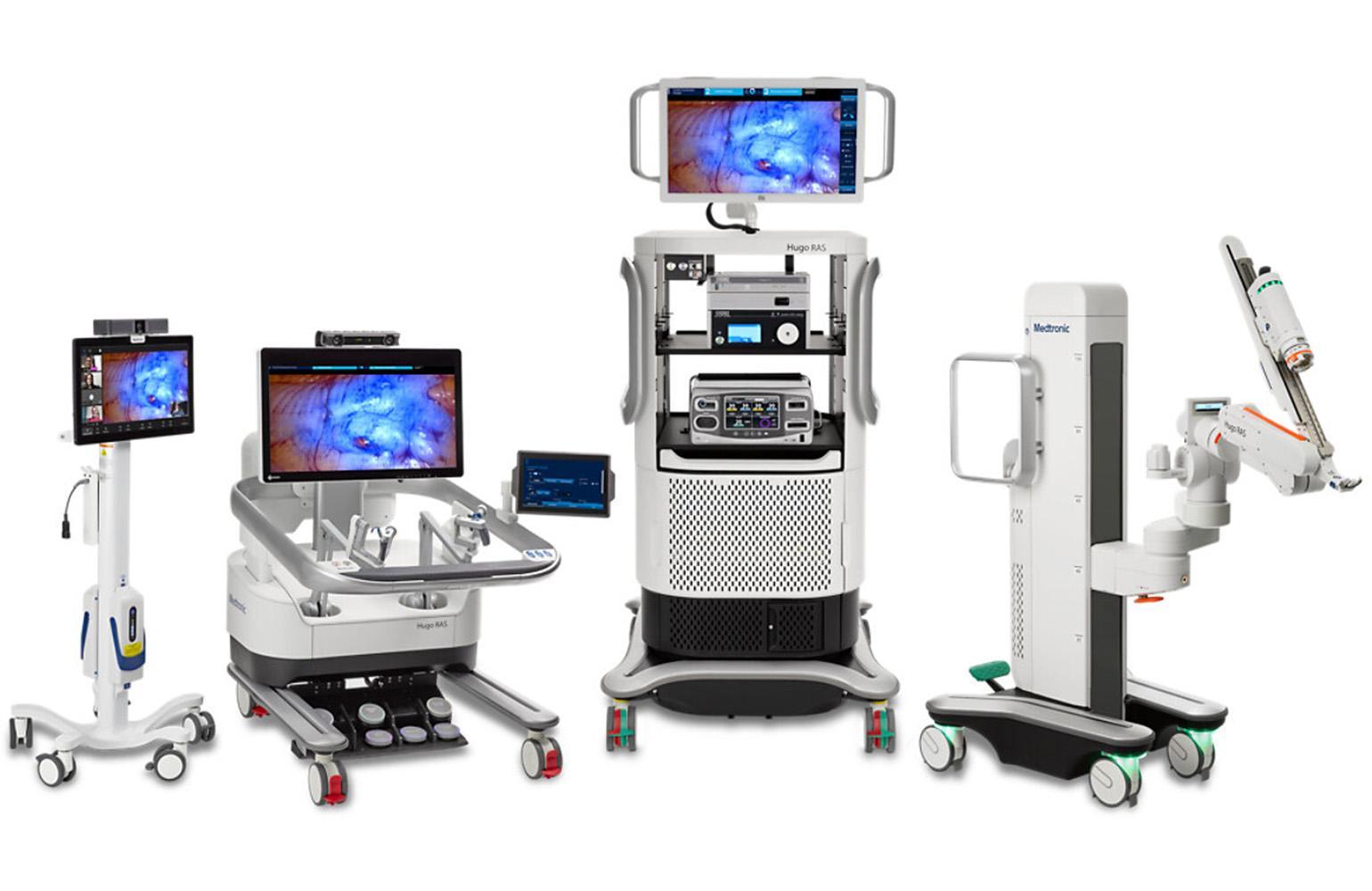
Medtronic’s Hugo robotic-assisted surgery system has received U.S. Food and Drug Administration clearance for general surgery procedures, expanding the company’s position in a market long dominated by established surgical-robot platforms.
The clearance allows the cart-based, modular system to be used across a range of abdominal operations. Medtronic said the authorized upper-abdominal procedures include cholecystectomy, Roux-en-Y gastric bypass, ventral hernia repair and small-bowel resection. The FDA also cleared lower-abdominal procedures for inguinal hernia and appendectomy.
Together, those procedures represent about 3.5 million surgeries a year in the United States, according to Medtronic. The decision therefore broadens Hugo’s potential use well beyond the urology indication that marked its earlier U.S. entry.
A larger addressable market for Hugo
General surgery is a consequential expansion because it covers procedures performed at high volume across hospitals and ambulatory surgical settings. For Medtronic, the authorization creates an opportunity to offer Hugo to facilities seeking robotic capability for multiple kinds of abdominal operations rather than a narrower specialty use.
Hugo is designed as a modular system, with individual robotic arms mounted on separate carts. Surgeons can use the number of arms needed for a given operation, rather than relying on a fixed-arm configuration. Medtronic says that approach can provide flexibility in port placement and access, particularly in procedures that require work in more than one part of the abdomen.
Rajit Kamal, Medtronic’s general manager of robotic surgical technologies, told The Robot Report that the company had begun its U.S. commercial journey in February of the previous year and had placed the system at leading hospitals under its urology indication. General-surgery clearance, he said, opens additional opportunities for Hugo and for Medtronic’s broader offerings in service, training, support and digital surgical tools.
The clearance does not mean every operation within those categories will be performed robotically, nor does it settle questions about which platform is best for a particular patient or hospital. Surgical approaches remain dependent on clinical judgment, training, institutional resources and the specifics of each case. But it gives hospitals and surgeons a new FDA-cleared option in a much broader procedural field.

Building on experience outside the United States
Medtronic had already received CE marking for Hugo in general surgery in Europe in 2022. That international experience supplied clinical information used in its U.S. submission, according to the company.
General surgery has become Hugo’s fastest-growing procedural mix outside the United States, Kamal said. Medtronic attributes that growth in part to the system’s modular design and to the company’s longstanding presence in open and laparoscopic surgery. The company said its technologies in those areas have been used for more than 50 years.
The international record is relevant because surgical robotics depends on more than regulatory authorization. Hospitals need trained teams, operating-room workflows, instruments, technical support and evidence that a system can be integrated into routine care. Experience in other markets can inform those operational steps, although U.S. adoption will still depend on local purchasing and implementation decisions.
Medtronic says Hugo is on track to surpass 50,000 cumulative procedures globally by the end of its fiscal year. That total spans the system’s approved uses in markets where it is available and is not limited to the newly cleared U.S. general-surgery procedures.
From urology to abdominal procedures
The FDA had previously cleared Hugo for urology in December 2025. Urology is a familiar entry point for robotic surgery systems, but the new clearance reaches a different and substantially wider set of common operations.
Medtronic also conducted a U.S. clinical study of Hugo for hernia repair. In September 2025, the company said that study had met its safety and effectiveness endpoints. Around the same time, it received an investigational device exemption to run a U.S. clinical trial for general surgery.
According to Kamal, Medtronic used two routes in pursuing the general-surgery clearance: a U.S. clinical trial conducted under the FDA process and clinical experience from use outside the country. The company’s ability to point to both kinds of evidence reflects a common pattern in medical-device development, in which regulatory submissions bring together trial data, prior clinical use and engineering information appropriate to the device and indication.

Competition and hospital choice
The announcement is significant less because it introduces robotic surgery to general surgery for the first time than because it adds a major competitor to the U.S. market for those operations. Robotic surgery is already an established part of care in many hospitals, particularly for minimally invasive procedures. A new broad indication can increase the number of systems that hospitals evaluate when replacing equipment, adding capacity or standardizing surgical programs.
Medtronic’s pitch centers on modularity and on combining the robot with related products and services. For a hospital, however, the practical calculation is wider: capital spending, instrument availability, staffing, surgeon preferences, clinical training, maintenance and operating-room scheduling can all influence whether an FDA-cleared platform is adopted.
That makes regulatory clearance an important threshold rather than the final commercial outcome. The decision lets Medtronic market Hugo for the covered procedures in the United States, but adoption will develop hospital by hospital and specialty team by specialty team.
What the clearance changes now
The immediate change is straightforward. Hugo can now be used in the United States for the cleared upper- and lower-abdominal general-surgery procedures, alongside its existing urology indication. Medtronic can pursue a broader set of customers and make a case that one system may support more of a hospital’s surgical activity.
For the wider robotics sector, the move underscores where competition is heading: not simply toward placing robots in operating rooms, but toward securing indications that allow those systems to be used frequently across multiple surgical services. In that environment, procedural breadth, training infrastructure and reliable integration into hospital workflows may be as important as the hardware itself.
Hugo’s latest clearance gives Medtronic the regulatory room to test that proposition in one of U.S. surgery’s largest procedural markets.
This article is based on reporting by The Robot Report. Read the original article.

Originally published on therobotreport.com