A major robotics advocate leaves Nvidia
Robotics is entering a period of uncertainty after Nvidia’s board accepted the resignation of co-founder Jensen Huang on November 12. Colette Kress, Nvidia’s chief financial officer, is serving as interim chief executive while the company searches for a permanent successor.
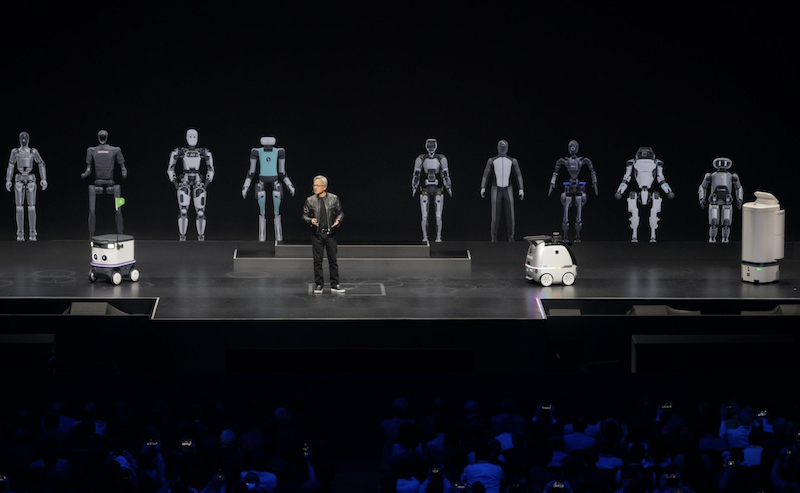
For years, Huang used Nvidia’s visibility, technical platforms and capital to elevate robotics. His long keynote presentations routinely included robots, humanoid demonstrations, development tools, research and startups. He argued that robots would transform the world, making the field a recurring part of Nvidia’s larger story about accelerated computing and AI.
That advocacy was meaningful for an industry that has often struggled to secure sustained mainstream attention. Huang could place robotics before one of technology’s largest audiences even when the sector’s near-term contribution to Nvidia’s business was comparatively small.
More than keynote visibility
Huang’s role was not limited to public presentations. He also backed the sector financially. Serve Robotics co-founder and chief executive Ali Kashani recalled that the sidewalk delivery-robot company was close to bankruptcy in late 2023 after a major investor withdrew from a committed funding round.
According to Kashani, the company was days from running out of cash and unable to make payroll. He contacted Huang, spoke with him the following morning and had dinner with Nvidia’s executive team later that day to find a way to bridge the company. Nvidia then led a financing round that helped bring Serve back from the brink.
Four months later, Serve Robotics rang the Nasdaq bell to mark its public listing. Kashani said he had heard similar stories from founders and current and former Nvidia employees whose lives Huang had changed.
The episode captures why Huang’s departure is significant for robotics: he was not only a prominent messenger for the field, but also someone capable of bringing Nvidia’s resources to bear on a company at a decisive moment.
Robotics was central to a long-term vision
Yaro Tenzer, co-founder and chief executive of RightHand Robotics, said Huang was particularly effective at presenting a broad vision for the industry. In Tenzer’s view, Huang helped expand investors’ ideas about what robotics could become.
Nvidia introduced its Isaac robotics platform in 2017 and continued to keep robotics in its keynotes and long-term planning. The company has used its computing and software capabilities to support a vision often described as physical AI: systems that bring AI into machines operating in the physical world.
That category is wider than robotics alone, but it has become a substantial and fast-growing business for Nvidia. During its third-quarter earnings call, the company said physical AI revenue had nearly tripled year over year and was on track to exceed $25 billion in fiscal 2027.
Strong growth, but a limited share of Nvidia’s business
The projected physical-AI figure is substantial, yet it remains a relatively small part of Nvidia’s overall scale. The report says the segment would account for about 6% of Nvidia’s projected annual revenue of more than $400 billion.
That contrast helps explain the distinctive role Huang played. Robotics received attention from Nvidia that was disproportionate to its short-term commercial contribution. For an industry seeking recognition, having a global technology leader repeatedly make the case for robots mattered beyond the direct revenue attached to the business.
Huang’s presentations linked robotics to a larger narrative involving AI models, simulation, hardware and industrial deployment. This gave robotics companies an influential platform at a time when the sector was trying to persuade investors, customers and developers that intelligent machines could become an important technology market.
The challenge after Huang
The immediate question is whether Nvidia’s next leadership team will sustain that commitment with the same consistency. The company’s platforms and physical-AI business remain in place, and the reported revenue growth indicates that the opportunity has not disappeared with Huang’s resignation.
But a leadership change can alter how a company allocates attention, capital and executive time. Robotics companies benefited from Huang’s personal ability to tell a long-range story about their industry, showcase its technologies and connect its ambitions to Nvidia’s larger strategy.
For the sector, the transition is therefore about more than one executive. It is a test of whether the robotics momentum Nvidia helped cultivate has become durable enough to continue without its most visible champion. Nvidia’s future leadership decisions will help determine how prominently robotics remains in the company’s agenda—and how much of the industry’s momentum can be sustained on its own.
This article is based on reporting by The Robot Report. Read the original article.
Originally published on therobotreport.com