Autonomy breaks at the boundaries between subsystems
An autonomous drone may complete a planned inspection route in a controlled setting and still struggle with that same route at a working industrial site. According to an examination of industrial drone deployments, the gap is not explained by one failed component alone. It emerges when multiple sources of uncertainty affect navigation, perception, planning, control and inspection-data collection at the same time.
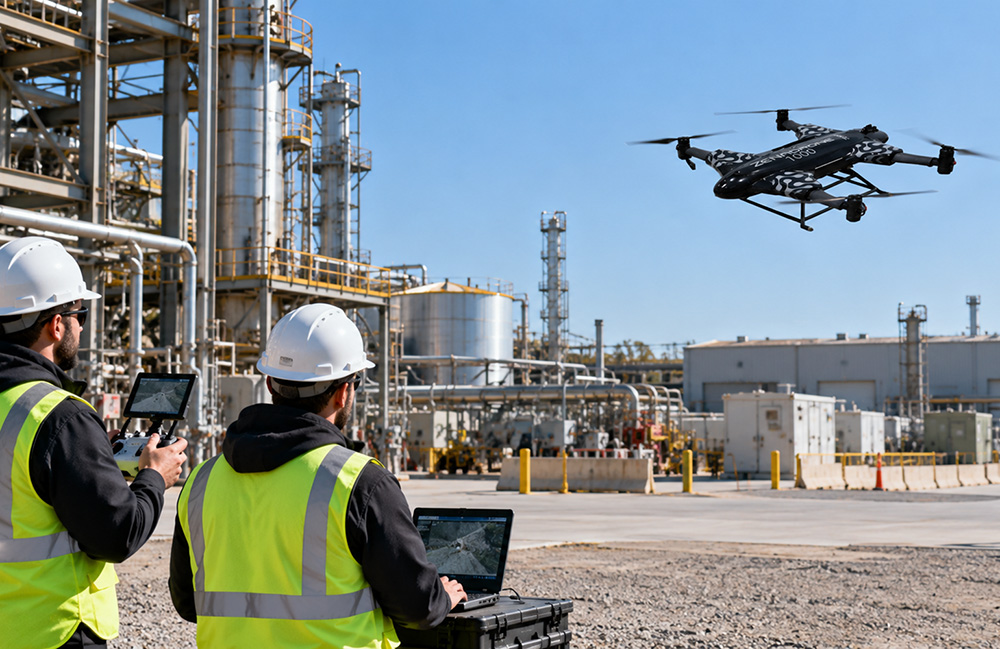
Operating facilities can combine steel structures, reflective equipment, narrow corridors, moving machinery, airborne particles and changing light. A wind gust can push an aircraft off its intended trajectory. Metal can interfere with satellite-navigation signals. Reflective surfaces can distort depth measurements. Each problem may be manageable on its own, but their interaction is the central challenge for real-world autonomy.
The result is a more demanding standard than a successful demonstration. A drone needs not only algorithms that work under favorable conditions, but also an integrated system that can determine whether its information remains trustworthy enough to continue flying.
Industrial settings challenge the usual assumptions
Industrial drone inspection is often discussed as a route-planning task: program a route, fly it repeatedly and collect images or other inspection data. In practice, the route is only one part of the problem. The aircraft must estimate its position, perceive nearby structures, avoid obstacles, maintain stable flight and obtain usable inspection data while conditions change around it.
The analysis describes a hypothetical drone inspecting pipework beside a steel-framed processing facility. As it approaches the structure, global navigation satellite system measurements become less reliable. Repetitive pipes make visual feature matching harder, while reflective surfaces yield inconsistent depth observations. Nearby structures can also create aerodynamic disturbances that the flight controller must reject.
That combination is not merely inaccurate positioning. The system must decide whether its remaining localization confidence supports continued flight, whether apparent free space is reliable, and whether the next planned maneuver is dynamically feasible. These decisions are coupled rather than separate.
Errors can cascade through the autonomy stack
Localization, perception and control are often evaluated as distinct subsystems. A navigation algorithm might estimate position accurately when sensing conditions are favorable. An obstacle detector might identify nearby structures during controlled testing. A flight controller might follow a planned trajectory while carrying a nominal payload.
None of those isolated results proves that a combined system can safely inspect energized infrastructure, confined structures or operating machinery. Industrial deployment requires an understanding of how uncertainty propagates from one function to another.
A localization error can corrupt the coordinates assigned to an obstacle. A delayed perception update can affect the quality of the information used for a maneuver. The drone’s autonomy stack must operate with those dependencies in mind, rather than assume that every component’s inputs remain reliable.
This is why a route that appears routine on a map can become difficult at a live facility. A steel structure affects satellite navigation at the same time that pipes complicate vision and reflective surfaces affect depth sensing. The drone’s controller is then making flight decisions while other parts of the system may be working from degraded estimates.
Reliable behavior requires knowing when not to trust an estimate
The key requirement identified in the analysis is not simply higher nominal accuracy. Engineers also need evidence that a system can recognize when its estimates are no longer dependable.
That capability is consequential because industrial drone autonomy involves decisions under uncertainty. Continuing a route can be reasonable when position, obstacle location and aircraft dynamics remain sufficiently well known. It can become unsafe when the evidence supporting those estimates weakens across several sensors or subsystems.
In this framing, validation must cover more than whether the drone finishes a route. It must address the conditions under which it should change behavior because confidence in localization, perception or maneuver feasibility has degraded. The operating environment is part of the test, not background scenery.
From demonstrations to deployment evidence
The article’s assessment is a useful corrective to the expectation that a strong autonomy demonstration automatically translates into dependable industrial deployment. Facilities introduce conditions that are difficult to reproduce in laboratory tests: metallic surfaces, repetitive geometry, narrow access routes, moving equipment, particulate matter and variable illumination can affect multiple sensors at once.
These conditions create both physical constraints and uncertainty in the data available to the drone. Reliable inspection therefore depends on the integration of GNSS reliability, simultaneous localization and mapping, sensor fusion, obstacle avoidance, flight control and validation.
The practical implication is not that autonomous inspection is impossible. It is that deployment claims need to be tied to integrated evidence. A drone operating around industrial assets must handle uncertainty that passes between systems, not just excel at a set of standalone benchmarks.
The deployment question
For industrial operators, the important question is not only whether an autonomous aircraft can follow a preplanned route. It is whether the vehicle can do so when position estimates weaken, visual cues repeat, depth sensing becomes inconsistent and disturbances push it away from its expected trajectory.
The answer depends on how the whole autonomy stack responds. A system that can detect that its information has become unreliable has a different operational profile from one that simply continues acting on degraded estimates.
As industrial drone use expands, that distinction will shape what counts as credible autonomy. The hardest cases are likely to be those where navigation, perception and control problems arrive together—the ordinary reality of operating around infrastructure rather than the exception of a laboratory test.
This article is based on reporting by The Robot Report. Read the original article.
Originally published on therobotreport.com