XPeng’s robot subsidiary lands one of the largest financings in humanoids
XPeng Motors has pushed deeper into the race to industrialize humanoid robots, announcing that its robotics unit Dogotix raised more than $900 million in an initial funding round. According to The Robot Report, the deal values the company at more than $6.3 billion after the transaction, with a pre-money valuation of $5 billion. The scale of the raise stands out even in a field that has already attracted heavy investment from automakers, venture firms, and major technology backers.
The financing signals that investors increasingly see humanoid robotics not as a distant research project but as a manufacturing and deployment challenge that companies are now willing to fund at scale. Dogotix said it will use the capital to develop hardware and software, collect data, train physical AI models, build mass-production facilities, and expand internationally. Those priorities show how the sector is shifting from proof-of-concept demos toward the infrastructure needed to build and operate fleets of machines in real environments.
From EV maker to AI mobility company
XPeng’s involvement also reflects a broader strategic move by automakers. The company, best known for electric vehicles, has been positioning itself as a full-stack AI mobility player rather than a pure car manufacturer. The report notes that XPeng develops its advanced driver-assistance technology and in-car operating system in-house, and that it released its first robotaxi based on its GX platform in May.
That background matters because the technical overlap between autonomous driving and robotics is part of the investment thesis. Perception systems, planning software, embedded compute, control stacks, simulation, and large-scale data collection are all capabilities that can be shared, at least in part, across vehicles and robots. For companies already spending heavily on autonomy, humanoids can look like an adjacent market where existing software and AI expertise may create an advantage.
Dogotix, founded in 2016 in Shenzhen, will remain an XPeng subsidiary. He Xiaopeng will continue as chief executive of both companies, preserving tight strategic alignment between the automaker and its robotics arm. That structure suggests XPeng does not view Dogotix as a peripheral experiment. It appears to be treating humanoids as part of a wider long-term platform strategy.

The production target is aggressive
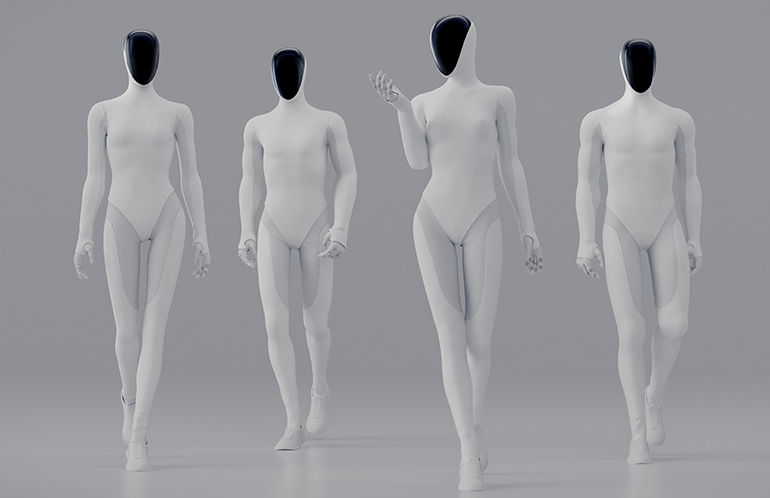
Dogotix’s near-term ambition is unusually explicit. XPeng said it plans to produce 1,000 IRON humanoid robots per month by the end of 2026, with commercial deliveries beginning in 2027. If achieved, that would mark a meaningful move beyond pilot-scale production and into the early stages of industrial output.
The company is targeting retail stores and industrial campuses for the IRON platform. Those settings are a practical choice. They offer structured environments, repeatable tasks, and clearer pathways to measuring labor substitution or augmentation. They also avoid the far more chaotic demands of the open household market, where humanoid robot hype has often outrun technical reality.
Dogotix is not limited to bipeds. The report says the company has also developed quadruped and tracked robots aimed at smart home, logistics, power inspection, and security applications. That portfolio suggests Dogotix is pursuing a broader embodied AI strategy in which different robot forms address different commercial use cases, rather than betting everything on a single humanoid design.
Why investors are leaning in anyway
The economics of the field remain unsettled. Dogotix reported losses in 2024 and 2025, according to the source text, which is not surprising for an early-stage robotics company building capital-intensive systems. Investors appear willing to tolerate those losses because the potential upside is large if a company can reliably mass-produce useful robots and deploy them in volume.
Humanoids have become especially attractive to investors because they promise compatibility with environments already built for people. Warehouses, factories, stores, and campuses are full of stairs, doors, shelves, tools, and workflows designed around the human body. A robot that can navigate those spaces without costly redesign could, in theory, address a broad swath of labor shortages and repetitive work.
That theory is still being tested. Reliable locomotion, dexterous manipulation, battery life, safety, and cost remain hard problems. So do the data requirements for training robots that can generalize beyond tightly scripted tasks. Dogotix’s planned spending priorities reflect those bottlenecks directly: model training, data collection, and factory build-out are not accessories to the business model; they are the business model.

Part of a wider automaker robotics push
XPeng is far from alone. The Robot Report places Dogotix in a growing class of automaker-linked humanoid efforts. Hyundai is testing Boston Dynamics’ Atlas. Tesla is working toward scaling Optimus. BMW Group has deployed Figure AI’s Figure 03 after earlier tests. The pattern is becoming clearer: manufacturers view humanoids as a potentially important extension of industrial automation, especially where conventional fixed robots are too rigid or too specialized.
The attraction is strategic as well as financial. Automakers already operate large factories, manage complex supply chains, and understand precision manufacturing. If humanoids become commercially viable, vehicle companies could be both customers and producers. That dual role could accelerate adoption by giving robot developers internal test beds and immediate industrial use cases.
- Automakers can apply experience in manufacturing at scale.
- Existing autonomy and software teams can feed robotics programs.
- Factories and campuses offer controlled early deployment environments.
Reuters, as cited in the report, said IDG Capital led Dogotix’s funding round, while Gaorong Ventures also participated. XPeng added that the raise set a record for a single private financing in China’s embodied AI sector. Even allowing for the promotional tone that often accompanies funding announcements, the amount itself is substantial evidence that investor appetite remains high.
What the raise says about the humanoid market
The larger significance of the deal is that it shifts the conversation from whether humanoids are attracting capital to what investors now expect in return. Capital on this scale raises the bar. Dogotix will be under pressure to show progress not just in prototypes, but in yield, unit economics, deployment reliability, and customer traction.
That is where the sector will be judged. Humanoid robotics has no shortage of demonstrations, concept videos, or ambitious roadmaps. What it still needs is sustained evidence that machines can perform economically useful work, safely and repeatedly, in settings that matter to customers. XPeng’s new funding gives Dogotix the resources to try to prove that case faster.
For the broader industry, the message is clear: embodied AI is entering a more expensive and more consequential phase. The winners may not be the companies with the most attention, but the ones that can convert software ambition into manufactured systems, trained models, and dependable commercial operations. Dogotix has now bought itself a place in that contest at a very large price.
This article is based on reporting by The Robot Report. Read the original article.

Originally published on therobotreport.com