Google Is Recasting the Free Tier of Gemini
Google is about to make the no-cost version of its Gemini assistant a far narrower proposition. According to a newly published support document reported by ZDNET, anyone using the Gemini app or website without a paid plan will lose access to both the Flash and Pro models beginning Friday, October 9. What remains is Flash-Lite — the lightest option in the current lineup and, by Google's own tiering, the least capable of the three.
The tightening does not stop at the free tier. Subscribers to AI Plus, Google's entry-level paid plan at $5 per month, will also see their choices trimmed on the same day. Those users lose the Pro model and are left with Flash and Flash-Lite. The one group moving in the opposite direction is AI Pro subscribers, who will pick up access to the Deep Think reasoning mode — a capability that until now has been reserved for people paying far more.
The result is a pricing ladder in which every rung now maps to a visibly different quality of model, rather than a mostly uniform experience with a few extra features bolted on at the top.
What Each Tier Looks Like After October 9
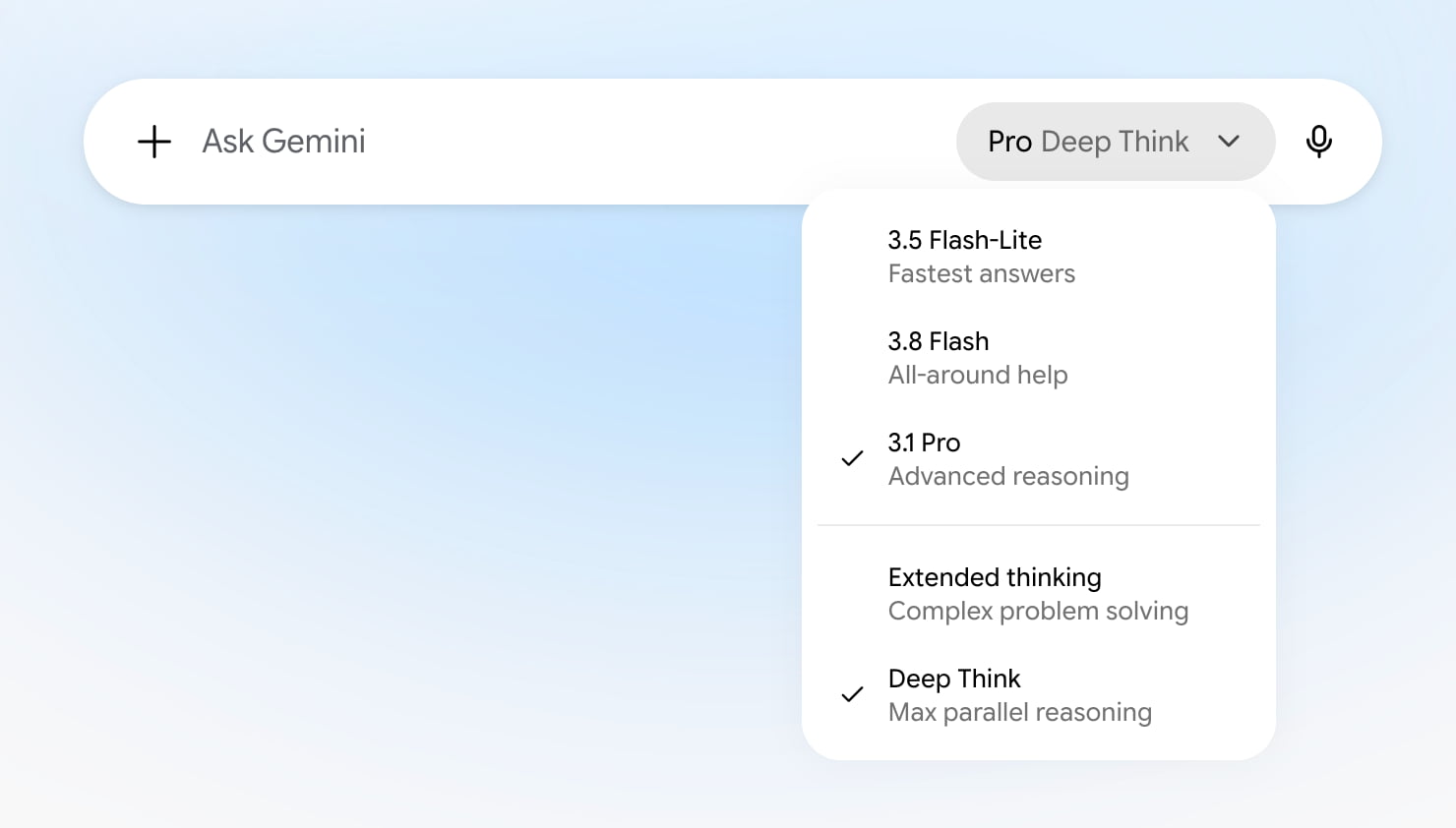
Google currently offers three models across its plans: 3.8 Flash, 3.5 Flash-Lite, and 3.1 Pro. Flash was positioned as the generalist workhorse, built to handle most everyday tasks such as answering questions and summarizing files. Pro sat above it as the more capable option for heavier demands, while Flash-Lite served as the fast, economical baseline.
Once the change takes effect, the tiers break down like this:
- Free: Flash-Lite only — down from three available models to one.
- AI Plus ($5 per month): Flash and Flash-Lite; Pro is removed entirely.
- AI Pro ($20 per month): the existing model set plus Deep Think.
- AI Ultra ($100 or $200 per month): unchanged, and previously the only tier where Deep Think existed at all.
In practical terms, a free user who genuinely needs Flash will have to buy an AI Plus subscription. An AI Plus subscriber who needs Pro will have to jump up to the AI Pro plan. The obvious design is a deliberate nudge: each lost capability has exactly one paid destination.

The Real Cost of Losing Flash
It is tempting to read "Flash-Lite only" as a minor downgrade, but the label understates the shift. Flash was the model most free users actually relied on for substantive work — the one called upon to digest a long document, condense a set of meeting notes, or produce a first draft. Flash-Lite is built for speed and efficiency rather than depth, which makes it a reasonable fit for quick lookups and short exchanges but a weaker partner for anything requiring sustained context or nuanced output.
For casual users who fire off a handful of questions a day, the change may be barely noticeable. For students, freelancers, hobbyists, and small operators who have quietly folded Gemini into a daily workflow without ever paying for it, October 9 marks the point where the tool stops doing the heavier half of the job. Those are precisely the users Google appears willing to convert into subscribers or let go.
Why the Cheapest Paid Plan Is Getting Squeezed Too
The AI Plus adjustment is arguably the more telling move. A $5 monthly plan that loses its most capable model is a weaker $5 plan than the one subscribers signed up for, and Google is making that change without any apparent reduction in price. Existing subscribers who depended on Pro now face a four-fold jump, from $5 to $20, to recover a capability they already had.
That is a familiar pattern in subscription software: introduce an inexpensive tier to lower the barrier to entry, then gradually reposition it so the higher tier becomes the "real" product. It works because switching costs are low but habit is strong — once an assistant is woven into someone's routine, dropping back to a noticeably weaker model feels like a loss rather than a neutral choice.

Deep Think and the Logic of the Upsell
The single bright spot in the announcement belongs to AI Pro subscribers. At $20 per month, they gain Deep Think, the reasoning mode previously locked behind the AI Ultra plans that run $100 or $200 per month. That is a genuine expansion of access, and it gives Google a clean headline feature to sell at the mid-tier price point.
Read alongside the cuts, however, the two moves form one strategy. Capabilities are being redistributed rather than simply removed: reasoning depth is pushed down into the mid-tier as an incentive to upgrade, while general-purpose model access is pulled up out of the free and budget tiers as an incentive to stop paying nothing. Customers in the middle end up with a different product than they had before, and Google ends up with a much clearer story about what each dollar buys.
How to Think About the Change If You Use Gemini
Whether any of this matters depends less on how often you open Gemini than on what you ask it to do. A few practical questions can sort most users into a lane:
- Are your prompts short and disposable? If you use Gemini for quick facts, rewrites, or brainstorming snippets, Flash-Lite will likely cover you, and staying free remains reasonable.
- Do you lean on it for documents? If summarizing files and working through longer material is core to your usage, losing Flash is the change that will sting first.
- Did you subscribe to AI Plus specifically for Pro? If so, the plan you are paying for no longer does what you bought it for, and it is worth deciding consciously whether Flash is still enough.
- Do you need heavy reasoning? For anyone already considering the $20 tier, Deep Think arriving at that price is a meaningful upgrade, provided the remaining model access covers your other needs.
The Wider Pattern in Consumer AI
Google's move fits a broader shift across the consumer AI market. The early land-grab phase, in which the most capable models were handed out freely to build habit and gather feedback, is giving way to segmentation. Companies that spent enormous sums on compute are under pressure to convert users into revenue, and the most direct lever available is to move the good models behind a paywall while leaving a competent-but-limited version available to everyone else.
That does not make the free tier worthless — a permanent, no-cost entry point still matters for adoption and for competing against rival assistants. But it does redefine what free means. Rather than a full-strength product with an upsell attached, the free tier increasingly functions as a demonstration: enough capability to show what the paid version can do, not enough to replace it.
For Google specifically, the October 9 change draws a sharper line than the company has drawn before. Free users keep a seat at the table, AI Plus subscribers get slightly less than they had, AI Pro subscribers get something genuinely new, and AI Ultra remains the province of those spending $100 or $200 a month. Whether that reshuffling persuades people to climb the ladder is now the open question — and one that will be answered, quietly, by how many free users decide that Flash-Lite is enough.
This article is based on reporting by ZDNET. Read the original article.
Originally published on zdnet.com