Generalist says one robotics foundation model can stretch across many kinds of hands
Robotics startup Generalist says its GEN-1 embodied foundation model now supports a broad range of robot end effectors, extending beyond standard grippers to five-fingered hands, specialized tools, and custom actuation setups. The announcement points to a central ambition in physical AI: building a single base model that can generalize across many ways of interacting with the world rather than learning each manipulation interface from scratch.
According to The Robot Report, Generalist said GEN-1 has been trained so that one underlying model can learn sensorimotor policies that transfer across sharply different embodiments. In practical terms, that means the company is trying to teach robots not just how to operate a specific gripper, but how to build reusable physical understanding that remains useful when the robot’s “hand” changes.
The concept echoes the role large foundation models play in language and image systems, where broad pretraining is meant to produce adaptable capabilities that can later be specialized. In robotics, however, the problem is harder. Hardware differs widely, sensor positions shift, actuation methods vary, and the physical consequences of a mistake are immediate. Generalist’s claim is that scaling data across many tool and hand configurations can help overcome some of that fragmentation.
The company’s argument rests on data scale and embodiment diversity
Generalist said GEN-1 is pretrained on an in-house robotics dataset covering more than half a million hours of real interaction data. The company also said that dataset now spans a wide variety of end effectors, including off-the-shelf tools, printed parts, custom modifications to two-finger grippers, and form factors inspired by commercial use cases. In total, it cited roughly 9,000 variations.
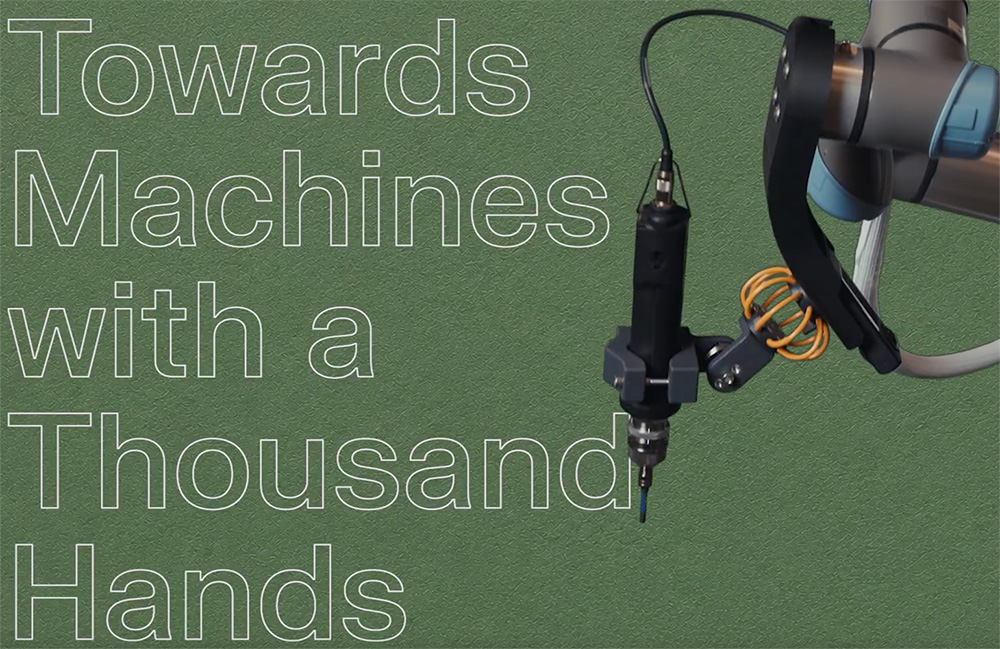
That breadth is the core of the company’s pitch. Instead of optimizing a model around one hand design, Generalist is treating different end effectors as different interfaces to the same physical world. A five-fingered hand, a tape dispenser, a spatula, or a screwdriver may produce different control problems, but all of them expose the model to geometry, force, friction, contact, and motion constraints. The more varied those interfaces become, the stronger the company believes the model’s underlying “physical commonsense” can get.
This is not the same as saying every tool becomes equally easy to control. In the examples described by The Robot Report, each device introduces its own vocabulary of action. Tongs bring compliance and spring dynamics. Scrapers and spatulas change the problem from grasping an object to managing distributed contact against a surface. A tape dispenser requires the model to coordinate tension and placement. A box cutter or peeler adds the need for controlled force along a constrained path. These are not cosmetic changes in hardware; they alter the structure of the task itself.
Generalist’s thesis is that learning across many such interfaces helps the model separate general physical principles from tool-specific details. If that holds up in practice, it would be a meaningful step for robotics, where transfer between embodiments has historically been difficult and expensive.
Why end effector flexibility matters
The significance of this announcement is not just academic. In commercial robotics, the hand or tool attached to a robot often determines which jobs it can perform. Warehousing, light manufacturing, lab automation, food handling, surface finishing, and service tasks all impose different physical demands. A model that only works well with one narrow type of gripper limits deployment flexibility and increases integration costs every time the hardware changes.
By contrast, a base model that can adapt across end effectors could simplify development cycles. It could reduce the need to build separate control stacks for every tool, make it easier to test robots in new task domains, and lower the data burden when moving from one manipulation setup to another. Even partial progress on that front would be valuable, because one of robotics’ persistent bottlenecks is that capabilities often remain brittle outside the exact conditions they were trained for.
Generalist’s framing also reflects a broader shift in AI robotics toward pretraining at scale. Rather than hand-engineering every behavior or training narrowly bounded policies, companies are betting that large, diverse real-world datasets can produce more reusable representations. The challenge, of course, is proving that those representations are robust enough to deliver reliable performance once systems leave the demo environment and encounter real operational variance.
What is established and what remains a company claim
The available source material supports several concrete points: Generalist says GEN-1 now supports a broad range of end effectors; it says its training data exceeds half a million hours of real interaction data; and it says the model has been exposed to about 9,000 end-effector variations. The company also argues that this diversity helps create transferable sensorimotor representations across different tools and embodiments.
What the source does not establish independently is how well that transfer performs against competitors, how much fine-tuning is still required for new hardware, or whether the approach holds under the reliability demands of production deployment. Those are important questions for any robotics foundation-model claim, particularly when the announcement comes through company-shared examples rather than a comparative benchmark study presented in the source text.
Even so, the update is notable because it targets one of the field’s hardest practical problems. If robot learning remains tightly coupled to a single manipulator design, scaling useful automation stays expensive and slow. If a shared model can retain competence across many embodiments, robotics systems become easier to repurpose and potentially more economically viable across industries.
A step toward more general physical intelligence
Generalist is effectively arguing that every new hand teaches the model another way to understand the same world. That is an ambitious framing, but it captures the direction much of advanced robotics is heading: away from single-task controllers and toward broader physical intelligence that can survive hardware variation.
Whether GEN-1 becomes a landmark platform will depend on results beyond this announcement. Still, the company’s latest update highlights an important competitive frontier. In embodied AI, the next leap may not come only from bigger models, but from models that can carry what they learn across the messy diversity of real tools, real contact, and real work.
This article is based on reporting by The Robot Report. Read the original article.
Originally published on therobotreport.com