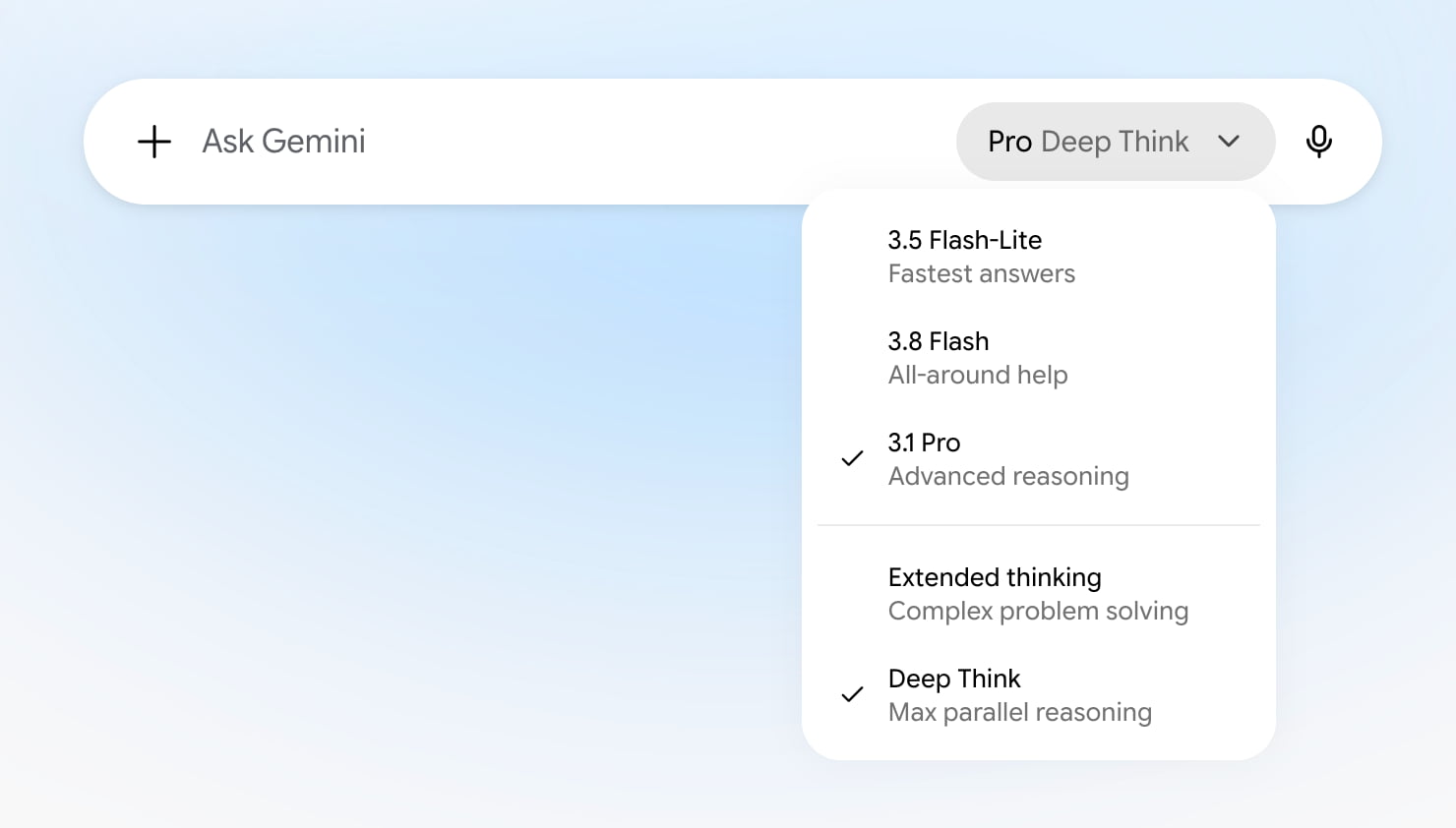
Google Is Redrawing the Lines Around Gemini
Google is preparing to change which Gemini models its users can actually reach, and the dividing line will follow subscription tiers rather than personal preference. According to 9to5Google, the company will soon introduce limits on model access for people using the Gemini app for free and for subscribers on the AI Plus plan. Separately, the AI Pro tier is adding Deep Think, the heavier-duty reasoning capability that Google has so far reserved for its most computationally demanding AI work.
The timing is not arbitrary. The report frames the change as a direct follow-on to the compute-based usage change Google introduced in May, when the company began accounting for consumption in terms of processing demand rather than simple prompt counts. That earlier shift established a principle that now appears to be guiding product decisions: heavier models and longer reasoning chains cost far more to serve, and that cost has to be rationed somewhere. Model access is the next logical lever to pull.
What Is Actually Changing
The reported essentials are narrow, but they carry real consequences for anyone who opens the Gemini app out of habit rather than out of a paid plan:
- Free users will face limits on which Gemini models they can select or reach at all.
- AI Plus subscribers will also see restrictions on model availability, despite paying a monthly fee.
- AI Pro subscribers are gaining access to Deep Think.
- The change builds on May's switch to compute-based usage accounting rather than raw request counts.
What the reporting does not yet spell out is exactly where each tier's ceiling lands. It remains unclear which models stay open to free users, how AI Plus sits relative to that baseline, and whether the new limits arrive as daily caps, session caps, or outright model gating at the interface level. Those distinctions matter enormously in practice: a user who can only send a handful of prompts to a capable model has a very different experience from one who never sees the model at all.

Why Compute, Not Features, Drives the Decision
The May change was the tell. By moving to compute-based accounting, Google effectively acknowledged that not all AI interactions are equal. A short factual question answered by a lightweight model consumes a fraction of the resources required by a long, multi-step reasoning task. When every request is priced the same from the user's perspective, the heaviest users naturally gravitate toward the most expensive models, and the provider absorbs the difference.
Tiering model access is the cleanest correction available. It does not require raising prices, removing features, or degrading quality for paying customers. It simply ensures that the most capable and most expensive models sit behind the plans that generate the most revenue. For a company running AI at global scale, that is closer to routine capacity planning than to a product retreat — though for users on the losing end of the new line, the effect feels the same either way.
Deep Think Becomes the New Ceiling
Placing Deep Think behind AI Pro is the clearest signal in the whole report. Deep Think represents the kind of capability that consumes substantially more compute per request, because it is designed to spend more effort before answering. Making it exclusive to the highest consumer tier accomplishes two things at once: it protects the most expensive inference from casual traffic, and it gives AI Pro a concrete reason to exist beyond faster responses or higher quotas.
This is a familiar pattern in software, applied to a new kind of resource. The premium tier does not merely get more of the same product; it gets access to a different class of capability that is technically impractical to offer broadly. Whether that proves compelling enough to move users up a tier is the commercial question Google will be answering over the coming months.

What Free Users Should Expect
Free access to AI assistants has always been a subsidised on-ramp, and this change treats it that way explicitly. Users who never pay should anticipate a narrower menu of models, with the strongest options either unavailable or metered more tightly than before. In practical terms, that means answers to complex, multi-step questions may become shorter, less thoroughly reasoned, or more likely to require follow-up prompts that consume whatever allowance remains.
The friction is likely to be uneven. Someone who uses Gemini for quick lookups may notice almost nothing. Someone who has come to rely on it for long drafting sessions, code explanation, or research-style questioning will feel the boundary quickly — and that is precisely the user Google would prefer to convert.
What AI Plus Subscribers Should Expect
The more awkward position belongs to AI Plus. These are paying customers, and the report indicates they too will see model limits. That creates an obvious question about what the middle tier is for if its access begins to resemble the free experience. Google's likely answer is that AI Plus retains advantages in quota, speed, and feature access even as the very top models migrate upward to AI Pro.
But perception matters as much as specification. A subscriber who discovers that the model they signed up for is no longer in their plan has a legitimate grievance, and subscription businesses handle that discovery poorly when the change arrives quietly. Clear communication about what each tier includes will matter as much as the technical limit itself.

The Broader Shift Toward Tiered Intelligence
This is less a Google-specific story than an early example of where the AI industry is heading. When intelligence is delivered as a service, capability becomes a resource that can be packaged, capped, and sold in slices. The result is a landscape where the same assistant behaves differently depending on what a user pays, and where the most capable reasoning is treated as a premium good rather than a default.
For users, that means the question shifts from "what can this AI do?" to "what can this AI do for me, on my plan?" For Google, it means walking a line between monetising expensive inference and preserving the broad, habitual usage that keeps Gemini competitive in a crowded assistant market.
What to Watch Next
Several details will determine how disruptive this actually is. The first is the specific model lineup for each tier. The second is how limits are communicated inside the app, since silent downgrades generate far more frustration than visible ones. The third is whether the restrictions expand over time, which would suggest compute pressure is more severe than a one-off adjustment.
For now, the direction is unmistakable. Google is sorting Gemini users by willingness to pay and matching them to models accordingly, with Deep Think as the reward at the top. The May compute change set the logic in motion; the October model limits are where that logic becomes visible to everyone who opens the app.
This article is based on reporting by 9to5google.com. Read the original article.
Originally published on 9to5google.com