The construction industry sits at a peculiar inflection point. While it is one of the last major sectors to be reshaped by automation, the pressures pushing it toward robotics have never been stronger. Monumental, an Amsterdam-based startup, has been working to prove that robots can take on the physically demanding work of laying bricks. In doing so, the company has learned valuable lessons about where automation fits on a modern job site.
An Industry Running Low on Hands
The case for construction robotics starts with an uncomfortable set of statistics. According to data from the Association of General Contractors, 92% of contractors report difficulty filling open roles. At the same time, the U.S. faces a shortfall of roughly 4.5 million homes, a gap that cannot be closed without enough skilled labor.
The problem is not cyclical; it is structural. Veteran workers are retiring in large numbers, and younger generations are not entering the trades at a rate that would replace them. Western Europe is experiencing the same trend, where bricklayers top the list of job shortages in countries including the U.K., the Netherlands, and Germany.
For Monumental founder and CEO Salar al Khafaji, that reality changes the conversation about automation. In many industries, robots and AI are feared as replacements for human workers. Construction has the opposite problem: there are not enough people to perform the work, and technology is necessary to keep projects moving.
Why Bricklaying Became the First Target
Monumental's decision to focus on bricklaying was not random. Al Khafaji points to two main reasons: difficulty and demand.
A Hard Job Worth Automating
Bricklaying is physically taxing. It requires repetitive heavy lifting, precision alignment, and endurance across long shifts. If a robotic system can handle that level of difficulty, the thinking goes, the same technology can be adapted to other construction tasks with less demanding requirements.
A Chronic Shortage of Skilled Labor
The market need is clear. In several Western European countries, bricklaying is the single most difficult position to fill. Monumental sees this as an opportunity to deploy machines where human labor is scarce rather than where workers are abundant.
The Three Phases of Construction and Where Robots Fit
Al Khafaji explains that building a home can be broken down into three major phases: site preparation, shell construction, and the finishing work that follows. Robotics has made uneven progress across these phases.
Ground Preparation Leads the Way
The earliest stage, which involves excavating and laying foundations, is currently the most mature for autonomous equipment. Heavy machinery such as excavators and ground movers are beginning to operate with autonomous guidance. These machines do not require sub-centimeter precision; they operate in open spaces where there is more room for error, making them a natural fit for automation.
That stage has attracted significant venture capital. Monumental notes competitors in this area, including Bedrock Robotics, Gravis Robotics, TerraFirma, HIVE, and Built Robotics. Recent funding rounds illustrate the momentum: Gravis Robotics raised $200 million, TerraFirma raised $115 million, and Bedrock Robotics raised $270 million.
Shell Construction Is Monumental's Focus
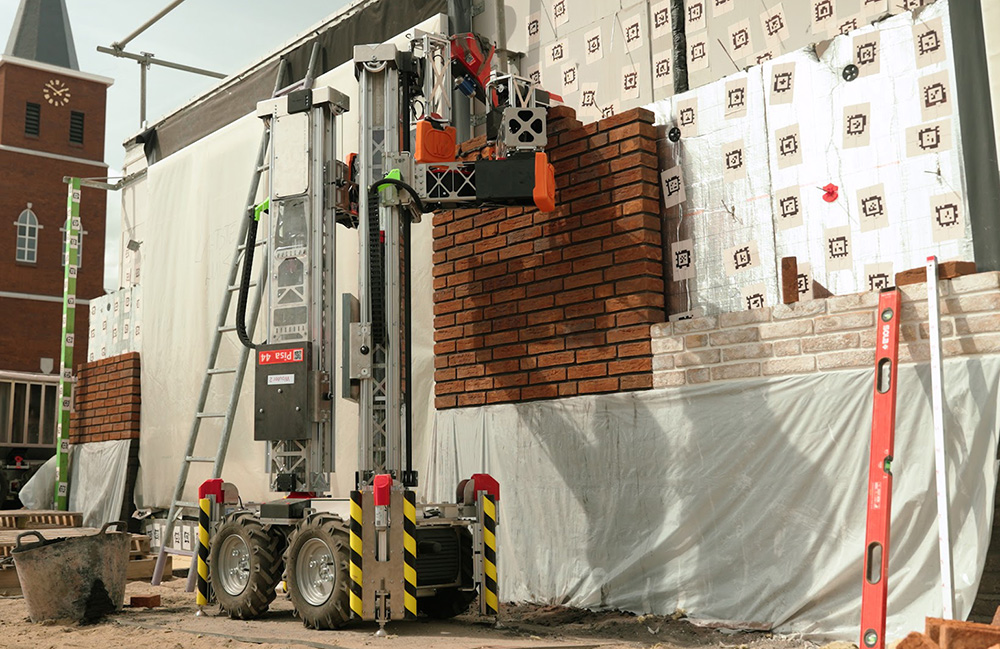
Monumental operates in the second phase, building the structural shell of a building. Instead of moving earth, this stage demands careful placement of materials such as brick and block. The company does not view the autonomous excavator companies as competitors because Monumental works in a different part of the process.
The company's robot, named Pisa, is designed to handle bricklaying and mortar application. The choice to automate this task is not just about filling empty roles; it is about unlocking the ability to build more homes as demand rises.
The Road Ahead for Construction Robotics
Monumental's thesis is that a successful bricklaying robot can demonstrate the broader potential of construction automation. If the same platform can be extended to block work and other shell-building tasks, the company hopes to capture a much larger share of the construction process.
That vision is still being tested. While autonomous excavation is already commercially available in many forms, bricklaying robots remain a harder challenge because they operate in tighter spaces, alongside other workers, and require a higher degree of accuracy.
Still, the market conditions point toward continued adoption. As labor shortages persist, contractors will have fewer options for completing projects on time. Technology like Monumental's offers a way to keep schedules intact without relying on an ever-expanding workforce.
Key Takeaways for Construction and Robotics
- Labor scarcity in construction is the primary driver of robotic adoption, not replacement economics.
- Bricklaying is an attractive first use case because it is physically demanding and suffers from an acute shortage of available workers.
- Ground preparation has already seen significant progress, with large investments flowing to autonomous heavy-machinery companies.
- Monumental sees shell construction, including bricklaying and block work, as its niche within the broader construction robotics landscape.
- The success of robotic systems in difficult tasks like bricklaying could pave the way for wider automation efforts across construction job sites.
Looking Forward
The convergence of a severe housing shortfall, an aging workforce, and rapid advances in robotics is creating a window for companies like Monumental to make a lasting impact. The company's experience suggests that construction robotics is not a story of machines stealing jobs, but of machines enabling an industry to survive.
Whether those efforts will scale remains to be seen, but the direction is clear. In an industry where 92% of contractors struggle to find workers, waiting for the labor market to heal is not a viable strategy. The next few years will likely determine whether bricklaying robots remain a niche experiment or become a standard part of the construction toolkit.
This article is based on reporting by The Robot Report. Read the original article.
Originally published on therobotreport.com