An engine built to redefine a small manufacturer
For most automakers, an in-house engine program is a routine extension of scale. For a low-volume British sports car maker like TVR, it was something closer to a declaration of intent. The company had spent years relying on powerplants from larger manufacturers, but under Peter Wheeler it pursued a more radical path: build an engine that would express TVR’s own priorities without compromise. The result was the Speed Six, an inline-six that did more than power a range of TVR models. It became the mechanical heart of the company’s identity during one of its most memorable eras.
The source material frames the Speed Six as both an engineering milestone and the starting point for an even more ambitious, ultimately unfulfilled project. That dual role is what makes the engine notable. On one level, it was a serious naturally aspirated road-car engine that delivered headline power for its size. On another, it served as the building block for the notorious Speed Twelve, a V12 concept aimed at GT1 racing and later an attempted roadgoing monster.
The Speed Six formula
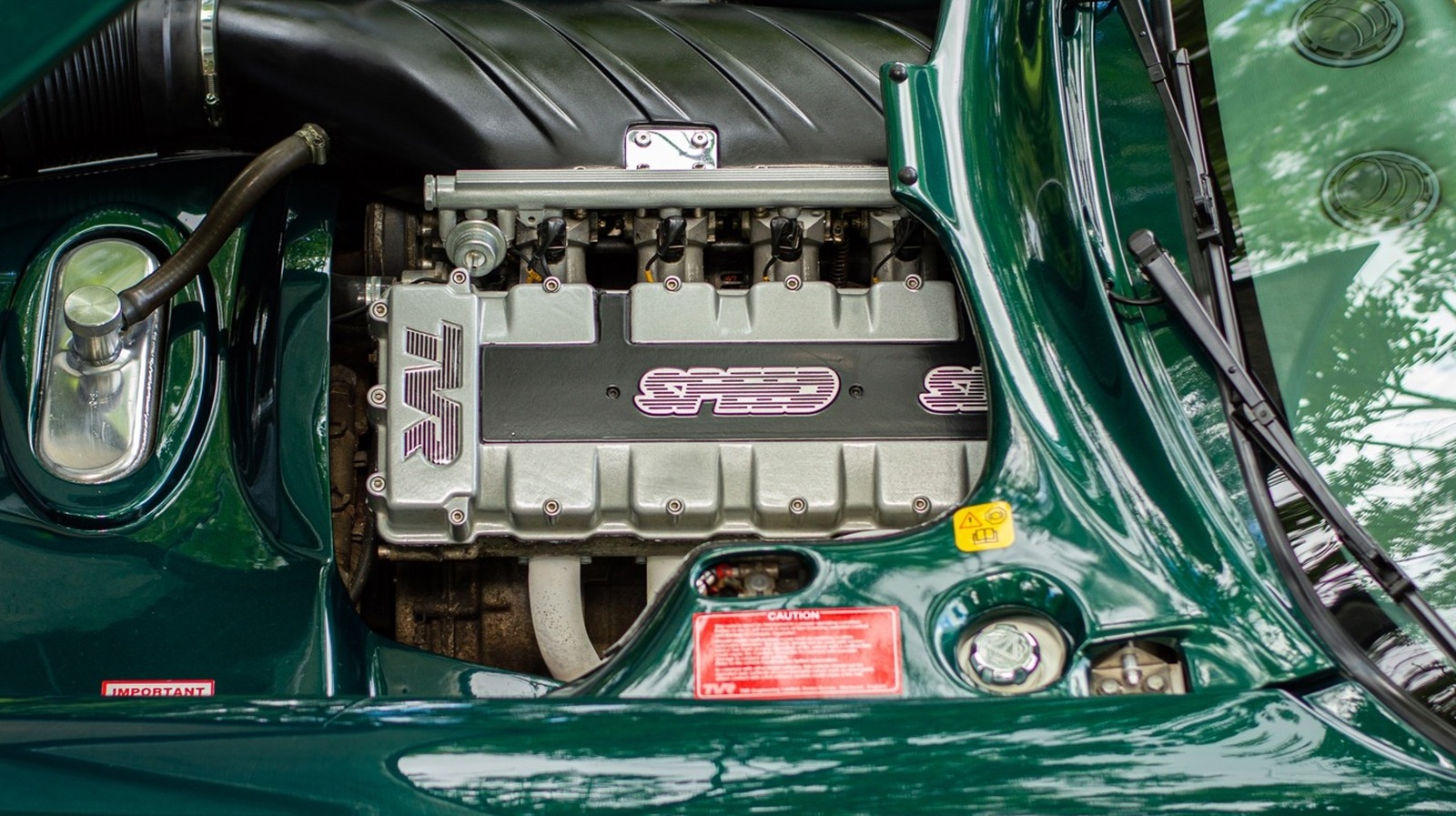
TVR’s Speed Six was a 24-valve, twin-cam inline-six offered in 4.0-liter and later 3.6-liter form. According to the supplied source text, both versions shared the same piston size while varying stroke length to arrive at different displacements. That is a compact detail, but it says a lot about the engineering philosophy involved. TVR was not just assembling an engine for adequacy. It was tuning geometry and breathing for a distinctive power character.
Each cylinder received its own throttle body and fuel injector, while equal-length tubular exhaust manifolds reinforced the engine’s performance-first approach. Those features are important not because they are exotic in isolation, but because they align with TVR’s broader reputation for building road cars that felt unusually raw and direct. The engine was intended to respond sharply, breathe freely, and sound like something developed with racing instincts, even if it lived in a street car.
The block was aluminum, and the engine used a dry-sump lubrication system. That dry-sump layout had a meaningful packaging benefit: it allowed the engine to sit lower in the chassis. Lower placement helps reduce the center of gravity, which in turn can improve handling and stability. For a company obsessed with driver involvement and willing to omit modern safety interventions, that packaging choice matched the larger mission.

Power without electronic cushioning
Performance figures alone do not fully capture why the Speed Six stood out, but they explain the engine’s reputation. In 3.6-liter form, the source text says it produced 350 horsepower and 290 pound-feet of torque. The 4.0-liter S version used in the Tuscan Speed Six S raised output to 390 horsepower at 7,000 rpm and 310 pound-feet at 5,250 rpm. Later Mark I Tuscan applications reportedly reached 400 horsepower and 315 pound-feet before the Mark II update.
Those numbers were impressive for a naturally aspirated engine in a lightweight road car, particularly in the context provided by the source. At 400 horsepower from 4.0 liters, the engine was effectively making 100 horsepower per liter. That benchmark still carries symbolic weight among enthusiasts because it signals efficient breathing and aggressive tuning without forced induction. In the period when TVR was establishing this engine, that output helped reinforce the sense that the company was punching above its size.
Just as important was the vehicle context. The source text describes a car weighing roughly 2,425 pounds and lacking ABS or traction control. In other words, the Speed Six was not deployed inside a heavily mediated modern performance package. Its output reached the road with relatively little electronic filtering. That sharpened the appeal for enthusiasts who valued immediacy, but it also made the experience more demanding. TVR’s brand was built in part on that willingness to let the mechanical system speak loudly and leave the driver with more responsibility.
From six cylinders to twelve
The engine’s afterlife as the basis for the Speed Twelve is what pushed the Speed Six from impressive component to legend-adjacent architecture. Wheeler wanted TVR to take on Le Mans through the GT1 category, and the company’s answer was to scale up from the inline-six design into a 7.7-liter V12. The source text describes the Speed Twelve as effectively combining two six-cylinder designs into a single engine concept.
That transformation is revealing. Rather than abandon the Speed Six philosophy when aiming at a top-tier racing target, TVR extended it. The company treated the six-cylinder not as a dead end but as a modular foundation for something much larger and much more extreme. The result, by all accounts in the source text, bordered on the absurd in output.
The most memorable detail is the claim that the Speed Twelve snapped the input shaft on TVR’s in-house dynamometer. Because the dyno, rated to handle 1,000 horsepower, was destroyed, the article says there was never a true factory output figure for the engine. What did emerge was a regulatory cap: the car had to be limited to 660 horsepower because of class rules. Even without a definitive unconstrained number, the story established the engine’s reputation as a machine that exceeded the company’s own measurement hardware.

The project that never reached Le Mans
For all its theatrical potential, the Speed Twelve never fulfilled its intended racing destiny. Rule changes rendered it ineligible before it could compete at Le Mans, according to the source material. That is a familiar outcome in motorsport history: engineering ambition outrun not by physics alone but by governance. Entire programs can be made obsolete by a shift in category definitions, homologation requirements, or balance-of-performance logic.
TVR then attempted to salvage the project through a production model, but even that push became part of the car’s mythology rather than its market success. The supplied text cuts off before fully recounting the anecdote, but it references the popular tale that Wheeler drove the road prototype and came back shaken by the experience. Whether treated as literal history or legend reinforced through enthusiast retelling, the story serves the same purpose. It positions the Speed Twelve as a threshold object, something too extreme even by TVR standards.
Why the Speed Six still matters
The Speed Six matters because it sits at the exact point where TVR’s engineering ambition, brand identity, and appetite for risk came together. It was not merely a specification-sheet achievement. It represented the company deciding that outsourcing the core of its cars was no longer enough. It also demonstrated how a relatively small manufacturer could pursue advanced features such as individual throttle bodies and dry-sump lubrication in the service of a distinctly analog performance ethos.
Its legacy is strengthened by what followed. Without the Speed Six, there is no Speed Twelve story, no image of a tiny company trying to build a GT1 terror from doubled architecture and brute force. The six-cylinder engine was the credible beginning that made the V12 fever dream seem possible.
That combination of accomplishment and escalation explains why the Speed Six endures in performance-car memory. It was excellent on its own terms, but it also opened the door to one of the most outlandish “what if” chapters in British sports-car history.
This article is based on reporting by Jalopnik. Read the original article.
Originally published on jalopnik.com