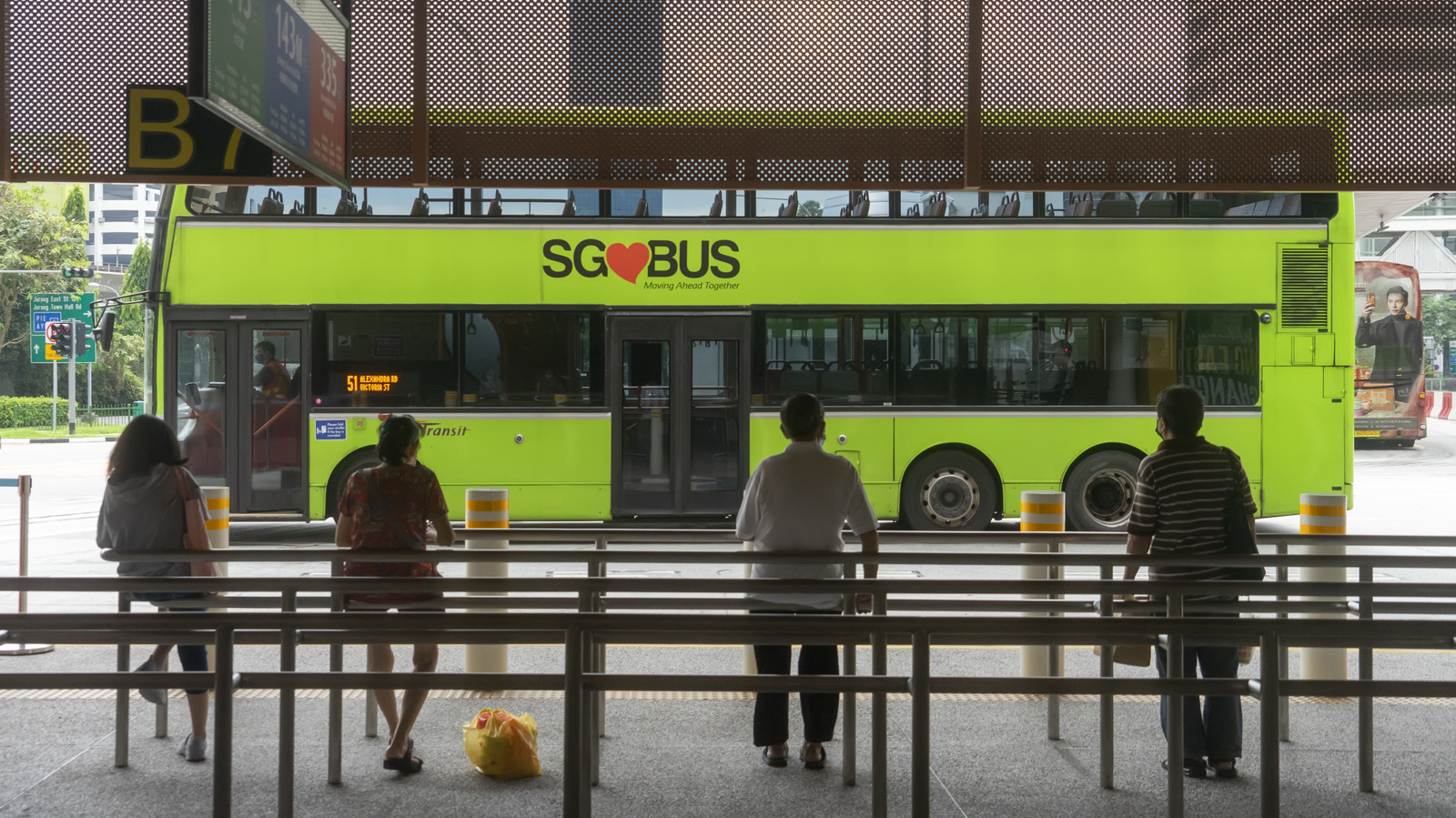
Singapore Is Putting a Price Tag on Transit Rudeness
Singapore's public transport system has built a global reputation on punctuality, cleanliness and a commuter culture that treats quiet as a shared resource. That reputation is now getting a sharper set of teeth. According to reporting from CNN, authorities in the city-state are expanding the financial penalties attached to disruptive behavior on buses and trains, with the harshest fines climbing to 5,000 Singapore dollars — roughly $3,900.
The change matters well beyond Singapore's borders. As fuel costs climb worldwide, more households in the United States and elsewhere are leaning on buses and subways to trim their budgets. That surge in ridership puts strangers in closer quarters, and it has revived an old question for transit agencies everywhere: how do you protect the experience of the many from the behavior of the few?
From Friendly Signs to Formal Penalties
Singapore did not arrive at this point overnight. Guidance aimed at riders began appearing on buses in December 2024, with signage advising passengers to keep noise levels down, occupy only one seat and avoid sitting on the floor, according to The Independent. Those signs were educational rather than punitive — a nudge rather than a citation.
Then, in October 2025, the country's parliament approved an amendment that handed public authorities the ability to address problem behavior directly. That shift is significant because it changed who can act. Previously, a bus driver's options were limited to removing an individual from the vehicle or bringing in the police. The new framework creates a middle tier of enforcement that sits between a verbal warning and a call to law enforcement.
Who Can Issue What
Under the amended rules, authorized staff working for the transit operators can hand out what are described as administrative notifications to passengers suspected of committing an offense. Those notices are not necessarily the end of the process. From there, the Land Transport Authority can open a formal investigation into the disruptive behavior, which is where the newly established fines come into play.
That layered approach gives the system flexibility. A commuter who steps out of line may first encounter a uniformed employee rather than a police officer, and the paperwork escalates only if the agency decides the incident warrants it.

The Cost of Bad Etiquette
The price list is where the policy becomes concrete. Offenses that many riders would file under mere annoyance now carry a financial consequence of roughly 500 Singapore dollars, or about $390. That category includes:
- Resting feet — clean or otherwise — on a seat
- Taking a phone call on speaker or talking loudly
- Playing music or scrolling through videos at high volume
- Leaving trash behind
- Eating or drinking on transit property
More serious conduct carries substantially heavier penalties. Soiling transit authority property or creating a hazard for fellow passengers can cost as much as 5,000 Singapore dollars, equivalent to about $3,900. That is roughly ten times the standard penalty, and it reflects a distinction the rules make between inconsiderate behavior and behavior that damages shared spaces or puts people at risk.
Why Singapore Is Doubling Down
The new fines do not exist in a vacuum. They align with guidelines that have governed Singapore's subway system for years, where bans on eating, drinking and playing audible music have long been standard. The country's transit networks are frequently cited alongside others in Asia for their cleanliness and efficiency, and the norms that produce that outcome are partly cultural and partly enforced.
What is notable here is the willingness to attach money to norms. Many cities publish courtesy guidelines that are essentially aspirational — requests printed on a poster, rarely backed by a penalty. Singapore's approach treats the shared environment as infrastructure worth protecting, in the same category as track maintenance or station cleaning.

A Quieter Commute Is Becoming a Global Goal
Singapore is not alone in deciding that headphones are not optional. Beijing, Kraków and Toronto have all banned playing loud audio without headphones on public transit, joining a growing list of metropolitan areas that treat uncontained sound as a nuisance worth regulating.
The trend reflects an awkward reality about shared spaces. Public transit is, by definition, public — a fact that produces both the best and the worst of urban life. Anyone who has ridden a rush-hour train has a story about a stranger's behavior, whether it involves a phone conversation conducted at full volume, a speaker blasting music, or something considerably worse. Agencies cannot legislate consideration, but they can decide how much they are willing to tolerate.
What Enforcement Can and Cannot Fix
Fines address the visible end of the problem: the behaviors that are loud, messy or hazardous enough to be noticed. They are less effective against the subtler friction of crowded spaces, where discomfort often comes from proximity rather than misconduct. And enforcement raises its own questions about consistency — who gets a warning, who gets a notification, and who gets investigated.
Still, the direction of travel is clear. Cities that depend on mass transit to move millions of people each day have an interest in making the experience bearable, because riders who feel unsafe or exhausted by their commute may eventually stop riding altogether.
What It Means for Riders and Visitors
For residents, the practical advice is unremarkable: keep calls off speaker, use headphones, take your trash with you, and keep your feet where they belong. For tourists, the message is that Singapore's famously orderly transit culture is not merely a matter of local habit — it is now backed by penalties that can climb into the thousands of dollars.
The broader lesson is about the trade-off every transit system faces. Efficiency and cleanliness do not emerge automatically from good intentions; they are the product of design, maintenance and, increasingly, rules that come with a price attached. Singapore has simply chosen to make that price explicit — and, at up to $3,900, memorable.
This article is based on reporting by Jalopnik. Read the original article.

Originally published on jalopnik.com



![Nissan reveals its newest EV, an affordable electric city cruiser with 259 km of range [Images]](https://electrek.co/wp-content/uploads/sites/3/2026/09/Nissan-affordable-Pixo-EV.jpeg?quality=82&strip=all&resize=1200,628)
