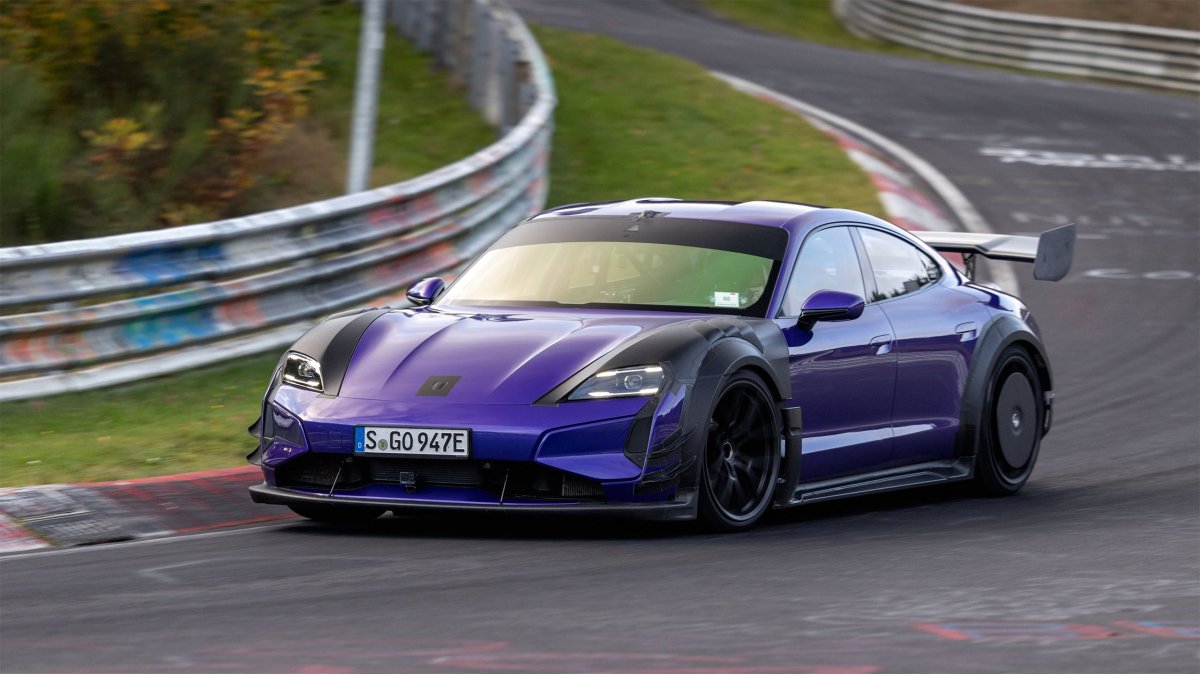
Porsche is back on top at the Nürburgring
Porsche has reclaimed the Nürburgring Nordschleife production electric vehicle lap record, posting a 6:55.553 in a Taycan Turbo GT fitted with the Weissach Pack and Manthey Kit. According to the source material, the run puts the car almost four seconds ahead of the 3,000-horsepower Yangwang U9 Xtreme, a result that immediately reframes the latest phase of the EV performance race around more than raw output.
The lap was driven by Porsche development driver Lars Kern, whose name has become closely associated with the company’s high-profile Nürburgring efforts. On a circuit as long, technical, and reputation-heavy as the Nordschleife, the time itself matters. But the margin and the context may matter more. Porsche did not beat a rival by arriving with an even more extreme power figure. It did so with a package that suggests chassis setup, aero efficiency, tires, and sustained composure remain decisive even in the electric era.
The record says something about EV maturity
There was a period when EV performance headlines were dominated by straight-line numbers and peak horsepower claims. Those metrics remain useful for marketing, but the Nürburgring is a different test. It punishes heat buildup, instability, weight mismanagement, and inconsistency over a long lap. To set a benchmark there, a car has to combine brute force with repeatable control.
That is why the Taycan result is strategically useful for Porsche. The source notes that the car used both the Weissach Pack and Manthey Kit, indicating a highly focused performance configuration rather than a basic trim-level comparison. Even so, the message is clear: Porsche wants the market to see the Taycan not just as a fast EV, but as a properly integrated high-performance machine capable of exploiting a difficult track environment better than challengers with much larger headline power.
Efficiency of performance matters as much as power
The comparison with the Yangwang U9 Xtreme is central to the story. The source describes the Chinese rival as a 3,000-horsepower machine. Porsche’s advantage, then, is not a story of overwhelming numerical dominance. It is a story of performance efficiency: how effectively a vehicle translates its total capability into a complete lap.
That distinction is becoming more important as performance EVs proliferate. Massive power figures are increasingly common in the upper end of the market. What remains harder is packaging that power into something usable over a demanding circuit without excessive thermal degradation or dynamic compromise. Nürburgring records are imperfect proxies for road use, but they are still powerful shorthand for engineering discipline.
The Taycan is still a brand statement
For Porsche, the Taycan has never only been about selling an electric sedan. It is the company’s argument that electrification does not require abandoning core brand values around handling precision and track credibility. Every major lap-time headline helps reinforce that claim, especially when newer rivals are trying to use spectacular output figures to define the segment.
The latest record also underscores how seriously incumbents are defending performance territory. New EV brands have often tried to seize attention by presenting themselves as freer from legacy constraints. Porsche’s answer is familiar: take an established engineering culture, refine the car relentlessly, and use benchmark laps to demonstrate that experience still counts.
Why the Nordschleife still matters
Some critics dismiss Nürburgring timing wars as marketing theater, and there is truth in that. Manufacturers choose conditions carefully, optimize vehicles aggressively, and use the circuit because it carries symbolic weight. But the theater works because the track still means something. The Nordschleife is punishing enough that a record there suggests genuine capability, even if it does not capture every dimension of real-world ownership.
For EVs in particular, it serves a useful function. Battery-electric performance cars often face skepticism around sustained hard driving, weight, and heat management. A record lap does not settle those debates, but it offers a high-visibility data point in them. If a car can produce a class-leading time over the full Nordschleife, it has at least demonstrated a level of engineering coherence that extends beyond launch-control spectacle.
A reminder that power is not the whole story
The sharpest takeaway from Porsche’s new record is simple: power alone does not decide elite EV performance. The Taycan Turbo GT’s 6:55.553 lap shows that integration still wins. Suspension tuning, aerodynamic stability, tire grip, braking confidence, and thermal resilience remain the ingredients that turn a specification sheet into an actual result.
That is good news for performance engineering because it means the segment has not collapsed into a single-number arms race. There is still room for balance, refinement, and execution to matter. Porsche’s latest Nürburgring result is therefore more than a bragging right. It is an argument about what counts in fast electric cars.
For now, that argument has a stopwatch behind it. And on one of the world’s most closely watched proving grounds, Porsche once again has the time everyone else has to chase.
This article is based on reporting by The Drive. Read the original article.
Originally published on thedrive.com