A routine crowd-pleaser turned into a cautionary clip
Spectator drags thrive on a simple premise: ordinary people bring ordinary vehicles onto a short oval track and race for a few seconds in full view of the stands. That formula is exactly why the format is entertaining, but it is also why incidents can escalate quickly when a heavy road vehicle loses control. A recent example at Colorado National Speedway has done precisely that.
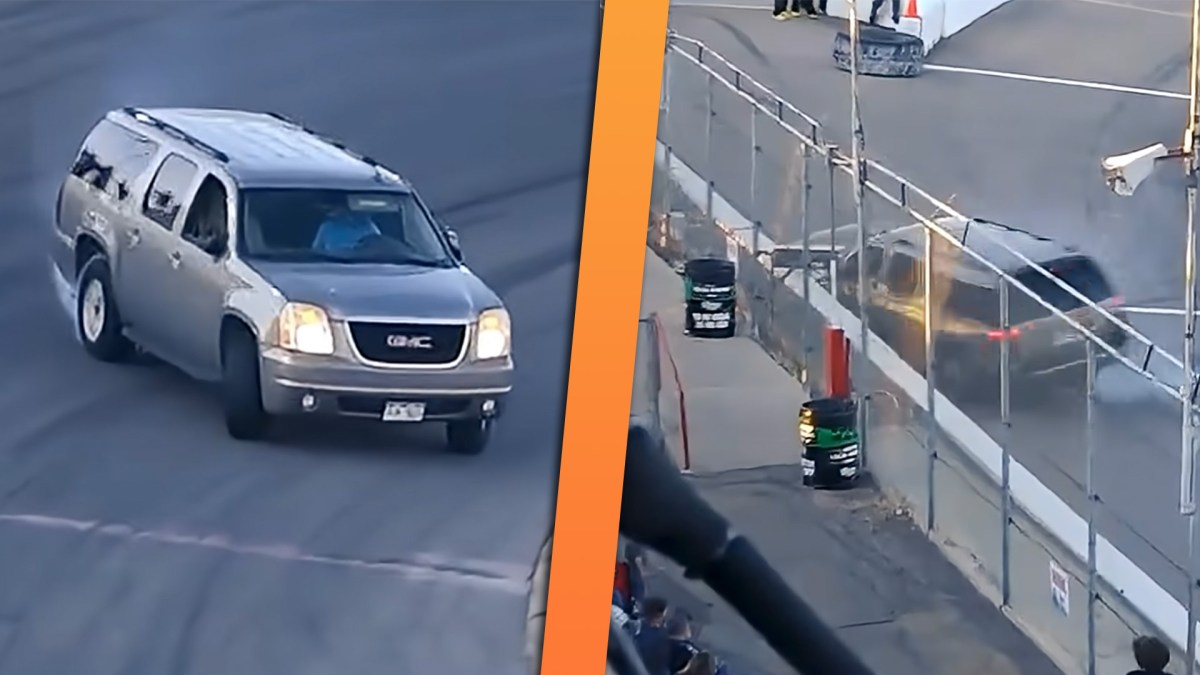
According to The Drive, a driver piloting a GMC Yukon XL in a spectator drag event on May 2 lost control and hit the wall, shattering rear glass and sending the spare tire rolling down the track. The event was captured by FloRacing’s broadcast crew, giving the crash a level of visibility that helped it spread online beyond the usual local racing audience.
The driver was reportedly OK, The Drive said, despite major damage down the driver’s side of the SUV. That outcome is the most important fact in the story. But the incident also highlights a deeper truth about grassroots motorsport: the line between accessible fun and serious hazard can be uncomfortably thin, especially when the vehicles involved are large, heavy, and never designed for competitive track work.
Why spectator drags are uniquely risky
The charm of spectator drags is that participants run what they brought. That can mean street trucks, crossovers, sedans, electric pickups, or family SUVs. The format lowers the barrier to entry and gives grassroots motorsport a democratic feel that professional racing can never match. Yet that same openness introduces unpredictable vehicle dynamics and uneven driver preparation.
In the Yukon crash described by The Drive, the driver was taking the inside line against a single-cab Ford F-150. The report says the SUV appeared under control until it broke traction. Once the rear stepped out, countersteer sent the vehicle straight into the wall. For a long-wheelbase, high-mass three-row SUV, there is very little margin once that slide begins.
That is the central problem with using large road-going utility vehicles in racing environments. They carry substantial weight, have handling traits optimized for ordinary driving rather than track stability, and can be difficult to recover when momentum shifts suddenly. When they strike a barrier, the forces involved are considerable even at moderate speed.

The video age changes the stakes
Crashes at local tracks are not new. What has changed is how quickly they become public events. The Drive notes that professional video and commentary made this crash particularly visible. In the past, many incidents lived briefly in local memory or circulated as shaky phone clips. Now a broadcast-quality angle can turn a trackside mistake into a widely shared online cautionary tale within hours.
That visibility cuts both ways. It can fuel spectacle, but it can also sharpen public attention on safety practices. Viewers notice whether helmets are being worn, whether barriers and runoff look adequate, and whether event organizers appear prepared for the obvious risks that come with mixing amateur drivers and road vehicles.
Colorado National Speedway hosts spectator drag events on the first Saturday of every month, according to The Drive. That regular cadence shows how established and popular the format is. It also means safety culture cannot be treated as incidental. Repetition only helps if it is paired with seriousness about the limits of both drivers and machines.
What the crash illustrates
The Yukon incident is not best understood as a punchline, even if online audiences treat it that way. It is a compact example of what happens when mass, momentum, and overconfidence arrive at the same point on a short track. Amateur events are designed to feel accessible. Physics is not.
The report’s description of the damage from headlight to taillight on the driver’s side captures how violent even a brief loss of control can become. The fact that the airbags did not appear to deploy, as The Drive observed, only adds to the sense that road-vehicle safety systems do not always map neatly onto racing-style impacts and contexts.
Grassroots motorsport remains valuable precisely because it is close to the public. It gives people a place to participate rather than just watch. But that openness has to be matched by restraint. Spectator drags work best when entrants treat the event as a structured activity, not as an invitation to test fate in the family hauler.
The viral Yukon crash is a reminder of that balance. The driver reportedly walked away, which is fortunate. The vehicle did not. More importantly, the clip now stands as a clear lesson in the limits of improvised performance driving: a few seconds of enthusiasm in a 6,000-pound SUV can turn into a barrier strike fast enough to change a local novelty race into a national warning.
This article is based on reporting by The Drive. Read the original article.

Originally published on thedrive.com