A sprint-race win that turned into a rules debate
Marc Marquez’s victory in MotoGP’s sprint race at Jerez has quickly become more than a comeback story. It is now a live argument about how racing rules are written, how they are interpreted in chaotic conditions, and whether a move can be both legal and unacceptable to competitors at the same time.
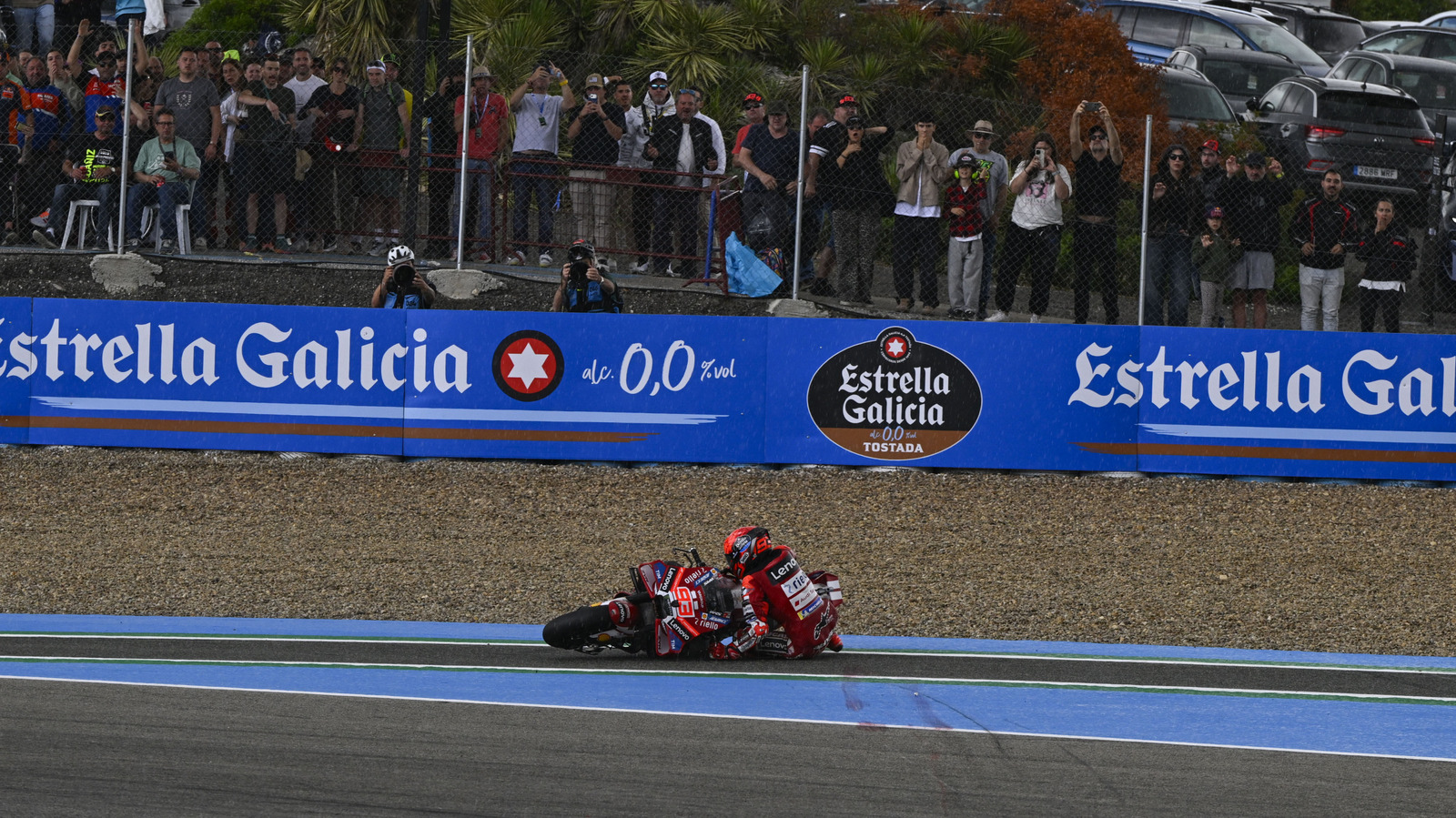
According to the supplied source text, Marquez crashed at the circuit’s final corner during changing weather in Saturday’s sprint. Instead of entering the pit lane in the conventional way before the fall, he picked up his Ducati and went directly across the track and grass to his box, swapped onto a wet-weather bike, and rejoined the race. He ultimately charged back from 17th to take the win.
The result looked extraordinary on track, but the lasting impact may be regulatory. Rival teams and riders are questioning whether MotoGP’s current rules leave too much room for improvisation at the pit entry in mixed conditions.
The weather created the opening
The race unfolded at the exact kind of moment that stresses every part of a race weekend: light rain beginning to fall, slick tires still offering useful grip, and riders trying to judge the latest possible lap to switch to wet machinery. Once precipitation began, race officials allowed riders to change bikes, but the timing remained crucial. Go in too early and a rider gives away pace on a surface that is not yet fully wet. Stay out too long and a crash becomes likely.
Marquez had started from pole and built an advantage, but the source says the key turning point came on lap seven of a 12-lap race. As conditions worsened at Turn 13, he dropped the bike. From there, the episode shifted from racing instinct to procedural literacy.
Rather than losing the opportunity entirely, Marquez recovered the motorcycle and headed straight to pit lane for the wet bike. The move cost him track position immediately, dropping him to 17th, but it preserved his chance to capitalize as the rain intensified and other riders either stopped to swap machines or crashed themselves.

Legal by the letter, controversial in practice
The source frames Marquez’s defense plainly: read the rules. As described, MotoGP regulations do not specifically define where a rider must enter the pit lane in this scenario. The rulebook requires riders not to cut the inside white line in turns on the pit entry, a condition Marquez reportedly respected. The same clarity does not exist for the outside lines, creating the gray area he used.
That distinction matters because it separates unsafe improvisation from a gap in the written framework. The complaint from rivals is not simply that Marquez took advantage of weather chaos. It is that the regulations failed to define pit-lane entry tightly enough to prevent a path that most competitors apparently considered outside the spirit of the rule.
Those are not the same claim. One argues a rider broke the rules. The other argues the rules are incomplete. Based on the supplied text, the criticism from other teams is focused on the second point.
Why competitors want the rule changed
The backlash was immediate. The source cites Aprilia team boss Paolo Bonora saying something needs to be fixed about the gray area. It also cites comments attributed by Motorsport.com to LCR Honda rider Johann Zarco, who argued Marquez should not have been allowed to win after the crash at the last corner and the unusual route to the pits.
The frustration is understandable from a competitive standpoint. In variable weather, decisions about when and how to switch bikes can decide the outcome of a race. If one rider finds a legal but unconventional path through a poorly defined section of the rulebook, rivals may see the result less as ingenuity and more as an avoidable regulatory failure.
At the same time, high-level motorsport has always rewarded competitors who understand the rules better than everyone else. The source explicitly presents Marquez as a rider whose advantage was not only skill and speed but deep familiarity with the written regulations. In that reading, the move was not an abuse of the system but a master class in operating within it.
Mixed-condition racing remains one of MotoGP’s hardest tests
The controversy also highlights a broader truth about MotoGP: few situations are harder to regulate perfectly than a race crossing from dry to wet. Officials must decide when bike swaps are permitted. Riders must balance grip, timing, and risk in seconds. Teams must interpret rules under pressure. The margin between brilliance and disorder becomes very small.
That is why pit procedures matter so much. They are not administrative details attached to the spectacle; they are part of the competitive structure. When a rule is vague, the ambiguity can directly shape the podium.
Marquez’s recovery drive underlined the racing side of the equation as well. Once back out, he still had to exploit worsening conditions, work through the field, and pass teammate Pecco Bagnaia for the lead. The shortcut and swap created the opportunity, but they did not hand him the victory on their own.
A likely regulatory aftershock
The most durable consequence of the Jerez sprint may be what happens next. If rival teams continue pressing the issue, MotoGP organizers will face pressure to clarify exactly how riders may enter pit lane after incidents near the final corner, especially during flag-to-flag style moments where bike changes are allowed. The current wording, as summarized in the source, appears too narrow to prevent future repetitions.
That makes this an important case study in modern motorsport governance. Regulations are often tested not in routine laps but in edge cases, where weather, track position, and instinct collide. At Jerez, Marquez found one of those edge cases first and turned it into a win.
Whether the move is remembered as cunning opportunism or as the loophole that forced a rewrite, it has already done something more valuable for observers than for his rivals: it exposed exactly where the rules stop being precise.
This article is based on reporting by Jalopnik. Read the original article.

Originally published on jalopnik.com