An unlikely vehicle just finished an unusually serious trip
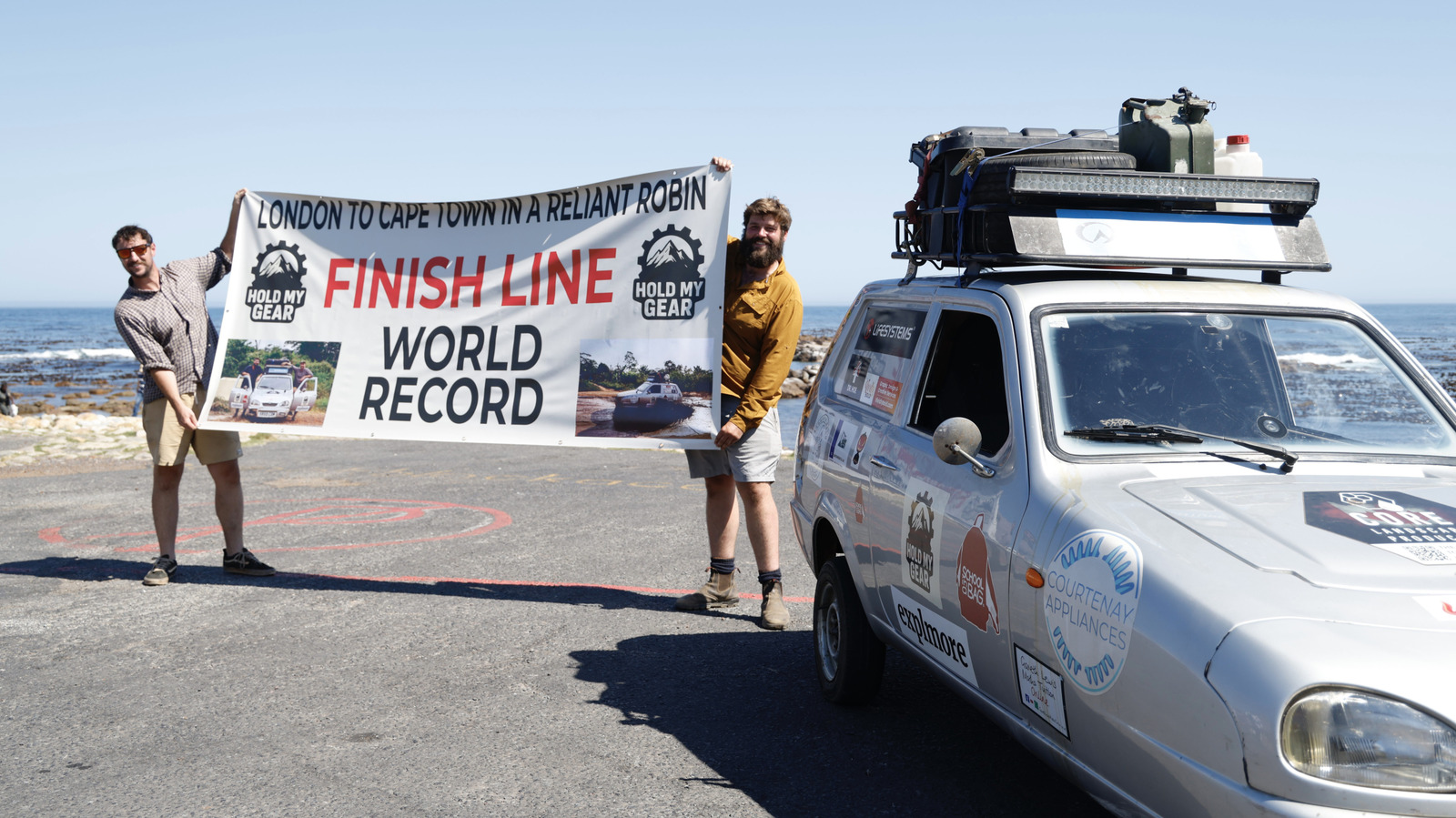
The Reliant Robin is not normally discussed as a credible overland platform. Its reputation, especially outside Britain, is closer to a motoring joke than to a machine built for endurance. That is what makes a newly completed 14,000-mile journey from London to Cape Town so striking. According to Jalopnik’s account of the trip, Ollie Jenks and Seth Scott turned a Robin into a makeshift expedition vehicle and used it to set a record for the longest trip made in a three-wheeled vehicle.
The journey, carried out under the Hold My Gear banner, crossed 22 countries and pushed a famously improbable car through desert, jungle, and war-affected regions. The point was not simply to travel in an unusual vehicle. Scott’s original idea was explicitly record-driven: to surpass the benchmark set by Anton Gonnissen, who completed a long-distance route in a three-wheeled motorcycle in 2019.
Why the trip matters beyond the stunt factor
On the surface, the story reads like automotive absurdism. A Reliant Robin is associated with fragility, awkwardness, and instability, not long-range expedition work. But the completed run is also a reminder of something more fundamental about vehicle culture: capability often emerges from preparation, repairability, and human persistence as much as from ideal product design.
The pair did not rely on stock charm alone. The Robin, nicknamed “Shelia the Three-Wheeler,” was reworked into a pseudo-overlander with practical upgrades. The preparation described by Jalopnik centered less on radical engineering than on basic resilience. Rusty or broken parts were replaced. Additional lighting was fitted. A roof rack was added. The original seats gave way to used Mazda MX-5 seats with more modern belts. In the back, the team installed a large battery-and-inverter setup along with a steel guard for the small fuel tank.
Those details matter because they show the trip was not achieved by pretending the Robin was already fit for purpose. The car had to be adapted, protected, and constantly managed. This was less a demonstration that the Robin is secretly a perfect expedition machine than proof that determined travelers can stretch the meaning of vehicle suitability much further than conventional wisdom suggests.
The real story is the accumulation of small failures
The most revealing part of the journey may be how quickly things started to go wrong. The source account says the team stopped on the first day to upgrade the suspension because the car was already sagging under the weight of the equipment. On the second day, the rear window started to fall out. Not long after leaving Le Mans, the engine began to misfire. By the end of the first week, the trip had already become a rolling lesson in improvisation, maintenance, and damage control.
That early sequence is useful because it punctures the simplified idea of endurance travel as either triumph or disaster. Most extreme road journeys are instead a chain of manageable problems. The vehicle does not need to be perfect. It needs to keep moving, keep being repaired, and keep avoiding a terminal failure. For a small, lightly built three-wheeler carrying overlanding gear, that is a meaningful achievement.
The route itself sharpened the challenge. The trip did not stay within a tidy network of easy roads and familiar support services. It moved across continents, political boundaries, and difficult environments. Jalopnik’s summary specifically points to desert, jungle, and war as part of the journey’s context. Even without a full itinerary in the supplied text, the scale and variety of those conditions explain why a 14,000-mile distance alone understates what the car and crew had to absorb.
A record built on personality as much as engineering
There is also a distinctly modern media element to this run. Jenks and Scott did not quietly drive to Cape Town and return with documentation afterward. They built the trip as a public narrative. That approach matters because projects like this now sit at the intersection of endurance challenge, online storytelling, and enthusiast entertainment. The Robin was part engineering problem, part character in an ongoing travel serial, and part symbol of doing something obviously unreasonable simply because it can be attempted.
Jenks’s own quoted uncertainty about why they were doing it adds to that tone. Yet the ambiguity is part of the appeal. Not every transportation story has to point toward policy, electrification, or industrial strategy. Sometimes the significance lies in how enthusiast culture keeps rediscovering the value of difficult, unnecessary, and technically dubious adventures.
That is especially true in an era when many vehicles are safer, more capable, and more electronically managed than ever. A Robin crossing Africa is almost the inverse of that trend. It foregrounds vulnerability, mechanical visibility, and physical constraint. The machine is understandable. The stakes are obvious. When something breaks, the challenge is immediate and concrete.
More than a novelty
It would be easy to dismiss the expedition as little more than an internet-age gag. That would miss why these journeys endure in public imagination. A small, compromised vehicle making it through a punishing route highlights ingenuity in a way that larger, better-funded expeditions sometimes cannot. Every mile traveled in the wrong vehicle feels earned.
The Robin’s success does not rewrite its reputation as a quirky and limited machine. It does, however, expand the story around what counts as a serious transport challenge. Records are often built by matching the best tool to the task. This one appears to have been built by choosing a hilariously unsuitable tool and then refusing to give up on it.
For transportation culture, that still counts as a meaningful development. The journey turns a vehicle best known for comic instability into evidence that durability is not always about original design intent. Sometimes it is about adaptation, stubbornness, and enough mechanical empathy to keep a bad idea alive for 14,000 miles.
This article is based on reporting by Jalopnik. Read the original article.
Originally published on jalopnik.com