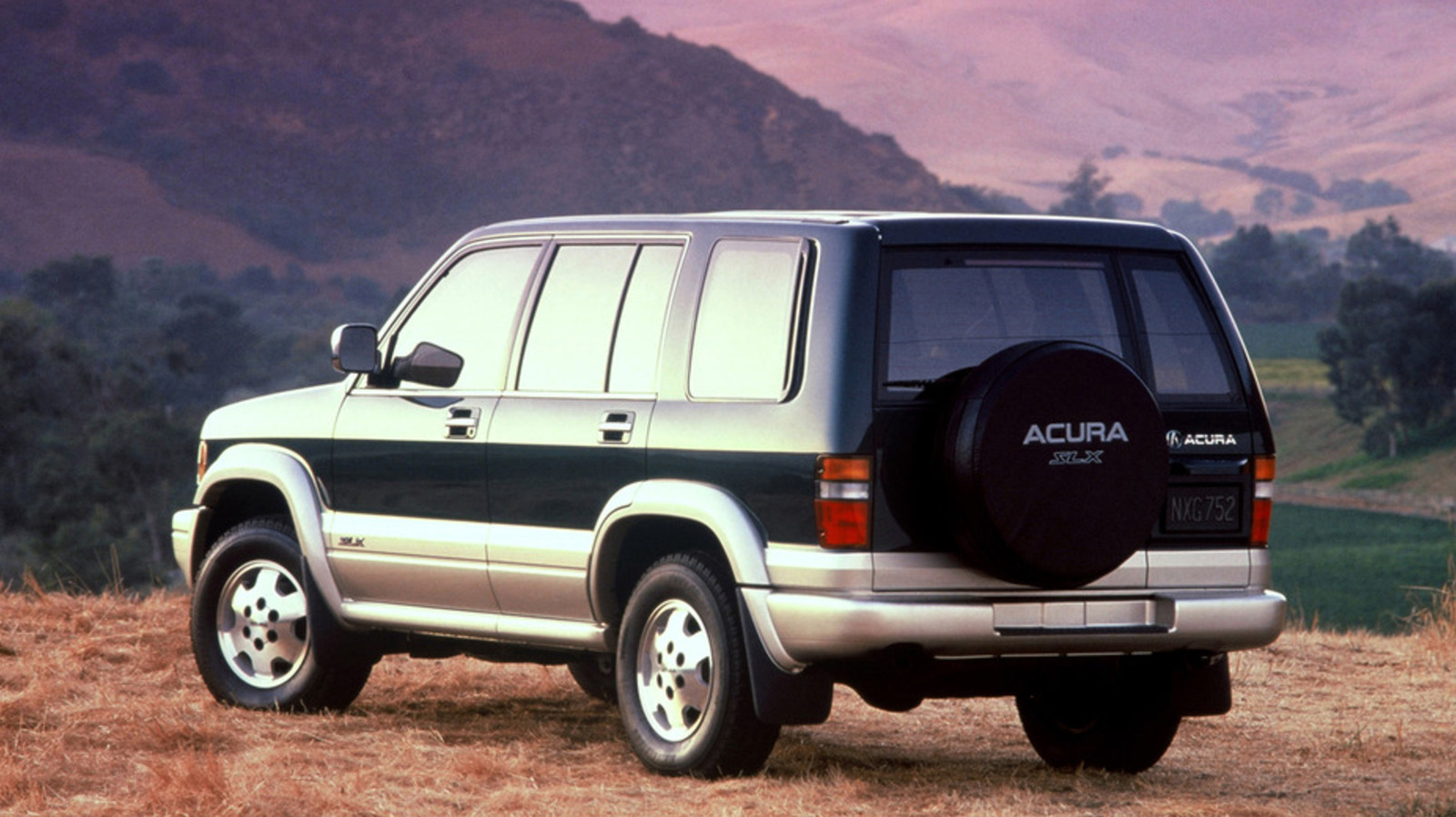
A luxury-badge SUV launch that quickly ran into a safety cloud
When Acura entered the SUV market in 1996 with the SLX, it was trying to extend its premium import lineup into one of the industry’s most important growth segments. Instead, the model became tied to one of the most damaging safety judgments a vehicle can receive from Consumer Reports.
The SLX was closely related to the Isuzu Trooper, effectively a rebadged version of that vehicle with Acura branding and positioning. That connection became a major problem when Consumer Reports tested both models in an avoidance maneuver and concluded that their outside wheels could lift off the ground during sudden steering inputs intended to avoid an obstacle. The publication rated both vehicles “not acceptable,” citing rollover risk.
That verdict became the defining story of the SLX. For a new entrant from a luxury brand, the timing could hardly have been worse. Acura was attempting to establish credibility in the SUV category, but the Consumer Reports finding turned the conversation toward stability and safety rather than refinement, utility, or market expansion.
Why the result mattered so much
Consumer Reports has long had outsized influence in the U.S. auto market because its ratings can shape mainstream buyer perception very quickly. A label as severe as “not acceptable” does more than dent a review cycle. It can make a vehicle seem categorically unsafe, even when regulatory agencies do not necessarily reach the same conclusion.
That is largely what happened here. According to the supplied source material, the SLX and Trooper were flagged after the magazine’s routine testing suggested a high rollover risk in abrupt maneuvers. The charge was serious enough to become a lasting part of the vehicle’s reputation, and it aligned with a broader public concern from that era about SUV rollover behavior.
Acura’s challenge was made harder by the underlying architecture of the vehicle. SUVs generally sit higher than passenger cars, raising the center of gravity and increasing rollover susceptibility relative to lower-slung designs. That does not automatically make any single model defective, but it does mean that stability concerns can become central if testing reveals troubling behavior at the margins.
A dispute that never fully settled the public narrative
The SLX story also shows the gap that can open between consumer testing, engineering arguments, and regulatory interpretation. The source text notes that when the National Highway Traffic Safety Administration examined the situation at Consumer Reports’ request, the agency declined to pursue a further investigation. A spokesperson said the agency could not identify a defect.
That did not erase the consumer-facing damage. Once the vehicle had been publicly associated with wheel lift and rollover risk, the marketplace had already absorbed the headline. For many shoppers, the distinction between a failed magazine test and a federally established defect is less important than the existence of a visible warning from a trusted publication.
The source also points to a narrower technical dispute. Consumer Reports singled out 1995 and 1996 Trooper and SLX models with suspension changes, while statements cited from Isuzu engineers said those updates did not alter the center of gravity. Later suspension revisions also were not explicitly tied by Acura to the rollover controversy. Even so, the public story was already set.
Commercial consequences for Acura
The sales effect was severe. The supplied source says Acura sold only about 6,590 units of the SLX over its four-year production run. For a brand trying to establish itself in a new segment, that is a small total and a sign that the vehicle never escaped the shadow of the test result.
The SLX was eventually replaced by the MDX for the 2001 model year, a vehicle designed in-house by Acura rather than sourced from Isuzu. In hindsight, that transition looks like more than a normal product-cycle change. It marked a strategic reset. Acura moved from a borrowed platform carrying outside baggage to a model it could define on its own terms.
The contrast is especially notable because the MDX went on to become a much more important product for Acura than the SLX ever was. The lesson is straightforward: in a category where buyers weigh family use, cargo needs, and all-weather confidence, trust is not optional. A model can recover from a weak value proposition or conservative styling. Recovering from a widely publicized safety stigma is much harder.
Why the SLX remains a cautionary case
The Acura SLX is now a reminder of how fragile a new-market expansion can be when a company depends on a lightly differentiated rebadge and then loses control of the product narrative. Acura entered the SUV space at a moment when the segment was growing, but the vehicle’s identity became inseparable from the Trooper’s testing controversy.
It also remains relevant because rollover concerns have never entirely disappeared from the SUV discussion. Vehicle design has advanced, and stability systems have improved, but the underlying tradeoff between height, mass distribution, and handling limits still matters.
For Acura, the SLX was not just an underperforming model. It was an early lesson that entering a major category requires more than a badge, upscale trim, or market timing. It requires a product robust enough to survive the harshest scrutiny. The SLX did not, and Consumer Reports’ “not acceptable” label is the reason people still remember it today.
This article is based on reporting by Jalopnik. Read the original article.
Originally published on jalopnik.com