Ford goes back to the electric drag-racing playbook
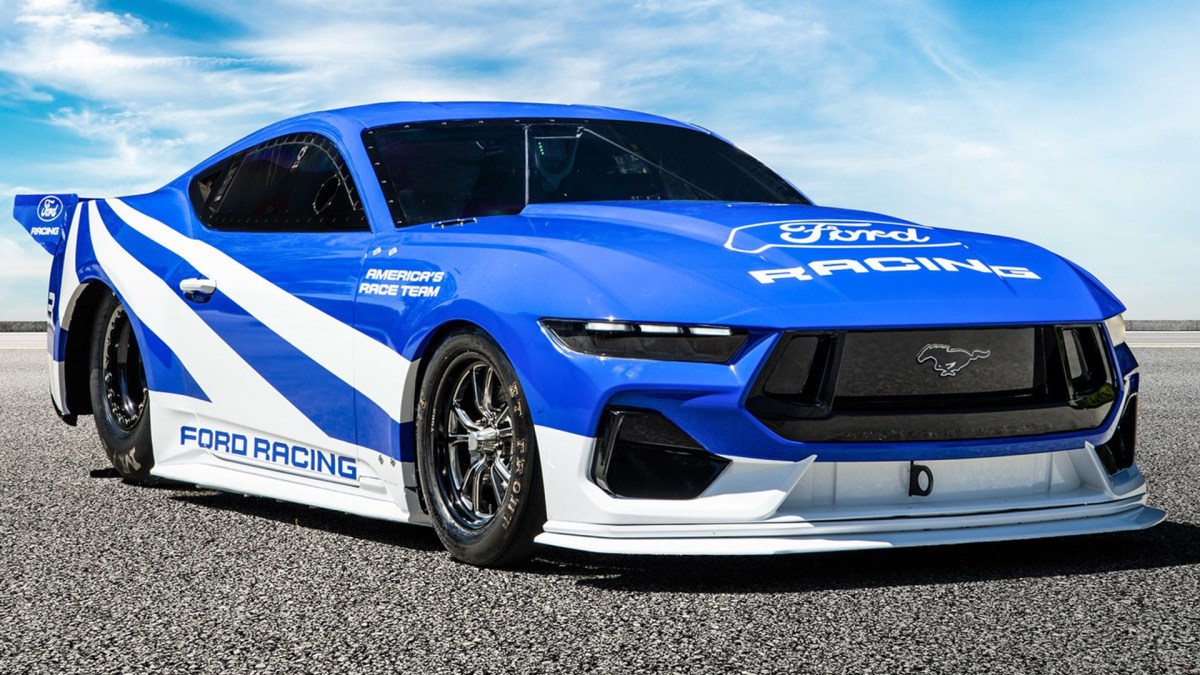
Ford has unveiled a new Mustang Cobra Jet drag car, and it is electric again. According to The Drive, the latest version is called the Cobra Jet 2200 and is rated at 2,200 horsepower. Ford said the car will appear at the NHRA 4-Wide Nationals in Charlotte, where it is expected to make demonstration runs.
The headline number is the obvious draw. At 2,200 horsepower, the Cobra Jet 2200 becomes the latest in a sequence of extreme electric Mustang drag machines intended to show what battery-electric drivetrains can do in a format where instant torque matters most.
The third straight electric Cobra Jet
This is not Ford’s first attempt. The report notes that the first electric Mustang Cobra Jet arrived in 2021 with 1,400 horsepower and went on to break an NHRA quarter-mile record at 8.128 seconds and 171.97 miles per hour. Ford followed that with the Cobra Jet 1800 in 2023, a vehicle built specifically to push the benchmark further.
That history makes the new car less of a surprise and more of an escalation. The progression from 1,400 horsepower to 1,800 and now 2,200 shows that Ford is continuing to use the Cobra Jet nameplate as a high-visibility laboratory for electric straight-line performance. In that narrow mission, EVs are a natural fit. Drag racing rewards violent, repeatable acceleration, and electric powertrains deliver it well.
Performance is not the same as novelty
What makes this launch interesting is not just the specification, but the reaction around it. The Drive argues that another electric Cobra Jet may feel less futuristic than earlier iterations did. In 2021, a 1,400-horsepower electric drag Mustang still had shock value. In 2026, the idea of a very fast EV no longer lands the same way.
That shift says something about the market. The underlying performance case for EVs remains strong, especially in a straight line. But the cultural power of that performance has changed. A one-off electric monster no longer sells itself as pure novelty when electric propulsion is already part of everyday driving.
That may be why Ford’s other electric demonstrators have drawn attention in different ways. The report points to the SuperVan 4.2 at Pikes Peak and a 2,250-horsepower Mach-E with active aerodynamics and carbon brakes. Those vehicles combine power with unusual formats, extreme design, or broader engineering experimentation. The Cobra Jet formula, by contrast, is now familiar.
Ford’s broader message on propulsion choices
The debut also lands at a moment when automakers are speaking more cautiously about the pace of electrification. The Drive cites comments from Ford Racing Global Director Mark Rushbrook, who said the company remains committed to offering internal-combustion, hybrid, and full-electric vehicles, even if the path to an all-EV future is slower than previously expected.
That makes the Cobra Jet 2200 more than a stunt car. It is also a statement that Ford still sees value in electric performance development, even as the company acknowledges that customer demand is spread across multiple powertrains. The electric drag car becomes a low-volume but high-visibility way to keep pushing technical boundaries without pretending the entire market is moving in one direction at one speed.
What to watch in Charlotte
Ford has not yet published a deep technical breakdown in the material cited here, so key details remain unknown. The report says specifics are still scarce, and it is not yet clear what combination of battery, motor setup, weight, or chassis changes underpins the 2,200-horsepower figure.
That leaves the NHRA appearance as the real next data point. If the Cobra Jet 2200 posts a meaningful run, the story will shift from headline horsepower to actual elapsed time. In drag racing, that is what counts. The quickest car wins, and electric power still gives Ford a compelling tool for that job.
The harder question is whether that will be enough to move the public imagination. The Cobra Jet 2200 looks set to be very fast. Whether it also feels new is a different matter.
This article is based on reporting by The Drive. Read the original article.
Originally published on thedrive.com