A Surviving Relic of Kubota's Ambitious Past
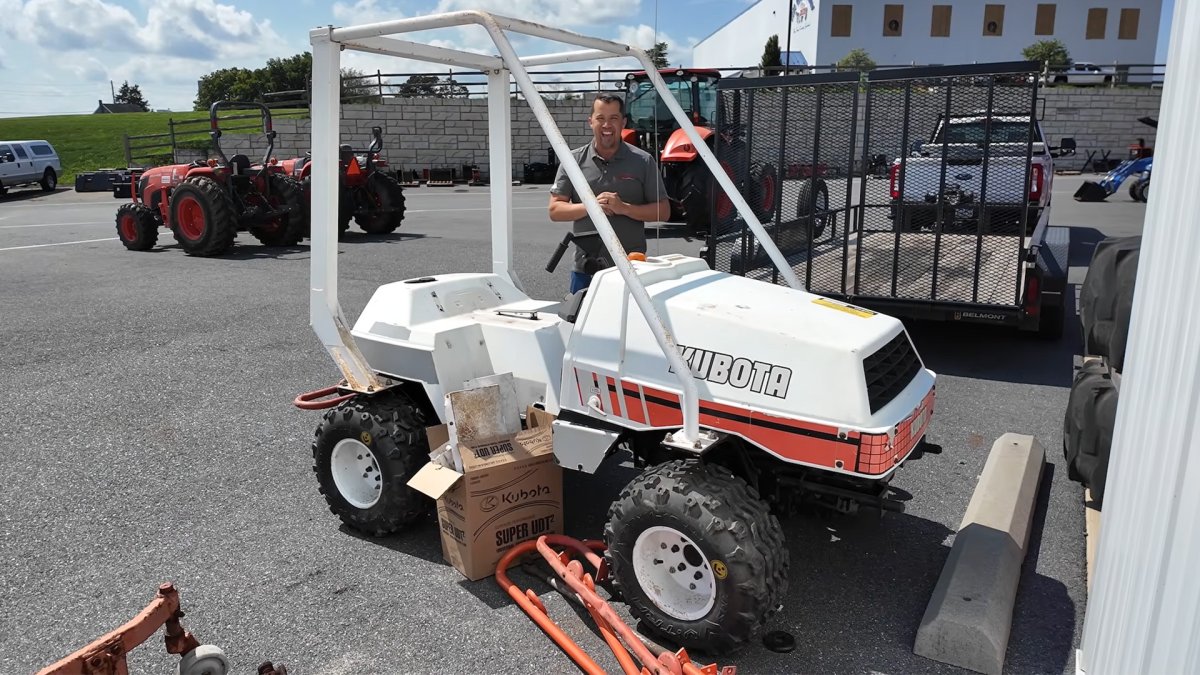
The far corners of farm machinery history are full of inventions that seemed like good ideas but never quite found their rhythm. Few are as fascinating as the Kubota PX-2100, a compact tractor from the 1980s that could be operated by remote control, way before ubiquitous electronics and autonomous farming became a modern refrain. For decades, most people had never seen one in person, and serious documentation was scarce. That changed recently when Neil Messick, of Messick's Farm Equipment, showcased a surviving example of the PX-2100 on his company's YouTube channel.
Messick is known for his deep interest in agricultural history, and the video reveals a machine that looks every bit the product of an era brimming with optimism about microchips and automation. His discovery offers a rare public look at a tractor that was, and remains, an outlier in Kubota's product lineage. The find is important not because the tractor was popular; it wasn't. Instead, it is a time capsule of what forward-thinking tractor engineers believed the future would hold some four decades ago, and a reminder of how much the industry has changed since.
Futuristic Tech Packed Into a Compact Frame
The PX-2100 was not a massive row-crop machine. It was a compact tractor built around a modest 20-horsepower, three-cylinder engine. That power output seems considerably humble alongside today's full-size agricultural equipment, but it was carefully matched to the tractor's intended work. Kubota targeted governments and municipalities, suggesting the PX-2100 as a solution for mowing ditches and other awkward spaces where getting onboard a machine might be inconvenient, uncomfortable, or unsafe.
The tractor was sold with a PTO-driven mower deck sized for roadside work, making it a self-contained unit for grounds maintenance. But beneath that utilitarian exterior hid a suite of technology that was startlingly advanced for the time. The PX-2100 featured four-wheel steering with the ability to crab-walk, which allowed the tractor to move diagonally while keeping the body oriented in a straight line. That capability would be useful in tight quarters and on slopes, giving operators maneuverability that was rare on any vehicle in the 1980s, let alone a tractor.
Remote Control and Fly-by-Wire Operation
The signature feature, however, was the remote control. With a claimed 100-meter range, the operator could stand at a distance and guide the tractor without needing to be seated. According to the source, all the tractor's systems were managed by fly-by-wire, eliminating mechanical links between the driver controls and the wheels. That meant the unusual yoke-like steering mechanism communicated with the wheels using electronics rather than direct physical connections, a deeply modern architecture at a time when most farm equipment was entirely hydraulic or mechanical.
An electronic control box mounted beneath the seat acted as the system's hub, overseeing the network of components. For a person accustomed to wiring work, it might seem intimidating, but for a couple of decades later it is easy to recognize this box as an early example of what has become standard electronic control architecture in modern machinery. That control box was effectively the tractor's brain, coordinating commands from the remote and translating them into actions from the engine, steering, and transmission.
The Drivetrain and Steering Details
Beyond the headline RC capability, the PX-2100 was equipped with a hydrostatic transmission, a feature that was not especially common on compact tractors in that era. Combined with its sophisticated steering and fly-by-wire controls, it gave the machine a decidedly high-tech character. Kubota was not yet a household name in the United States some forty years ago, so this ambitious product had to introduce both the brand and a radical new way of operating a tractor to skeptical buyers.
Kubota's bet was that the PX-2100's technical wizardry would sell itself. In practice, the complexity likely worked against it.
The Obstacles That Made It a Flop
Most modern farmers care deeply about machinery repairability, and that concern is hardly new. Although the system was forward-looking, treating a tractor like a computer presented obvious maintenance difficulties in an era before specialized diagnostic tools in every shop. As the Messick video points out, the PX-2100 was, in a word, too complex for its time. Today's electronics are built with user-friendly diagnostics in mind; in 1980s, those systems would have been difficult to troubleshoot and expensive to repair when something went wrong.
One can only imagine the hesitation of a municipal public works department considering a piece of equipment that required specialized understanding to repair.
Several factors likely pushed the PX-2100 into obscurity:
- The remote-control function, though novel, was not a core need for many potential customers.
- Maintenance and repairability concerns made technicians wary of adopting an unproven electronic control system.
- The compact 20-horsepower platform limited the machine to light-duty tasks, narrowing its appeal.
- Its futuristic design and controls were unfamiliar to operators used to sitting on a conventional tractor and steering with a wheel.
- High-tech components drove up the price, making it hard to justify next to more conventional, lower-cost options.
An Eye-Watering Price Tag
Ultimately, purchase price made the innovation a tough sell. The PX-2100 had a starting price of $22,000, which, when adjusted for inflation, equals nearly $75,000 in today's money. From a modern perspective, seventy-five thousand dollars for a compact tractor with only 20 horsepower is a hard pill to swallow even with a remote-control feature.
That price placed it in a strange position. It was too small and too expensive for serious agricultural work, and its high-tech features were geared toward niche government applications. The value proposition was unclear, especially for farmers who could buy a larger, more powerful machine for the same cost or a conventional compact for far less. The PX-2100, in other words, was priced as an innovation showcase, not as a utility tool.
A Missing Page in Tractor History
Because these rigs vanished from the market, very little reliable knowledge about them has survived. The PX-2100's specifications and actual production history are sparsely documented, which makes Messick's video particularly valuable. His walkaround offers an intimate look at how Kubota approached electronically controlled machinery before it had global brand recognition in the United States.
This rare survivor provides an opportunity to reflect on the evolution of agricultural technology.
Today's farmers are increasingly comfortable with electronics and GPS-guided equipment. What seemed like science fiction in the 1980s is now an everyday reality, and the PX-2100 stands as a curious precursor. Though it never achieved success in its own day, its ideas about remote control and drive-by-wire machinery anticipated a future that eventually caught up. The tractor was not a commercial success, but it proved that Kubota was willing to experiment and think differently about how heavy machinery might operate.
As we look at machines like the PX-2100 on video, we're reminded that progress often begins with ideas that are too far ahead. Some of those concepts fail, but they leave breadcrumbs for the innovations that follow.
This article is based on reporting by The Drive. Read the original article.
Originally published on thedrive.com