An Italian Grand Tourer With an American Accent
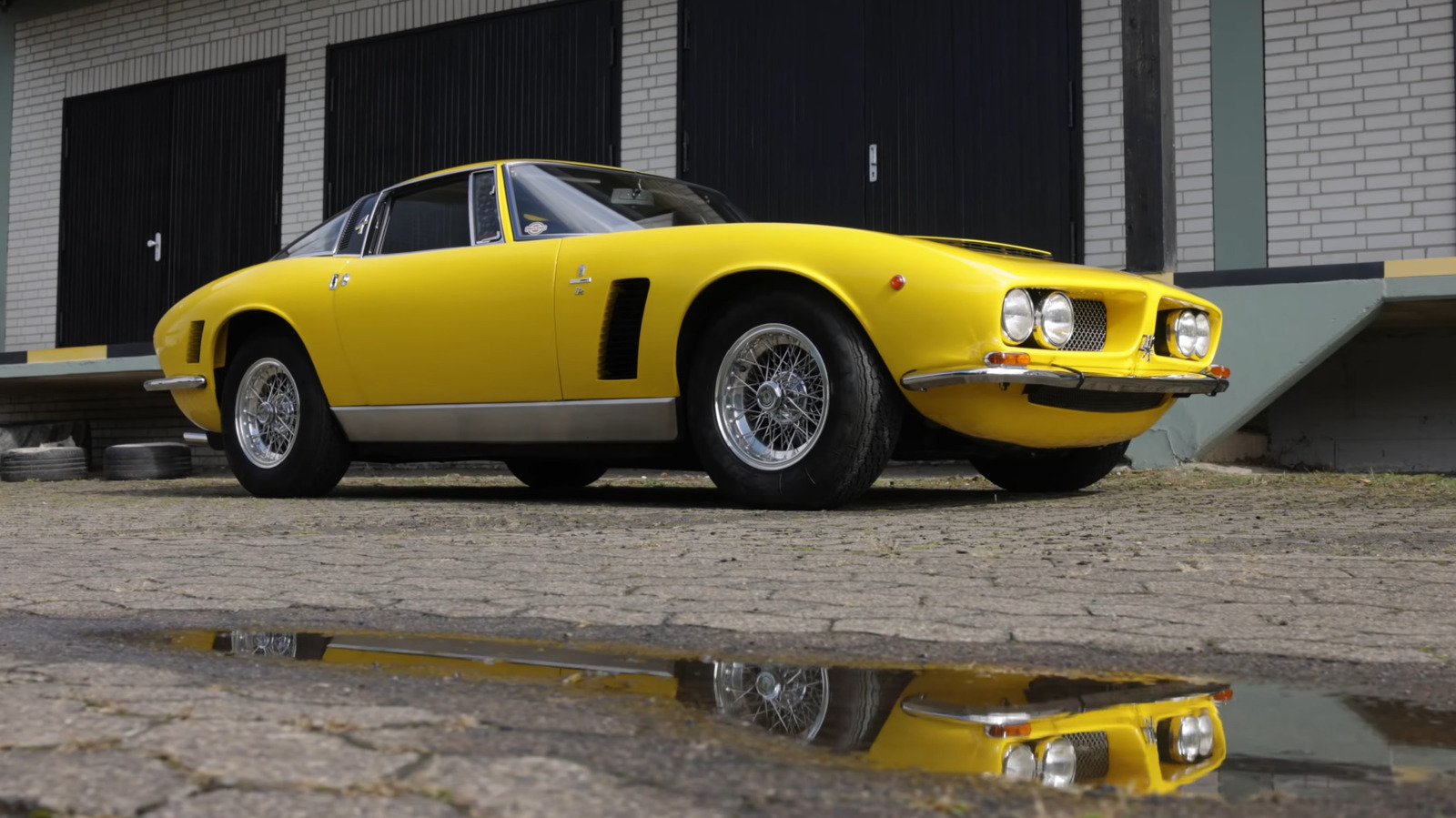
The Iso Grifo belongs to a very specific and very appealing chapter of automotive history: the European exotic powered by an American engine. It was far from the first car to try the formula — the Facel Vega HK500, the Jensen Interceptor, and De Tomaso's Mangusta and Pantera all did something similar — but few machines pulled it off with as much style or as much raw capability. The Grifo was a low-slung grand tourer whose elegant lines were backed by enough Detroit-derived grunt to trouble even the fastest sports cars of its day.
Production was tiny. Only around 400 examples were built across a run that lasted nearly a decade, and when that run finished, the company behind the car closed down for good. More than 50 years after it first appeared, the Grifo remains a car worth talking about — which is the premise behind a Jalopnik feature by Chloe Clougher that gathered seven facts about the model, from its six-figure modern values to the way its biggest V8 stacked up against the V12s of Lamborghini and Ferrari.
Turin, 1963: Where the Grifo Story Begins
The Grifo made its public debut at the 1963 Turin Motor Show, where the covers came off a body shaped by Giugiaro. That reveal is the starting point for everything that followed. The car's proportions and surfacing gave it a presence that sat comfortably alongside the established Italian exotics of the era, and it is a large part of why the model is still celebrated today.
What makes the design story notable is the pairing it represented. This was not an Italian car trying to hide its American hardware. It was an Italian car that openly embraced it, wrapping a muscular drivetrain in coachwork that could hold its own on a show stand in Turin.

Rarity Was Engineered Into the Grifo
Survival rates and production totals matter enormously in the collector market, and the Grifo scores highly on both fronts. Roughly 400 cars were completed over a production life of close to ten years — a figure that would be modest for a single model year at most mainstream makers, let alone for an entire decade.
The scarcity was not the result of a deliberate limited-edition strategy. It was simply how many cars the operation managed to build before it ceased to exist. When the Grifo's production run ended, so did the manufacturer. That combination of a short, finite build and the disappearance of the marque has helped cement the car's status among enthusiasts who prize the unusual over the obvious.
An American Attitude Toward Engine Choice
Here is where the Grifo diverges sharply from its European rivals. Ferrari buyers of the era knew exactly what they were getting: a 365 GTB/4 came with a 4.4-liter Colombo V12 regardless of model year. Lamborghini Miura customers all received a 3.9-liter V12. Every Aston Martin DB5 left the factory with a 4.0-liter inline-six designed by Tadek Marek.
Iso took the opposite approach. Just as late-1960s Corvettes and Mustangs could be ordered with a wide menu of small-block and big-block V8s, the Grifo let buyers choose their power. The company was competing against Europe's elite, but it adopted an American heart and an American attitude toward powertrain variety at the same time.
Series I: Chevrolet Small Blocks
In its earliest form, the Grifo relied on Chevrolet small-block power. The base Series I car used a 327-cubic-inch Chevy V8, with output landing somewhere between 300 and 350 horsepower. Customers who wanted more had the option of a 350-cubic-inch Chevrolet small block as well, giving the entry-level Grifo a meaningful spread of performance depending on how it was specified.
Series II and the Ford 351 Cleveland
The engine story changed for the later cars. From 1972 onward, Series II Grifos — known as IR-8 models — were fitted with Ford's 351 Cleveland V8, which produced roughly 330 horsepower. These Ford-powered cars are especially rare: only 37 of them were ever sold. For collectors chasing the least-common variant, that number makes the IR-8 a distinct sub-species within an already tiny population.
Big Blocks, Tri-Power, and the Move to 454 Cubic Inches
The headline performance came from Chevrolet's big-block 427, which in Grifo form was rated at up to 435 horsepower and 460 pound-feet of torque. That output was achieved with a Tri-Power induction setup — a trio of two-barrel carburetors feeding the engine, a configuration familiar to anyone who knows American muscle cars of the period.
Some Grifos went bigger still, using a 454-cubic-inch Chevrolet engine. In other words, the top of the Grifo range did not just borrow American power; it borrowed the most aggressive American power available.

How the Grifo's 435 Horsepower Compared
The fascination with the Grifo's biggest engine is not just about displacement. It is about context. Against the single-specification V12 Ferraris and Lamborghinis of the era, a 435-horsepower American V8 represented a very different engineering philosophy — one built on accessible torque and brute capacity rather than high-revving, quad-cam complexity. The Jalopnik feature frames the comparison directly, weighing the Grifo's peak output against the engines offered by Lamborghini and Ferrari at the time.
That contrast is exactly why the car resonates. It was not trying to beat Italy's finest at their own game. It was playing a different game entirely, and in the estimation of many enthusiasts, playing it better than anyone else who attempted the same trick.
What a Grifo Is Worth Today
The market has noticed. Grifos now command valuations north of $300,000, a figure that reflects both the model's rarity and its reputation as the most successful marriage of Italian design and American muscle. With only a few hundred cars built and a substantial portion of them surviving into the collector era, demand has consistently outpaced supply.
Those valuations place the Grifo firmly in the upper tier of classic GT ownership, alongside far more famous machinery. It is a reminder that low production numbers plus genuine historical significance plus a great story tend to produce strong prices over the long term.
Why the Grifo Still Matters
The Grifo is a useful corrective to the assumption that great Italian exotics must be powered by Italian engines. Its appeal came from the combination: Giugiaro lines, a low, aggressive stance, and a drivetrain that could be ordered in an almost bewildering variety of forms. The car was discontinued decades ago and its maker vanished with it, yet the Grifo's reputation has only grown.
More than 50 years after its Turin debut, it remains the benchmark for the American-V8 Italian exotic — the car that took a familiar idea and executed it with more style, more power, and more audacity than the competition.
Key Takeaways
- The Iso Grifo debuted at the 1963 Turin Motor Show with Giugiaro-designed bodywork.
- Roughly 400 cars were built over a production run of nearly ten years.
- Series I models used Chevrolet 327 and 350 small blocks, rated between 300 and 350 horsepower.
- From 1972, Series II IR-8 cars used a Ford 351 Cleveland making around 330 horsepower; only 37 were sold.
- Big-block options included a Chevrolet 427 with up to 435 horsepower and 460 pound-feet of torque via Tri-Power carburetion, plus a 454-cubic-inch Chevrolet engine.
- Ferrari, Lamborghini, and Aston Martin offered one engine per model in the same period; Iso offered a menu.
- Today, Grifo values exceed $300,000.
This article is based on reporting by Jalopnik. Read the original article.
Originally published on jalopnik.com