A Patent That Sounds Like a Movie Gag
Stellantis has filed a patent application with a title that sounds almost boring: High-Voltage Battery Quick Release System For Vehicle. But the details are anything but. The system is designed to deal with one of the most frightening failure modes of an electric vehicle: a lithium-ion battery pack that catches fire and refuses to go out. Instead of trying to suppress the blaze while the pack remains attached, the patent describes a way to separate the pack from the car and let it fall to the ground. Jalopnik's Justin Hughes noted that if the idea were a Fast and Furious plot device, it might be called ejecto batteryo. It is a solution that feels very Dodge.
How the Quick-Release Battery Drop Works
The core idea is mechanical. A high-voltage battery pack is normally held in place by a pair of opposing castellated frames. When the system is triggered, those frames move against each other until their gaps line up. At that point, gravity does the rest, and the battery drops away from the vehicle. The patent also mentions pyrotechnic fasteners, which could use explosive charges to release the pack. For a brand like Dodge, explosive bolts might seem more on-theme, but either approach aims at the same goal: get the battery out from under the occupants before the fire spreads.
This is different from a previously reported design from Chinese automaker Chery. That system, according to Jalopnik, forcefully launches the battery out the side of the car. While that might remove the burning pack quickly, it also turns the battery into a projectile that could endanger pedestrians, cyclists, pets, or anything else in its path. Dodge's version is less dramatic. It unplugs the pack and drops it downward rather than firing it sideways. The distinction matters because a safety system that creates a new hazard for bystanders is not much of a safety system.
Gravity Versus Explosives
The patent leaves room for both gravity and pyrotechnic release. In one version, the interlocking frames simply shift and let the pack fall. In another, explosive fasteners detonate to accomplish the same separation. The irony is hard to miss: a burning lithium-ion battery is already a severe fire risk, and adding small explosions is not an obvious recipe for calm. Yet if the goal is to move the hazard away from the passenger compartment as fast as possible, the logic is understandable. The system is not trying to extinguish the fire. It is trying to change the fire's address.
The 12-Volt Battery Becomes a Getaway Engine
Once the high-voltage pack is on the ground, a new problem appears. The car is still sitting on top of the battery, and it has just ejected the very component that normally drives it. That is where the patent's most clever detail comes in. The standard 12-volt battery is connected to the drive system. It can use that small reserve of energy to move the vehicle a short but safe distance away from the burning pack. The car cannot travel far or fast, but it can creep out of immediate danger.
Jalopnik compared this to a starship using impulse engines to pull away from an ejected warp core before it explodes. The analogy fits. The 12-volt battery is not meant for highway speeds or long ranges. It is a limp-home, or in this case a limp-away, power source. Its job is to put a few feet or yards between the vehicle and the fire, giving occupants a better chance to exit and avoid the worst of the thermal event.
The Burning Battery Is Still Somebody's Problem
The patent solves one problem while leaving another behind. After the car drives away, the burning battery remains exactly where the vehicle used to be. Lithium-ion battery fires are notoriously difficult to extinguish, often requiring tens of thousands of gallons of water. Even then, they can reignite. The patent does not offer a solution for that. It simply relocates the danger. The occupants are safer, and the car minus its battery may be intact, but the raging inferno is now an issue for someone else.
That raises obvious concerns. In a dense city, a dropped and burning battery could threaten nearby vehicles, buildings, or infrastructure. In a drought-stricken area or a region vulnerable to wildfires, a large battery fire on the ground could be far more than a local inconvenience. The system protects the people inside the car, but it does so by externalizing risk to the surrounding environment. Whether that trade-off is acceptable would depend on how rare such fires are, how quickly emergency responders can reach the scene, and whether the battery can be moved or contained after ejection.
A Different Kind of Safety Trade-Off
Automotive safety features usually try to reduce harm for everyone involved. Seat belts, crumple zones, and airbags protect occupants while generally avoiding new dangers for people outside the vehicle. The ejecting battery patent is more complicated. It prioritizes the occupants and the vehicle over the immediate surroundings. That does not make it useless. In a remote area, dropping a burning pack and driving away could be a reasonable last resort. In a crowded parking garage or on a city street, the same action could create a new emergency.
Why It Feels Like a Dodge Idea
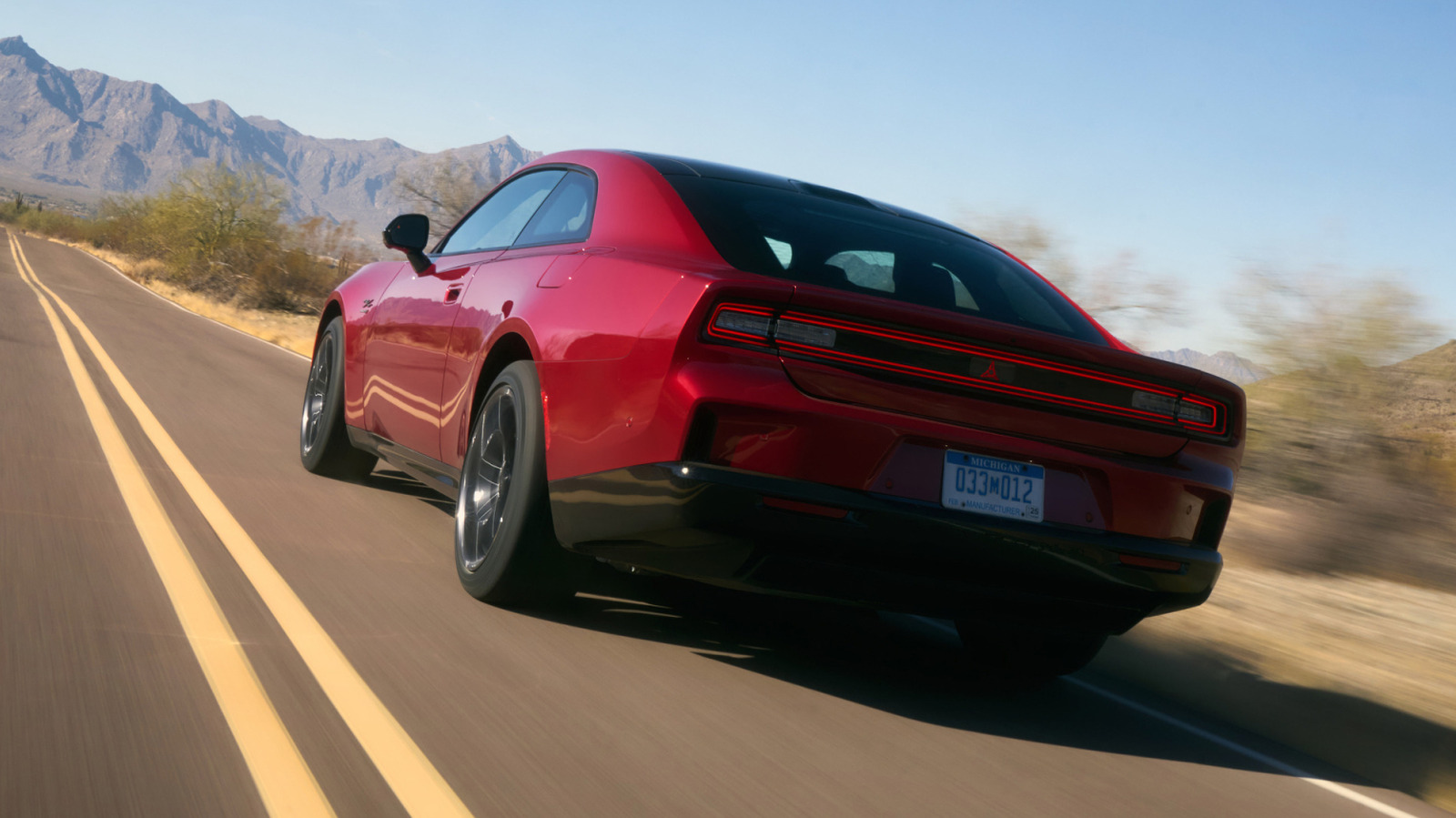
The patent arrives at a time when the Dodge Charger Daytona EV has not generated overwhelming enthusiasm. Jalopnik's piece notes that few people seem to want the electric Charger, yet Stellantis continues to develop technology that seems tailored to Dodge's image. The brand has long traded on muscle, attitude, and a touch of theatrical excess. A system that drops a flaming battery and then drives away using the 12-volt battery fits that persona almost too well. It is equal parts practical engineering and action-movie fantasy. The article even jokes that a Fast and Furious character, Roman Pearce, should be listed as an inventor. That fictional comparison captures the vibe: a dramatic escape from an exploding hazard, executed at low speed and with maximum style.
Will the Ejecting Battery Ever Reach Production?
Probably not. Patents are often filed to protect ideas that never make it to showrooms. Automakers explore far-fetched concepts for many reasons: to claim intellectual property, to study failure modes, or to keep engineers thinking about extreme scenarios. The high-voltage battery quick-release system could remain a piece of patent art, a curious footnote in the long history of EV safety research. Even if it never appears on a production Dodge, it highlights the difficult problem of lithium-ion battery fires. Once a pack enters thermal runaway, conventional firefighting can be slow and water-intensive. Automakers are still searching for better ways to prevent, contain, or manage those events.
The ejecting battery concept takes a different path. It does not try to stop the fire. It tries to put distance between the fire and the people who need to escape it. That is a blunt solution, but blunt solutions sometimes have a certain logic. The patent's biggest weakness is that the danger does not disappear. It just moves. For drivers in isolated areas, that might be enough. For everyone else nearby, it could be the beginning of a much larger problem.

The Bottom Line
Stellantis has patented a high-voltage battery quick-release system that drops a burning pack to the ground and uses the 12-volt battery to move the car away. It is a creative, slightly absurd, and very Dodge-like answer to EV fire safety. The system could protect occupants in a worst-case scenario, but it leaves a burning battery behind, potentially endangering surroundings. Patents rarely become production reality, and this one may never leave the drawing board. Still, it is a fascinating glimpse at how automakers are thinking about the hardest safety challenge posed by electric vehicles.
This article is based on reporting by Jalopnik. Read the original article.
Originally published on jalopnik.com