A long-running question in star formation gets fresh evidence
Roughly half of Sun-like stars are not alone. Many exist in binary or even more complex multiple-star systems, making the solar system’s solitary central star less typical than popular imagination often suggests. One of astronomy’s enduring questions is how those close stellar partnerships form in the first place. A new preprint described in the supplied source text argues that the dominant mechanism may be disk fragmentation.
The study, led by graduate student Ryan Sponzilli of the University of Illinois according to the source text, examined 51 infant binary systems and found evidence strongly favoring that explanation over a competing model known as turbulent fragmentation followed by inward migration. If that conclusion holds, it would sharpen one of the field’s key debates about how stars and their companions emerge from stellar nurseries.
Two competing formation stories
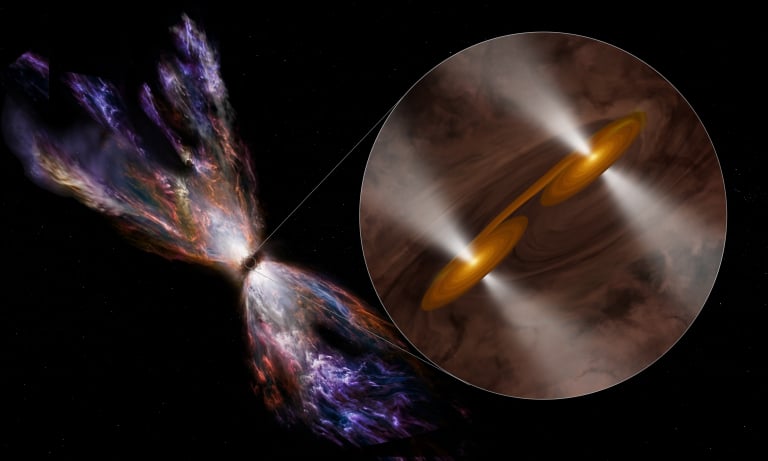
The two theories differ in both sequence and expected geometry. In the disk-fragmentation scenario, a single massive disk of gas and dust around a newborn star becomes unstable and breaks apart, eventually coalescing into another nearby star. Because both stars arise from the same rotating structure, their spins should be aligned.
The alternative picture begins earlier and more chaotically. In turbulent fragmentation followed by inward migration, turbulence in a cloud produces two widely separated clumps that each form a star. Gravitational interactions then draw the stars inward over time until they end up as a close binary pair. Since they formed in separate and disorderly conditions, their spins and orbital orientations should not line up in any consistent way.
That difference in predicted alignment gives astronomers a way to test the models. If young binaries tend to show synchronized orientations, disk fragmentation gains support. If their axes appear random, the turbulent scenario becomes more plausible.

How the team tested the idea
Directly measuring the rotation of very young stars is difficult because they are still wrapped in gas and dust. The researchers instead used a proxy: the streams of gas blasting away from the stars’ poles. According to the supplied source text, the team relied on data from the Atacama Large Millimeter Array, which traced carbon monoxide in these outflows.
Those jets provide a practical stand-in for the angular momentum of the system. If the outflows from the two stars in a binary are firing in parallel and are oriented in a way consistent with shared rotation, that implies the pair formed from the same spinning disk. If the jets point in mismatched directions, the system looks more like the product of separate, turbulent origins.
The reported result leans clearly toward the first explanation. The researchers found 42 outflows in the 51 binary pairs, across 38 systems. After statistical simulation, the source text says, the data strongly favored disk fragmentation.
Why that matters
This question is not a narrow technical dispute. The way binary systems form affects how astronomers think about star formation more broadly, including the evolution of disks, the transport of angular momentum, and the environments in which planets later emerge. If close binaries frequently come from disk fragmentation, then massive circumstellar disks are doing more than feeding one central star. Under the right conditions, they may be directly manufacturing stellar companions.
That has consequences for how common certain architectures should be and for what sorts of disks are likely to survive long enough to make planets. A close companion can strongly reshape surrounding material, altering where planets might form and whether stable planetary systems can persist. In that sense, understanding binary formation is part of understanding how ordinary or unusual our own solar history may be.
The result also reinforces a broader theme in modern astronomy: geometry matters. Many astrophysical debates that once seemed abstract are now being attacked through careful measurement of orientation, motion, and structure. Alignment is not merely a descriptive feature here. It is evidence that can distinguish between rival physical histories.
Caution and significance
As with many emerging astronomy results, some caution is appropriate. The paper is available in preprint, meaning it has not yet completed peer review. The source material does not claim the question is fully settled, only that the evidence from this sample strongly supports one theory over the other.
Even so, the study stands out because it grounds a long-running debate in observable consequences from a meaningful sample of very young systems. Rather than inferring formation pathways only from mature binaries whose early history is difficult to reconstruct, the team looked at infant systems closer to the process itself. That is one reason the result is compelling.
What it says about the Sun
The study also throws the solar system’s history into sharper relief. If half of Sun-like stars exist with companions and disk fragmentation is a common route to close binaries, then the Sun’s isolation becomes more interesting, not less. Solitary stars may require their own explanation, or at least different initial conditions, within a universe where companionship is frequently built into stellar birth.
That does not make the Sun exceptional in any grand philosophical sense, but it does remind us that the baseline picture of a star as a lone object is incomplete. In many cases, stars seem to be born in relationship. This preprint strengthens the argument that those relationships often begin not with distant fragments drifting together later, but with one unstable disk splitting its future into two.
If further study confirms the finding, disk fragmentation will move closer to the center of how astronomers explain close binary formation. That would be a meaningful shift in a field where the earliest moments of stellar life remain some of the hardest to reconstruct, and some of the most important for everything that follows.
This article is based on reporting by Universe Today. Read the original article.

Originally published on universetoday.com