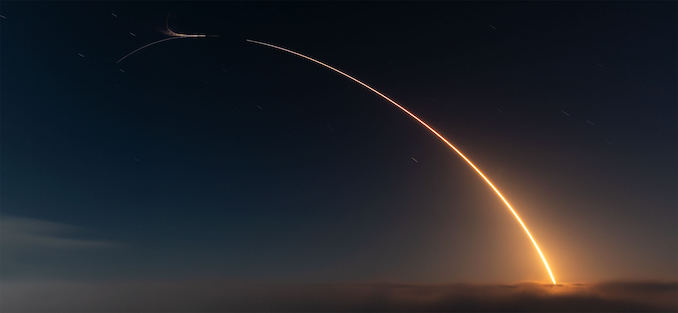
A late-night launch with broader significance
SpaceX’s upcoming Falcon 9 rideshare mission from Vandenberg Space Force Base is nominally about one Earth observation satellite and dozens of secondary payloads. In practice, it also says something about the current structure of global launch services. The mission, known as CAS500-2, is scheduled to lift off from Space Launch Complex 4 East with 45 payloads aboard, led by the Compact Advanced Satellite 500-2 built for Korea Aerospace Industries.
The primary spacecraft is part of South Korea’s CAS500 program, which the source text says is designed for precision ground-based observation. CAS500-2 is the second of two satellites in what KAI calls Phase 1 of that effort. Its deployment into a Sun-synchronous orbit about an hour after launch will mark another step in a national imaging program that has already had to absorb several years of delay.
From delay to deployment
One of the most revealing parts of the mission story is not the launch profile but the path that led to it. According to reporting cited in the source text, CAS500-2 had originally been scheduled to launch in 2022 on a Russian rocket. Russia’s war against Ukraine disrupted that plan, contributing to years of delay. Further delays followed after a change in SpaceX launch planning led to a separate mission rather than a joint launch with another satellite.
That sequence matters because it shows how launch timelines can be shaped by geopolitics as much as engineering. Satellite programs are often discussed in terms of payload readiness, orbital requirements, and manufacturing schedules. But access to orbit is also exposed to sanctions, war, launcher availability, and shifting commercial manifests. CAS500-2 is therefore more than a technical deployment. It is an example of how national space programs must navigate a launch market that can change abruptly.
It also underlines why allied launch relationships have become strategically important. In a pre-launch statement quoted in the source text, Space Launch Delta 30 said the mission reflects the strength of the U.S.-Republic of Korea alliance and Vandenberg’s role in enabling trusted international partners to place capabilities on orbit. Whatever the diplomatic phrasing, the operational point is clear: dependable access to launch has become part of broader security and technology cooperation.
Rideshare missions keep gaining strategic weight
The CAS500-2 flight also demonstrates the continuing rise of rideshare missions as a practical delivery model. Alongside the South Korean spacecraft, the Falcon 9 is set to carry 44 additional payloads. That multi-customer structure has become one of SpaceX’s most consequential offerings. It lowers the barrier to orbit for smaller missions while maximizing the utilization of each rocket.
Rideshare flights are often framed in purely commercial terms, but their significance is wider than cost-sharing. For governments, startups, and research organizations, regular rideshare opportunities can reduce dependence on bespoke launch campaigns that are harder to schedule and more vulnerable to disruption. For allied states, they can also provide a path to orbit using established infrastructure and flight-proven systems.
The mission architecture illustrates the point neatly. A single Falcon 9 will deliver a national Earth observation asset while also carrying a broad manifest of smaller payloads. That combination reflects a launch market increasingly organized around flexibility, cadence, and shared access rather than one payload per rocket.
Falcon 9’s operational track record remains central
The mission is also another reminder that reuse has moved from novelty to routine. The first stage assigned to the flight, booster B1071, is set to make its 33rd mission. The source text lists a varied resume that includes Germany’s SARah-1 satellite, NASA’s Surface Water and Ocean Topography mission, multiple National Reconnaissance Office launches, several smallsat rideshare flights, and numerous Starlink deliveries.
If the launch proceeds as planned, the booster will attempt a landing at Landing Zone 4 less than 7.5 minutes after liftoff. Spaceflight Now notes that a successful recovery would mark the 34th landing at that site and the 608th booster landing for SpaceX overall. Those numbers matter because they show how quickly launch reliability is now tied to reusability. What once looked experimental is now part of the expected mission flow.
For customers, that consistency can be as important as raw performance. National satellite operators do not just need launch capacity. They need predictable service, acceptable risk, and schedules that can survive market turbulence. Falcon 9’s flight history has made it a default option for many missions that might previously have been distributed across a wider range of providers.
A South Korean program still in motion
The CAS500 program itself remains unfinished. The source text says CAS500-4 and CAS500-5 make up Phase 2, but their planned 2025 launches have slipped and no new dates have been announced. That leaves CAS500-2 as part of a larger, still evolving national effort rather than an endpoint.
Even so, this mission carries symbolic and practical weight. Symbolically, it shows a delayed program regaining momentum after disruptions tied to war and launcher changes. Practically, it places another precision observation satellite in orbit through a commercial system that has become central to allied space access.
As launch markets consolidate around a handful of highly reliable providers, missions like CAS500-2 will increasingly be judged not only by whether they reach orbit, but by what they reveal about resilience. In this case, the lesson is straightforward: access to space now depends on a combination of diplomacy, commercial launch scale, and reusable systems able to absorb global shocks. CAS500-2 is one more example of that new normal.
This article is based on reporting by Spaceflight Now. Read the original article.
Originally published on spaceflightnow.com