Falcon Heavy returns with another major commercial mission
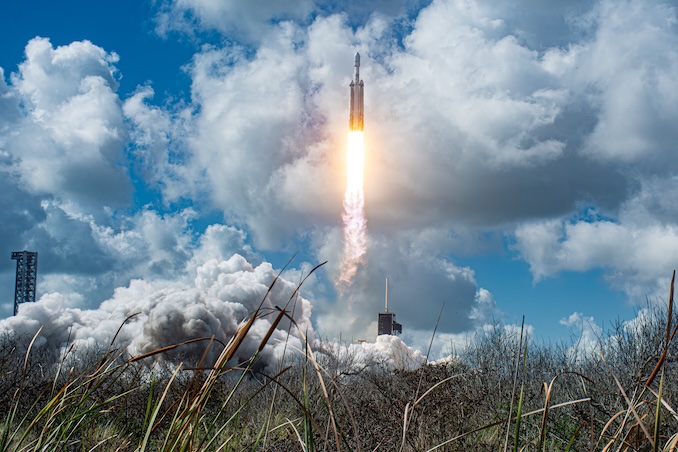
SpaceX launched the ViaSat-3 F3 communications satellite on April 29, sending the roughly six-ton spacecraft toward geosynchronous transfer orbit aboard a Falcon Heavy rocket. According to Spaceflight Now, the mission marked the 12th Falcon Heavy launch since the vehicle’s debut in 2018 and ended with confirmation that the satellite had been successfully deployed.
The launch lifted off from Launch Complex 39A at NASA’s Kennedy Space Center at 10:13 a.m. EDT. Falcon Heavy remains SpaceX’s most powerful operational rocket, and the mission showed the now-familiar combination that defines the vehicle: heavy-lift capability paired with partial reusability.
A flight profile built for long-duration delivery
The three-core rocket generated about 5 million pounds of thrust at liftoff as its 27 Merlin engines ignited together. Less than two and a half minutes into flight, the two side boosters separated from the center core. After a boost-back burn lasting more than a minute, both headed for landings at Cape Canaveral Space Force Station.
The center core continued for roughly another 90 seconds before stage separation. From there, the upper stage began a sequence of three burns spread over about five hours, a reminder that not every dramatic launch ends with immediate orbital insertion. For high-energy missions to geosynchronous transfer orbit, upper-stage endurance matters as much as liftoff spectacle.
Spaceflight Now reported that the upper stage carried an added thermal protection layer to withstand the long coast and multi-burn profile required for the mission. That is a notable detail because it highlights the degree to which even reusable, routine-seeming launch systems still rely on mission-specific adaptations.
Reusable boosters, evolving infrastructure
Less than eight minutes after launch, the side boosters, identified as B1072 and B1075, landed at Landing Zone 2 and Landing Zone 40. The report notes that this was the first Falcon Heavy mission to use SpaceX’s newest landing pad at Space Launch Complex 40.
That landing sequence has become a signature of SpaceX operations, but it still signals something important about the state of launch. Reusability is no longer just a test objective or a headline event. It is part of regular commercial execution. The center core was not recovered, which is typical for many Falcon Heavy missions, but the successful return of the side boosters keeps reinforcing the company’s operating model.
What ViaSat-3 F3 represents
The supplied materials focus more on the launch than the satellite’s service plan, but the mission itself is significant. Heavy communications spacecraft still depend on precise and reliable access to high-energy orbits, and Falcon Heavy continues to fill that role for payloads that exceed the capabilities or economics of smaller launch options.
For SpaceX, the flight adds another data point in a steady expansion of mission complexity across its fleet. For the broader industry, it shows that the heavy-lift market is no longer defined purely by government exploration or one-off prestige launches. Commercial communications infrastructure remains a major driver of demand.
A mature heavy-lift system with room to grow
The biggest takeaway from the mission is not novelty. It is maturity. Falcon Heavy launched on schedule, handled a long-duration profile, returned both side boosters, and delivered its payload successfully. That kind of repeatability matters in a launch market that increasingly rewards cadence and reliability as much as raw power.
Each such mission also contributes to a larger normalization of complex orbital logistics. Long upper-stage coasts, multi-burn insertions, and partial booster recovery are becoming operational habits rather than exceptions. In that sense, the ViaSat-3 F3 mission was not merely another satellite launch. It was another sign that heavy-lift reusability is settling into the industrial baseline of modern spaceflight.
This article is based on reporting by Spaceflight Now. Read the original article.
Originally published on spaceflightnow.com