Another Country Signs On to NASA’s Lunar Framework
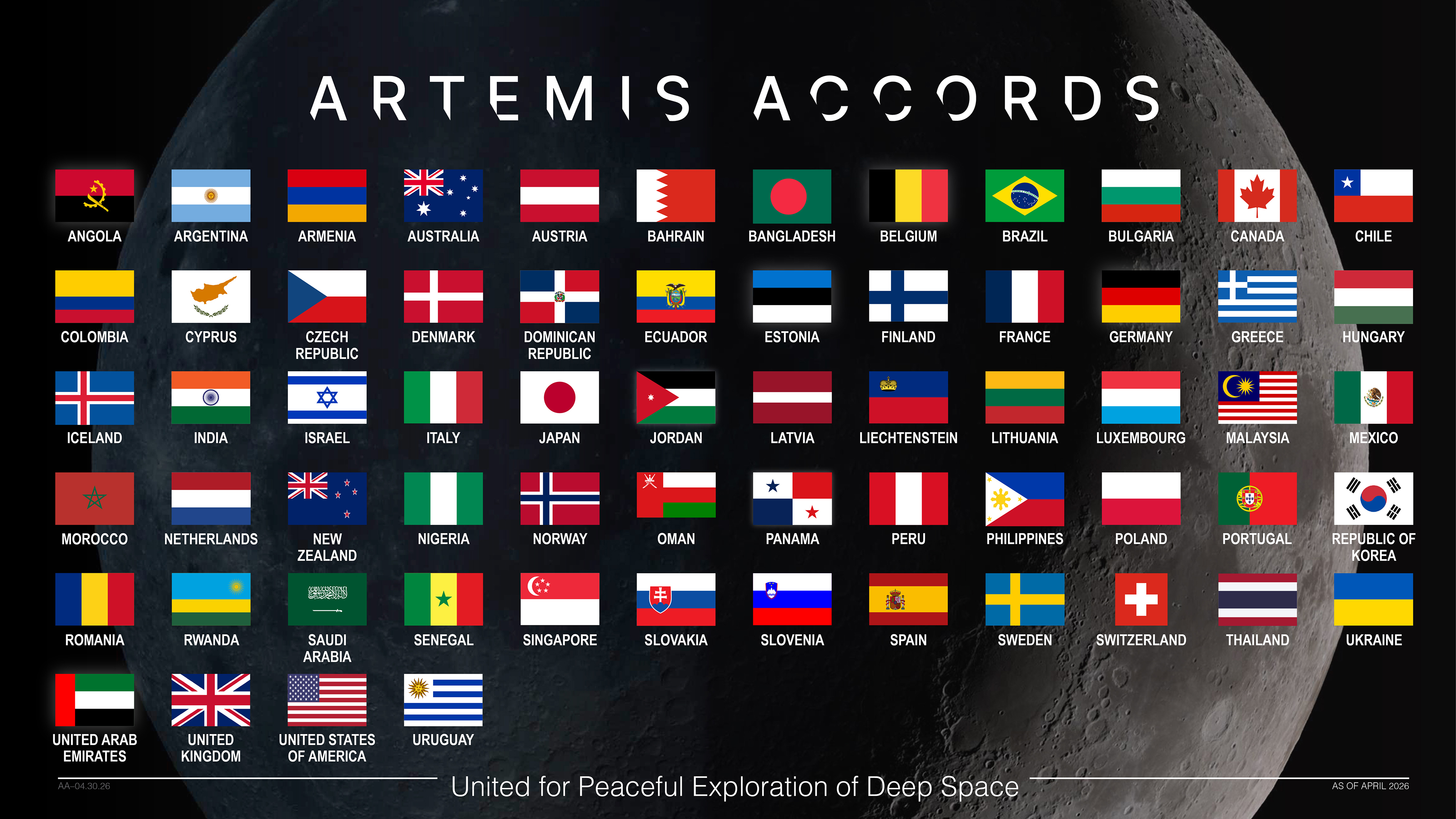
Morocco has become the 64th nation to sign the Artemis Accords, marking the latest expansion of the U.S.-backed framework for civil space cooperation. The signing took place on April 29 in Rabat, with Moroccan Foreign Minister Nasser Bourita signing on behalf of the country during a ceremony held alongside an official visit by U.S. Deputy Secretary of State Christopher Landau.
NASA framed the move as part of a broader effort to build a larger coalition around principles for peaceful and coordinated exploration of the Moon, Mars, and beyond. In recorded remarks included in the agency’s announcement, NASA Administrator Jared Isaacman said the accords began as a framework for like-minded nations to cooperate in the peaceful exploration of space and argued that partner nations would be able to make meaningful contributions to an enduring human presence on the lunar surface.
What the Accords Are Designed to Do
The Artemis Accords were established in 2020 by the United States, led by NASA and the State Department, together with seven founding nations. According to NASA’s description, they introduced a practical set of principles intended to improve safety, transparency, and coordination as both governments and private companies increase their involvement in lunar activities.
That mission has become more important as space is no longer defined solely by a handful of national agencies mounting occasional prestige missions. The Moon is increasingly treated as a destination for sustained operations, scientific work, technology demonstrations, and eventual commercial activity. That shift creates obvious governance questions: how countries share information, how they avoid interference, how they respond to emergencies, and how they preserve sites of historic significance.
The accords are NASA’s answer to those near-term operational problems. They are not a treaty replacing existing international space law. Rather, they are a framework that signatories agree to follow as they participate in civil exploration efforts.

The Principles Morocco Is Endorsing
NASA said signing the accords means committing to peaceful and transparent exploration, rendering aid to those in need, enabling access to scientific data, ensuring that activities do not interfere with those of others, and preserving historically significant sites and artifacts through the development of best practices.
Those principles sound broad, but they are closely tied to real future disputes that space planners expect to become harder as lunar activity expands. Interference can arise from competing operations in the same region. Data-sharing rules affect how scientific results are distributed. Heritage protections matter as more missions target areas connected to earlier human exploration. Emergency assistance becomes more consequential as missions become more frequent and complex.
By signing, Morocco is aligning itself with that emerging operational norm set. For NASA, every additional signatory strengthens the claim that the accords are becoming a widely accepted basis for how responsible exploration should work.
Why Morocco’s Signature Matters
Morocco is not joining a symbolic club with no strategic consequence. Each new signatory broadens the geographic and diplomatic reach of the accords, helping NASA and the United States demonstrate that the framework is not limited to a narrow bloc of traditional space powers. That matters politically as space governance becomes more contested and as nations seek influence over the rules that may shape lunar activity for decades.
The agency’s announcement also emphasized that more countries are expected to join in the coming months and years. That line is significant because it shows NASA still sees the accords as an active diplomatic project rather than a settled initiative. Expansion is part of the strategy.
Morocco’s participation may also help create new avenues for collaboration in science, technology, and policy. NASA’s statement did not announce any specific Moroccan lunar program or mission contribution. But the logic of the accords is that cooperation begins with shared principles before it matures into technical partnerships, data-sharing arrangements, and potentially broader participation in exploration programs.

The Accords as a Tool of Space Statecraft
The Artemis program is often described in engineering terms: rockets, spacecraft, landers, docking systems, and lunar surface operations. But the accords show that the project is also diplomatic infrastructure. NASA is not only trying to return astronauts to the Moon. It is also trying to shape the norms under which the next era of space activity will unfold.
That is why seemingly procedural announcements like this one deserve attention. They reveal the governance side of lunar exploration, where the competition is not only over hardware but over legitimacy, coordination, and standards of conduct. As more countries sign on, the accords become harder to dismiss as a purely American initiative and easier to present as a growing international baseline.
At the same time, their influence will ultimately depend on how signatories act. Principles gain weight when they are applied in real missions, real disputes, and real cooperative arrangements. The larger the coalition becomes, the more practical tests it will face.
What Comes Next
For now, the immediate takeaway is simple: the Artemis Accords continue to grow. With Morocco joining as the 64th signatory, NASA can point to another step in its effort to assemble an international framework for the next phase of civil space exploration.
The deeper significance lies in what the framework is meant to support. The Moon is moving from being a place visited occasionally to one that planners increasingly imagine as a site of repeated and overlapping activity. In that environment, operational norms matter almost as much as launch vehicles. Morocco’s signature adds one more country to the coalition trying to establish those norms before lunar traffic, competition, and commercial stakes become harder to manage.
As NASA continues to recruit new partners, the accords will remain one of the clearest indicators that the future of exploration is being built not only through missions, but through rules.
This article is based on reporting by NASA. Read the original article.

Originally published on nasa.gov