Asteroid mission planning may be getting a more efficient toolkit
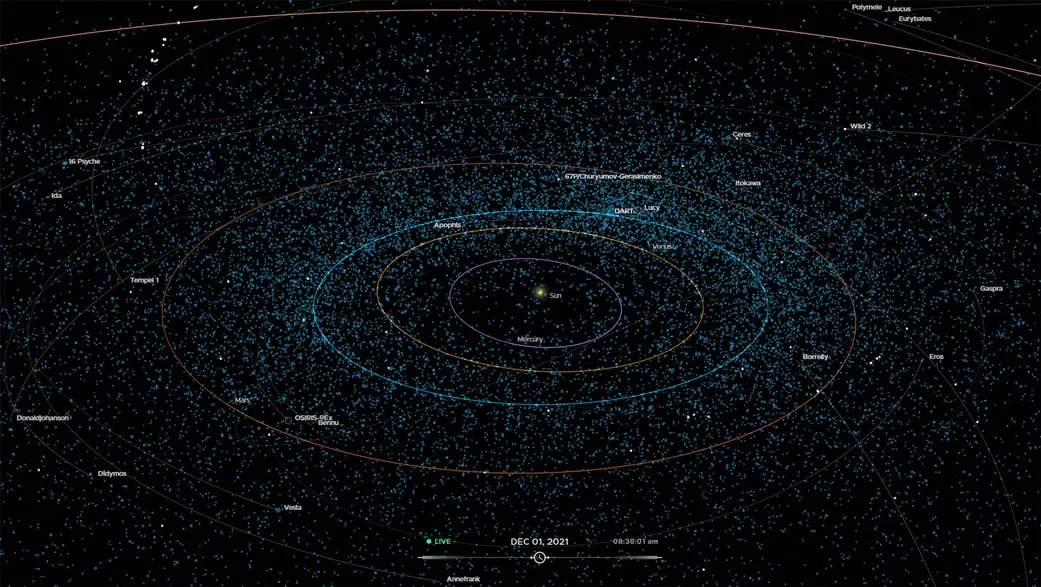
A new paper highlighted by Universe Today proposes a less computationally intensive way to plan trajectories to near-Earth asteroids, while also identifying lower-energy routes for spacecraft. The work, led by astrodynamicist Alessandro Beolchi of Khalifa University of Science and Technology and co-authors, targets one of the harder problems in mission design: how to reach small moving targets in space without spending unnecessary fuel or processing time.
Near-Earth Objects have long attracted attention as scientific targets and potential resources, but reaching them efficiently is difficult. Every mission must balance fuel use, timing, gravity, and orbital geometry, and traditional approaches can require large amounts of computation while still favoring faster rather than more energy-efficient paths.
The old standard was built for a different era
As Universe Today explains, NASA engineers historically relied on the patched-conics method, which simplifies trajectory planning by using the two-body problem. In that setup, calculations focus mainly on the Sun and the spacecraft, ignoring the gravitational influence of other bodies. The approach also assumes velocity changes come in short, powerful bursts from chemical rockets.
That framework was practical for decades, especially when fast transfers and chemically powered missions dominated interplanetary planning. But it is less ideal for an era in which efficiency matters more, propulsion options are changing, and mission designers do not necessarily want to disregard gravitational effects that could be useful rather than inconvenient.
A blended model changes the search space
The paper’s alternative combines two physical models. Near Earth, it uses the Circular Restricted Three-Body Problem, which accounts for the gravitational interaction between Earth and the Sun. That matters because it brings Lagrange points into the picture, the regions of relative orbital stability where spacecraft can effectively wait or maneuver with limited fuel expenditure.
Each of those regions also has what the report describes as an invariant manifold, essentially a pathway a spacecraft can follow to drift away from Earth with very low fuel use. Once the spacecraft is far enough from Earth, the model switches back to the more traditional two-body problem focused on the Sun and the spacecraft.
This is the key innovation described in the article: instead of applying one simplified framework to the entire trip, the method changes models depending on where the spacecraft is and which gravitational effects matter most.
Why that could matter for exploration
The immediate benefit is computational. Universe Today says the new method is much less intensive than existing approaches for finding asteroid rendezvous trajectories. The second benefit is operational: the method can also identify routes that require less energy.
That combination is important for missions to near-Earth asteroids because mission economics are unforgiving. A route that trims fuel use can enlarge payload margins, extend mission options, or make certain targets more practical. A route that also takes less computing effort to discover lowers barriers earlier in the planning process.

Asteroids remain attractive but difficult destinations
The context here matters. Near-Earth asteroids are often discussed as promising scientific and economic targets because they are numerous and, in some cases, comparatively accessible relative to deeper-space destinations. But “accessible” in this sense is still highly conditional. Mission planners must solve for moving objects with changing geometries under the influence of multiple gravitational bodies.
That is why methods that exploit natural orbital structures can be so valuable. If a spacecraft can use Earth-Sun dynamics more effectively before transitioning into a heliocentric path, it may be able to reach targets that would otherwise appear less attractive under cruder planning models.
Efficiency is becoming a design principle
The article also reflects a larger shift in spaceflight. Traditional chemical propulsion and brute-force transfer planning are no longer the only assumptions guiding mission design. As efficiency becomes more important, planners are more willing to use models that better reflect the actual structure of the solar system, especially when those models open up low-energy routes.
The source does not claim that the new paper has already transformed operational mission design, and it does not provide a list of specific asteroid missions that will adopt the technique. But it does present a meaningful research direction: use richer local dynamics near Earth, then simplify later, rather than simplifying everything from the start.

A more practical map for asteroid access
For asteroid science, planetary defense, and any future resource-focused missions, better trajectory design is not a minor technical footnote. It determines which missions are feasible, how expensive they are, and what kinds of spacecraft architectures make sense.
If Beolchi and colleagues’ method performs as described, it offers something mission planners always want: a way to search more cheaply for paths that also cost less to fly. In a field where every kilogram and every calculation matter, that is a meaningful development.
This article is based on reporting by Universe Today. Read the original article.
Originally published on universetoday.com