Mercury has always looked like an outlier among the rocky planets
Mercury belongs to the same broad family as Earth, Venus, and Mars, yet chemically it stands apart. Planetary missions have shown that its crust is rich in sulfur and magnesium, poor in iron at the surface, and overall far more chemically reduced than other rocky worlds in the Solar System. That reduced state means Mercury’s materials are dominated more by sulfides, carbides, and silicides than by the oxides that are common on Earth.
Those differences have made Mercury hard to interpret. Scientists do not have rocks collected directly from the planet, and models built around Earth’s magmatic history are a poor fit for a world formed under very different chemical conditions. A team at Rice University has now taken a practical detour around that problem by turning to a rare meteorite whose composition appears unusually close to Mercury’s.
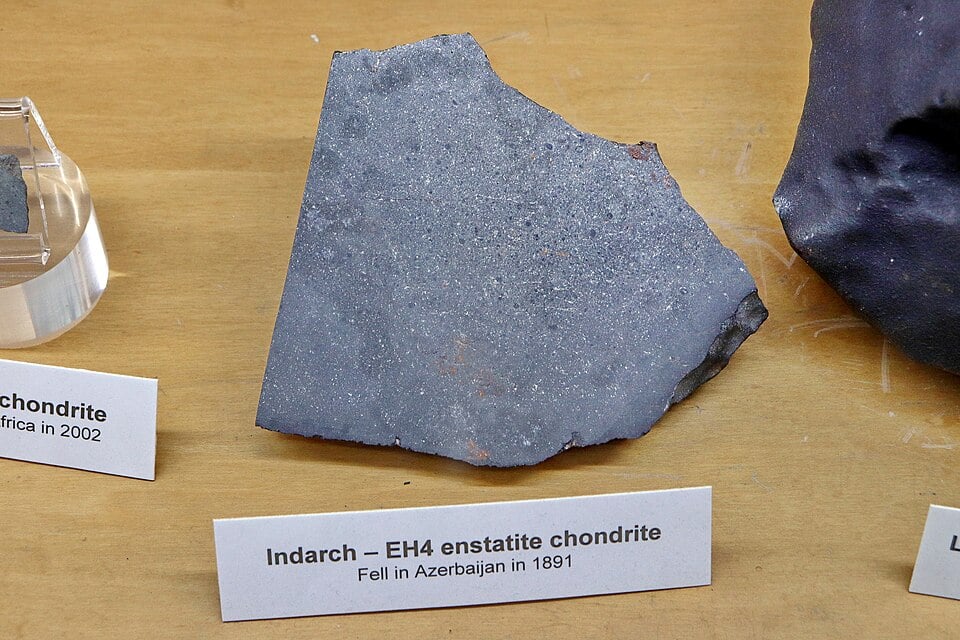
The meteorite is Indarch, an EH4 enstatite chondrite that fell in Azerbaijan in 1891. According to the researchers, its highly reduced chemistry makes it a compelling proxy for materials that may have helped build Mercury. Using that link, the team created laboratory compositions based on Indarch and subjected them to high-temperature experiments designed to reproduce Mercury-like rock formation.
Why Indarch matters
Indarch is unusual even by meteorite standards. Enstatite chondrites are rare, and they are thought to have formed near the Sun in the early solar nebula. They contain high iron content and uncommon sulfur-rich compounds, features that make them especially useful for thinking about a world like Mercury, which formed in a hotter, more chemically reducing environment than Earth.
The Rice team’s reasoning is straightforward: if Mercury’s rocks cannot be examined directly in the lab, a meteorite with very similar chemistry can provide a controlled starting point. That does not make Indarch a literal sample of Mercury. It makes it a plausible analog, one that can be melted, pressurized, and tracked through mineral transformations in ways that spacecraft observations alone cannot provide.
This matters because surface measurements from missions can tell scientists what elements are present, but they are less direct about how those materials evolved inside the planet. Experimental petrology can fill that gap by showing what kinds of melts and minerals should emerge under Mercury-like conditions.

Bringing a difficult planet into the lab
The researchers built a model melt composition based on Indarch and heated it under controlled conditions to produce synthetic Mercury-like rocks. That approach lets scientists test how highly reduced materials behave as they melt, crystallize, and separate into different mineral phases.
For Mercury, this is more than a geochemical curiosity. The planet’s surface composition carries clues about its interior structure, thermal history, and formative environment. If the crust is sulfur-rich and strongly reduced, those traits may help explain how Mercury differentiated, what its mantle was like, and why its chemistry diverged so far from its rocky siblings.
The experiments therefore act as a translation layer between remote sensing data and planetary history. They allow researchers to ask not only what Mercury looks like today, but what combination of early building blocks and later evolution could have produced that outcome.
A different template for rocky planet formation
The broader implication is that Earth should not be treated as the default template for understanding every rocky planet. Mercury has long resisted that instinct. Its composition reflects formation conditions that were closer to the Sun and far more reducing than those that shaped Earth.
By anchoring their work to Indarch, the Rice scientists are effectively testing a different branch of rocky world evolution. That can sharpen models of how materials were distributed in the inner solar nebula and how local chemical environments influenced the planets that emerged from it.
It also matters for comparative planetology. The more clearly scientists can define Mercury’s path, the more informative it becomes as a counterexample. Worlds that look superficially similar in size class or density can still preserve radically different chemical histories.
What this means for planetary science
Mercury remains one of the least intuitively understood terrestrial planets. It is close to the Sun, geologically distinct, and chemically unlike the planetary models most researchers learned from Earth. That makes every credible proxy valuable.
The Indarch-based experiments do not eliminate uncertainty, but they reduce it in an important way. They give scientists a tangible material framework for interpreting Mercury’s reduced chemistry rather than relying purely on inference from orbital measurements. In planetary science, where direct samples are scarce, that kind of analog work can be decisive.
The result is a more experimentally grounded picture of how Mercury may have formed and evolved. It also reinforces a larger lesson: the Solar System’s rocky planets share a family resemblance, but they did not all grow up under the same chemical rules. Mercury may be the clearest proof of that, and a meteorite that landed on Earth more than a century ago is now helping explain why.
This article is based on reporting by Universe Today. Read the original article.

Originally published on universetoday.com