A long-imagined solar observatory begins to work
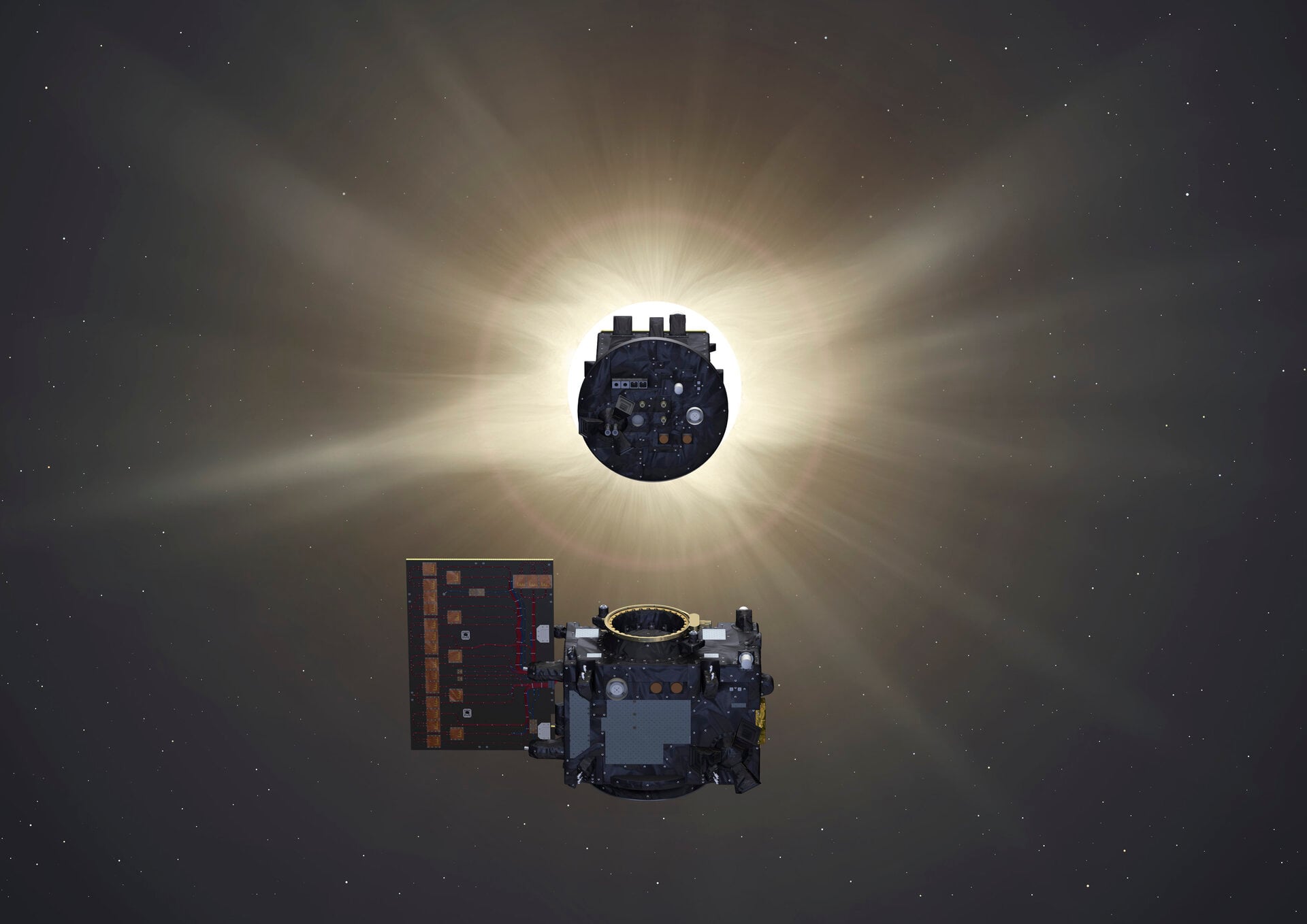
The European Space Agency’s Proba-3 mission is beginning to deliver on one of solar science’s oldest ambitions: the ability to create total solar eclipses on demand and use them to study the Sun’s outer atmosphere in unprecedented detail.
According to ESA reporting summarized by Universe Today, the mission’s first science results show that the two-spacecraft system can track space weather back toward its source by directly observing the solar corona, the faint outer layer of the Sun that is usually washed out by the photosphere’s intense light.
That matters because the corona is where many of the processes behind the solar wind and other space-weather events unfold. Understanding how activity in that region develops is a central problem for both solar physics and practical forecasting, since space weather can affect satellites, communications, navigation, and power systems.
How Proba-3 makes its own eclipses
Proba-3 does not rely on rare natural alignments. Instead, it flies two spacecraft in formation: one acts as an occulter, physically blocking the Sun, while the other carries the coronagraph that observes the artificial eclipse.
The technical demands are extreme. During observation periods, the spacecraft must hold a separation of 150 meters with submillimeter precision. They do this in a highly elliptical 19.7-hour Earth orbit, with science operations concentrated near apogee, roughly 60,530 kilometers from Earth.
That precision is the real breakthrough. Ground-based coronagraphs struggle against atmospheric distortion, while natural eclipses are brief and geographically limited. A formation-flying system in space can avoid both constraints and produce stable, repeatable observations.
So far, researchers have reportedly collected 250 hours of high-resolution video of the corona across 57 artificial eclipses. For comparison, a total solar eclipse on Earth can last at most about 7.5 minutes. Proba-3 has already multiplied that observational window on a dramatic scale.

What the mission is seeing
The mission’s primary instrument for coronal imaging is ASPIICS, which can observe to within about 70,000 kilometers of the Sun’s visible surface. That region is especially valuable because it lies close to where the corona transitions into the outflowing solar wind.
ASPIICS captures two images per minute, enabling scientists to watch evolving structures rather than rely only on snapshots. That continuous view is important for linking coronal features to the space-weather disturbances they may later produce farther out in the solar system.
Proba-3 also carries other instruments. The Digital Absolute Radiometer measures changes in solar energy output over time, while the 3D Energetic Electron Spectrometer studies Earth’s Van Allen belts as the spacecraft moves through them. But the headline capability remains the eclipse-making coronagraph itself.
Why this is a meaningful advance
Solar physicists have long wanted direct, prolonged views of the inner corona because many of the Sun’s most consequential behaviors originate there. The corona is where magnetic structures twist, reconnect, and release energy. It is also where the solar wind is accelerated, yet the exact details of those processes remain difficult to pin down.
Proba-3 addresses that observational gap with a clever engineering solution rather than a larger telescope. By separating the occulter from the imaging spacecraft, ESA can simulate the geometry of an eclipse with a baseline that would be cumbersome to achieve inside a single spacecraft.
The result is not merely better imagery. It is a new observing mode, one that could reshape how coronal science is done if the mission continues performing as designed.
What makes the mission unusual
Space missions often demonstrate a new instrument or collect data in a known way. Proba-3 is notable because it demonstrates a new kind of spacecraft coordination. Its scientific value depends on autonomous or near-autonomous precision between two free-flying vehicles, not on one tightly integrated bus.
That architecture could matter beyond this mission. If formation flying at this level becomes routine, it opens paths for future observatories that behave as distributed systems rather than single craft. In that sense, Proba-3 is both a solar mission and a technology pathfinder.
The reported publication of early results in The Astrophysical Journal Letters reinforces that the mission is moving from demonstration toward scientific return. That transition is often where ambitious concepts prove whether they are genuinely useful or merely elegant.
What comes next
ESA expects the mission to surpass its nominal two-year lifetime in December 2026, suggesting more observing time lies ahead if hardware and operations remain healthy. More data should help scientists track recurring coronal structures, compare eclipse sequences over time, and connect local coronal dynamics with broader space-weather behavior.
For now, the significance of Proba-3 is clear enough. It has shown that precision formation flying can do more than test navigation software or orbital choreography. It can create a scientific instrument that does not really exist on any one spacecraft alone.
That is why the mission stands out. Artificial eclipses sound theatrical, but they solve a real observational problem. By turning an ancient astronomical spectacle into a repeatable engineering tool, Proba-3 may give solar researchers one of the most practical new windows on the Sun in years.
This article is based on reporting by Universe Today. Read the original article.

Originally published on universetoday.com