A new proposal targets one of Mars exploration’s hardest problems
Scientists designing future human missions to Mars face a basic but unforgiving constraint: everything depends on reliable power. Habitats, life-support systems, water processing, oxygen production, fuel generation, science equipment, and communications all require a steady source of electricity. A newly described concept from researchers in China argues that the Martian atmosphere itself could become part of that energy architecture.
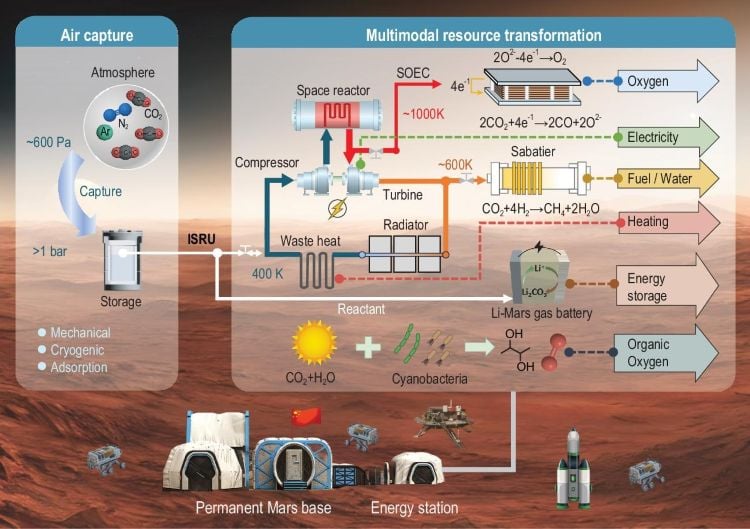
The study, recently published in National Science Review, outlines a system called the Mars Atmospheric Resource & Multimodal Energy System, or MARS-MES. The idea is to use in situ resource utilization, commonly known as ISRU, to reduce dependence on power systems shipped from Earth. Instead of treating Mars mainly as a logistical burden, the proposal treats local atmospheric resources as feedstock for generation, storage, and life-support support functions.
Why Mars power is such a difficult engineering problem
Mars offers a punishing operating environment. According to the researchers, the planet’s atmosphere has only about 1% of Earth’s atmospheric pressure, is more than 95% carbon dioxide, and reaches peak temperatures around 20 degrees Celsius. Those conditions are radically different from Earth’s and complicate any attempt to build dependable power infrastructure for long-duration missions.
Transporting enough energy hardware and consumables from Earth is one obvious solution, but it comes with mass, cost, and mission-risk penalties. That is why ISRU has become such an important long-term strategy in Mars planning. Every kilogram not launched from Earth can ease mission design, lower cost, and potentially extend mission duration or crew capability.
The Chinese team’s proposal is built around that premise. Rather than relying solely on imported systems, it explores whether local atmospheric capture and conversion could support a broader energy ecosystem on the surface.

How the proposed system would work
The concept begins with air capture. Because the Martian atmosphere is extremely thin, the researchers propose compressing it to make it more useful for downstream processes. The study identifies several ways to do that, including mechanical compression, cryogenic trapping, and temperature adsorption.
Each of those methods comes with tradeoffs. The researchers note that mechanical compression has not yet demonstrated long-term performance, cryogenic trapping remains in the testing phase, and temperature adsorption still struggles with limited rates and low heat production. Those caveats matter because they show the proposal is not a finished system ready for deployment. It is a technical roadmap pointing to subsystems that still need major validation.
Once atmospheric gases are captured, the energy system would pair them with a micro-nuclear reactor for in situ power generation. The proposal also calls for storing electricity in lithium-Martian gas batteries, which the team presents as a route to long-term, stable electrical supply. In parallel, the system is meant to support life-support resource transformation, linking power generation with the production of essentials such as oxygen, fuel, and water.
That multimodal design is the proposal’s most important feature. It is not merely about generating electricity from one device. It is an attempt to connect energy, storage, and life-support logistics into one integrated surface infrastructure.
Why integration matters for human missions
Future human missions to Mars will likely demand far more than a rover-scale power budget. Crewed habitats would need continuous lighting, thermal control, laboratory operations, exercise equipment, environmental control systems, and consumable processing. Mission planners also need resilience: a surface outpost cannot tolerate long power interruptions when crew safety depends on powered systems.
The proposal recognizes that reality. By combining local resource capture, nuclear-backed generation, energy storage, and transformation of life-support resources, the system aims to reduce the number of isolated subsystems astronauts would otherwise have to maintain. Integrated infrastructure could also offer redundancy. If the atmosphere can support multiple mission functions rather than just one, it becomes more valuable as a strategic resource.
This also helps explain why the study focuses on both benefits and challenges rather than presenting a single breakthrough device. On Mars, mission architecture matters as much as component performance. A workable surface power station has to fit inside a broader operational system that includes crew survival, transportation, maintenance, and mission duration.

What remains uncertain
The proposal is ambitious, but it is still conceptual. The study itself highlights technical limitations in the atmospheric capture methods under consideration. Long-duration operation, system durability, thermal management, and integration under Martian conditions all remain open engineering questions based on the source material provided.
The use of a micro-nuclear reactor also signals that local atmosphere alone is not being presented as a complete power source. Instead, captured atmospheric resources would work in combination with nuclear generation and specialized storage. That makes the concept more realistic in one sense, because it does not assume a single elegant fix, but it also underscores the complexity future missions will have to manage.
There is another practical implication. ISRU is often discussed as a way to slash dependence on Earth, but every ISRU system introduces its own machinery, maintenance burden, and failure modes. The closer mission planners get to real human expeditions, the more those operational details will matter.
Why the study matters now
Mars mission timelines remain long, but the path to crewed exploration depends on solving enabling problems well before launch dates are set. Power is among the most foundational of those problems. Without a credible surface energy plan, every other ambition on Mars shrinks.
This new work matters because it pushes the conversation beyond generic calls for ISRU and into a more specific systems concept. It frames the Martian atmosphere not just as an environmental obstacle but as a resource that could be compressed, transformed, and folded into a mission’s core infrastructure. Even if the final architecture used by future explorers looks different, the study adds to a growing body of work focused on making Mars missions less dependent on constant resupply from Earth.
That is likely to be the long game for Mars exploration: not one breakthrough technology, but a stack of interlocking systems that turn local conditions into mission assets. MARS-MES is an early example of that thinking pushed into the power domain, where success or failure would shape nearly every aspect of a human presence on the planet.
This article is based on reporting by Universe Today. Read the original article.

Originally published on universetoday.com