A public search through one of astronomy’s richest new datasets
Astronomers are turning to the public to help comb through a major new release from the European Space Agency’s Euclid telescope, looking for one of the most visually striking and scientifically useful phenomena in the universe: gravitational lenses.
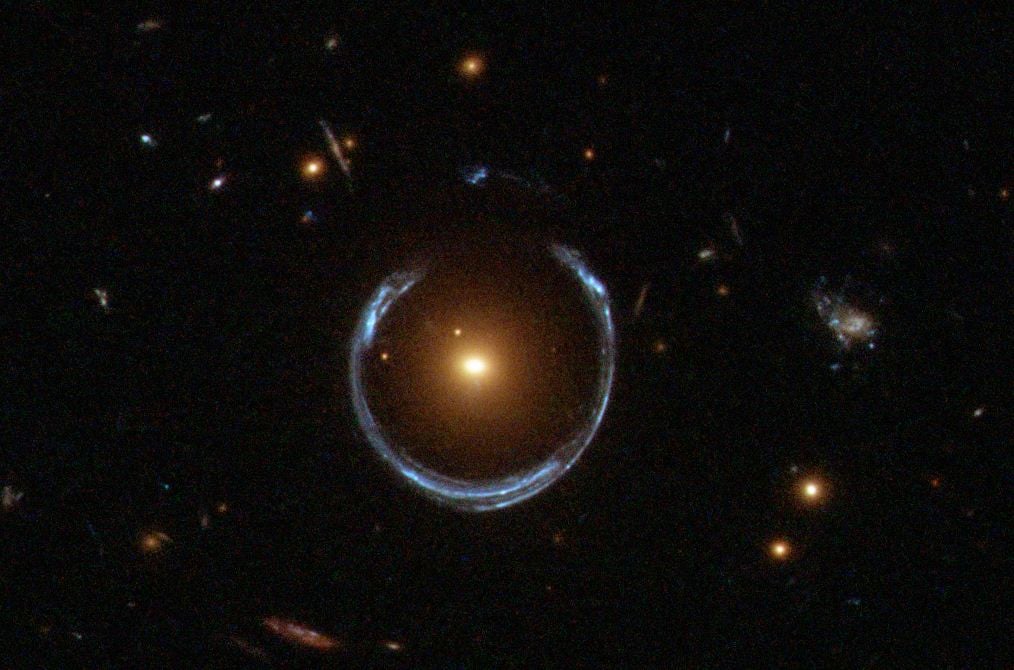
The effort is being organized through the Space Warps citizen science project on Zooniverse, where volunteers review telescope images for the telltale signatures of light being bent by massive foreground objects. Those signatures can appear as stretched arcs, distorted smears, or nearly complete Einstein rings.
Why gravitational lenses matter
Gravitational lensing follows directly from Einstein’s general theory of relativity. Massive galaxies and galaxy clusters warp space, and light traveling through that curved geometry changes course. When a distant source, a massive foreground object, and the observer line up in the right way, the background object can appear distorted into luminous arcs or rings.
These are more than beautiful oddities. Lenses act like natural telescopes, magnifying distant galaxies that might otherwise be too faint or too small to study in detail. They also give astronomers a way to map mass, including matter that does not emit light directly. That makes them valuable tools for probing galaxy evolution, cosmic structure, and the large-scale makeup of the universe.
Euclid has made the search much bigger
The source text says Euclid’s latest release covers roughly 72 million galaxies, about 30 times larger than the mission’s initial dataset. That scale changes the problem. Astronomers can use automated systems to filter vast archives, but even advanced software does not catch everything, especially when the shapes are subtle, irregular, or easily confused with ordinary galaxy structures.
According to the supplied article, artificial intelligence has already narrowed the field to around 300,000 candidate images. Even after that filtering, the volume is too large for a small professional team to inspect efficiently. That is where citizen science comes in.
Why humans are still needed after AI screening
The public role here is not symbolic. Human pattern recognition remains good at spotting ambiguous visual structures that algorithms may rank imperfectly. In lens hunting, that can mean distinguishing a genuine gravitational arc from a lookalike artifact, a foreground feature, or an ordinary galaxy shape.
This blend of machine preselection and human review has become a recurring model in large scientific surveys. AI handles the first pass through enormous datasets; people provide judgment on edge cases, unusual patterns, and visually complex examples. In effect, Euclid’s lens search is using both at once: computational scale first, then distributed human attention.

Citizen science with real scientific payoff
The article frames Space Warps in the tradition of earlier public-participation science efforts. The comparison is apt. Projects like SETI@home helped popularize the idea that people outside laboratories could still contribute to frontier research. Space Warps updates that concept for the era of image-rich astronomy, where the bottleneck is not only computing power but also classification.
For Euclid, the payoff could be substantial. A larger catalog of confirmed gravitational lenses would give astronomers more targets for follow-up studies and more data points for statistical analysis. That can improve models of galaxy distribution and mass structure while also opening windows onto distant objects that lenses magnify by chance alignment.
A telescope built for the big questions
Euclid was designed to study the large-scale structure of the universe, and gravitational lenses fit naturally within that mission. The more lenses astronomers can identify, the better their ability to use them as probes of cosmic architecture. Since the mission is already producing data on tens of millions of galaxies, the odds of uncovering rare and valuable systems rise sharply.
The immediate story, then, is not just that the telescope has found interesting images. It is that the scale of modern sky surveys now routinely exceeds what professional teams can inspect alone. Scientific discovery increasingly depends on carefully designed partnerships between automated tools and broad human participation.

What this means for the public
For volunteers, the project offers direct access to frontline astronomy. Participants are not being asked to complete a trivial engagement exercise; they are helping sift through a real dataset in search of phenomena that can advance research. That makes the work unusually tangible. A person scanning images from home may identify a lens system that becomes part of future scientific analysis.
As telescopes continue to generate ever-larger datasets, that model is likely to expand. Euclid’s new release shows why: the universe is full of structure, but finding its most revealing distortions still benefits from patient human eyes.
This article is based on reporting by Universe Today. Read the original article.
Originally published on universetoday.com