A laboratory propulsion result gives fresh momentum to a long-shot interstellar idea
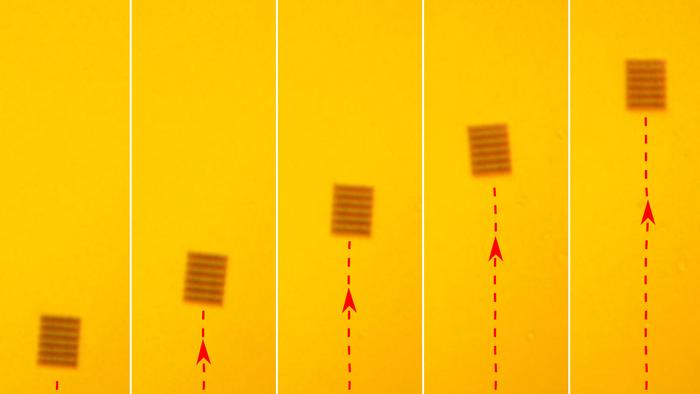
Scientists at Texas A&M University have demonstrated a class of microscopic devices that can be moved and steered in three dimensions using nothing but laser light, an advance that does not bring interstellar flight within immediate reach but does show a more controllable version of light-driven propulsion than earlier approaches.
The devices, described as “metajets,” are engineered so that light does more than simply push them forward. By carefully shaping how incoming light is redirected, the researchers were able to lift the devices vertically while also moving them sideways. That combination matters because it suggests a path toward active maneuverability, not just thrust, in systems powered by photon pressure.
The result speaks to one of the oldest and hardest problems in spaceflight. Conventional rockets are powerful enough to escape Earth and explore the Solar System, but they are painfully slow on interstellar scales. Universe Today notes that Alpha Centauri, the nearest star system, lies just over four light-years away. At ordinary spacecraft speeds, a trip would take far longer than a human lifetime. Even concepts far more aggressive than current rockets still leave travel times measured in tens of thousands of years.
That is why light propulsion remains so compelling. Photons carry momentum, and when they reflect from a surface they transfer some of it. The force is tiny, but in space, where there is no atmospheric drag and missions can accelerate for very long periods, tiny forces can accumulate into meaningful velocity.
What makes the metajets different
Solar sails are the best-known version of light propulsion. They work by presenting a reflective surface to sunlight or to a powerful laser beam. The basic principle is proven, but traditional sail concepts face control challenges. Getting a sail to move is one thing. Steering it precisely and keeping it stable is another.
The Texas A&M work introduces a more sophisticated optical architecture. Each metajet is coated with an ultrathin material etched with nanoscale patterns. Those patterns let the device bend and redirect incoming light in deliberately chosen ways. In effect, the structure of the surface determines how the momentum of the light gets translated into motion.
That engineering feature is the key step. Instead of treating light as a blunt source of push, the researchers use surface design to make light a controllable propulsion and guidance tool. In the lab, the metajets reportedly achieved full three-dimensional maneuverability, with the devices able to move laterally while being lifted vertically at the same time.
For space applications, that matters because control is as important as acceleration. A sail that can be pushed hard but not stabilized or steered is of limited use. A light-driven craft that can continuously adjust its orientation and direction becomes a much more credible building block for future missions.
The interstellar connection
The obvious long-term reference point is Breakthrough Starshot, the idea of using powerful Earth-based lasers to accelerate extremely small spacecraft to a meaningful fraction of the speed of light. In the broad vision behind such concepts, a tiny probe could be sent toward the Alpha Centauri system and arrive within decades rather than millennia.
The Texas A&M result does not mean that such a mission is now close. The source material itself frames the work as an early and tentative step. Scaling a microscopic lab demonstration into a viable interstellar system would require enormous advances in materials, laser infrastructure, fabrication, navigation, thermal management, and communications. Even if propulsion can be solved, sending data back across light-years remains a daunting systems challenge.
Still, the experiment is important because it addresses a central weakness in many futuristic propulsion ideas: they often describe how to generate motion but not how to maintain practical control. If metasurface engineering can reliably shape how a vehicle responds to illumination, then light propulsion begins to look less like a conceptual sketch and more like an engineering discipline.
Why this matters beyond starflight
The most immediate value of the work may not be interstellar travel at all. Technologies developed for extremely small, light-responsive devices can have nearer-term relevance in precision positioning, micro-robotics, materials science, and advanced optical systems. Space research often advances through that kind of cross-pollination, where a dramatic long-term vision helps drive work that turns out to be useful much sooner in adjacent fields.
There is also a strategic research lesson here. Space exploration is increasingly shaped by layered innovation: better materials, smarter control systems, nanoscale fabrication, and high-energy photonics all matter together. The metajet experiment sits at the intersection of those fields. It is less a standalone breakthrough than a sign that different technical domains are starting to align around problems that once belonged mostly to science fiction.
That alignment is worth watching. Interstellar flight remains one of the most difficult ambitions in all of engineering. But progress on such ambitions rarely arrives as a single dramatic leap. It tends to emerge as narrow demonstrations that make one impossible-seeming piece of the puzzle look a little less impossible.
What comes next
- Researchers will need to show that the control methods demonstrated in the lab can scale beyond microscopic test devices.
- Future work will likely focus on stability, efficiency, and how metasurface designs behave under stronger illumination.
- The long-range question is whether these control techniques can be integrated into laser-driven sail architectures intended for space.
For now, the Texas A&M experiment should be read neither as hype nor as a trivial curiosity. It is a small but meaningful data point in favor of a larger proposition: that light may eventually do more than illuminate deep space. Under the right conditions, and with the right engineered surfaces, it may help carry us across it.
This article is based on reporting by Universe Today. Read the original article.
Originally published on universetoday.com