Two rovers, two timelines of Mars
NASA’s Curiosity and Perseverance rovers have produced new 360-degree panoramas that do more than showcase dramatic scenery. Together, the images highlight a deeper scientific strategy: the two missions are effectively reading Mars in opposite temporal directions, filling in different chapters of the planet’s geological and environmental history.
The supplied NASA article says the rovers are separated by 2,345 miles, or 3,775 kilometers, roughly the distance from Los Angeles to Washington, D.C. Yet despite that physical separation, their findings are conceptually linked. Both are exploring terrain billions of years old. Curiosity, nearly 15 years into its mission, is reaching ever-younger layers in the foothills of Mount Sharp inside Gale Crater. Perseverance, about five years into its mission, is venturing through some of the oldest landscapes in the entire solar system near Jezero Crater.
This “time-traveling in opposite directions,” as NASA describes it, is what makes the new panoramas important. Mars is not being studied as a static desert but as a planetary archive. Different sites preserve different periods and processes, and these rovers are providing a way to compare them at ground level.
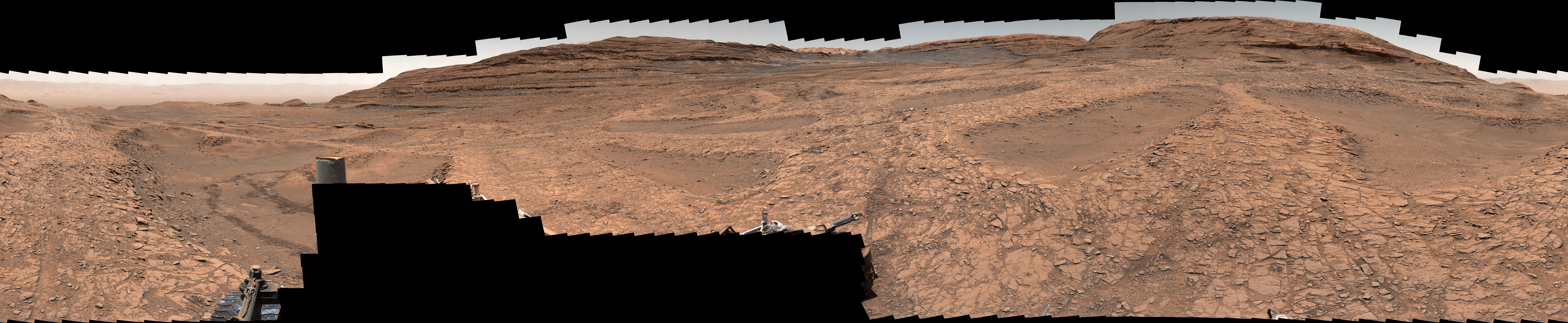
Curiosity’s panorama is one of the largest the rover has ever taken, stitched from 1,031 images captured between Nov. 9 and Dec. 7, 2025. At 1.5 billion pixels, it offers a detailed look at a region marked by boxwork formations, low ridges that resemble giant spiderwebs in orbiter imagery. According to NASA, these ridges formed when groundwater flowed through large fractures in the bedrock, leaving minerals behind that hardened the rock along those lines. Erosion later stripped away softer surroundings, leaving the more resistant ridges exposed.
That matters because groundwater is central to the question of habitability. Curiosity’s mission has long focused on whether Mars once had conditions capable of supporting life. NASA notes that within a year of landing in 2012, a sample drilled from an ancient lakebed confirmed that such conditions once existed, including suitable chemistry and possible nutrients for microbes. The boxwork region extends that story by pointing to later interactions between rock and water, preserving clues about how fluids moved through the subsurface over time.
Perseverance’s panorama is built from 980 images taken between Dec. 18, 2025, and Jan. 25, 2026, and centers on a site nicknamed “Lac de Charmes” outside the rim of Jezero Crater. NASA says the view captures the Jezero rim and ancient rocks around the crater, while another panorama from a place called “Crocodile Bridge” shows a region containing some of the oldest rocks anywhere in the solar system.
That gives Perseverance a different role from Curiosity. If Curiosity has been uncovering evidence of a once-habitable environment and tracing changing conditions through layered sediments, Perseverance is pushing deeper into early planetary history. Jezero Crater was selected in part because it preserves evidence of an ancient lake and river delta, making it a strong place to search for signs of past microbial life and to collect samples for possible return to Earth.
The panoramas are therefore not only visual records. They help scientists situate specific outcrops, fractures, ridges, and rock units within a larger field context. On Mars, where rover routes are slow and every drilling or sampling decision is costly, panoramic mapping is a core scientific tool. It guides movement, helps interpret geology at multiple scales, and supports decisions about which targets may contain the most important clues.
There is also a public dimension to these vast stitched images. Panoramas convert distant field science into something legible for non-specialists. They let viewers see that Mars is not uniform. Gale and Jezero tell different stories about water, sediment, crust, and time. One rover is climbing through layers that record environmental transitions. The other is probing terrain old enough to illuminate Mars’s earliest accessible history.
NASA’s new release is a reminder that planetary science often advances through accumulation rather than single dramatic events. No one panorama proves life existed on Mars. But taken together, these landscapes reveal how careful, long-duration exploration can resolve a planet’s past in increasing detail. Curiosity and Perseverance are not just driving across Mars. They are building a connected historical record of how a once wetter world evolved into the cold desert seen today.
This article is based on reporting by NASA. Read the original article.
Originally published on nasa.gov